

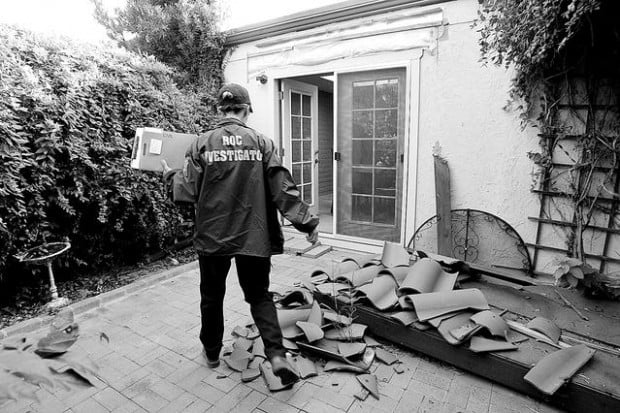
Shoddy workmanship, disconnected business phones and dangerous job sites are among the many complaints Tucson homeowners bring each year to the Arizona Registrar of Contractors.
Michael Lewis and his wife hired a man to remodel their three bathrooms and ended up with toilets in the garage and unfinished work in the house.
Kit Dougherty's mother hired someone to add a room, didn't see the project completed by him and lost about $8,000 in the process.
And Don Ratcliffe and his wife hired a man to build a new back porch last summer and instead ended up with leaks in the ceiling, ripped shingles on the roof and an uneven concrete floor.
As a bonus, Ratcliffe said, the man also left plugged-in power tools unattended in their backyard for days at a time.
To avoid the hassles and frustrations these families have experienced, the Arizona Registrar of Contractors is offering a free seminar Nov. 15.
People are also reading…
New homeowners, and new residents of Tucson and Arizona, can learn about the state's laws, what recourse is available and how to avoid being victimized in home repair scams.
The program will help buyers of newly constructed homes with questions about faulty workmanship. The seminar will also include a question-and-answer session on using the agency to seek financial assistance in correcting poor workmanship performed by a licensed contractor.
"The biggest investment you'll ever make is your home,'' said Irl Young, the agency's chief of investigations. He urges people to use only licensed contractors, get the contractor's number and then check with the state agency on the contractor's standing.
"If everyone would do that, they could avoid a lot of problems,'' he said.
Each year, the state agency averages about 2,200 investigations. There are three investigators handling cases in Pima County and part of Pinal County.
While a handyman exemption allows an unlicensed contractor to do home repairs and work without a license, the job cannot exceed $1,000 or require a building permit, Young said.
"Get a contract in writing,'' he said. "Specify what the contactor is going to be doing, how much it's going to cost and when it's going to be done. Then, if there is a problem and if they do file a complaint with us, then there is something in writing."
Ratcliffe said the man he hired lied about his status.
"It turns out he's not licensed, but he wrote up a contract as if he were,'' Ratcliffe said. "He told me he was licensed, but he didn't tell me the number."
The project, which Ratcliffe was told would take about 10 days, went on for more than two months. Ratcliffe said he put 50 percent down for the $3,700 job, and then the man came back and asked for more money.
"I basically fired him. He told me I couldn't fire him, and I said, 'Yes I can. This is my house,' " Ratcliffe said.
A civil suit is pending against the man now, Ratcliffe said.
Young said that while some legitimate contractors ask for a down payment, he recommends homeowners never pay more than 10 percent to 25 percent.
Setting up a pay schedule also helps, Young said, and prevents a contractor from saying more money is needed for supplies.
When Lewis and his wife decided to remodel their bathrooms, they knowingly hired an unlicensed contractor to save money.
"He convinced her that he was a bright, honest person,'' Lewis said. "I met him and spoke with him about it and he seemed OK, so I said 'Fine.' "
The man wanted half the money for supplies, Lewis said, so he and his wife paid $4,000 upfront.
"You learn from your errors and mistakes. This was the first time we were going to spend money on home improvement,'' he said. "We were trusting and believing that someone is going to stay true to what they're saying."
During the first week, the man showed up on time each morning and worked hard each day, he said, but during the second week he started showing up later and leaving earlier.
In the third week, he started missing days.
After Lewis and his wife went away for Thanksgiving, the man never showed up again and his phone was disconnected. Lewis estimates he and his wife lost about $2,000.
They took the man to small-claims court, but they never got their money back. "He just defaulted. He didn't show up for the hearing,'' Lewis said.
In the future, he said, he will work only with licensed contractors.
"As much money as you're trying to save or want to save, your best bet is to do the work you can do yourself and hire a licensed contractor to do the rest,'' he said.
Dougherty said that when her mother hired a man to put an addition on their home in July 2002, they didn't realize he wasn't a licensed contractor.
"We didn't do our homework and so we didn't know he's not licensed,'' she said. "We didn't ask the question."
Dougherty said the man never provided them with a formal contract.
"He'd just come by and say, 'I need another check,' and my mother would write him another check," she said.
They were promised the work would be done in two months, but it took three times that long. Once the structure was completed, an off-the-wall bed and window coverings they'd requested and paid for were still missing.
They eventually purchased the items themselves and had them installed by someone else.
The situation dragged on even after that, Dougherty said, because the man kept promising to return their money. There were always excuses, she said.
Eventually, he returned a small portion for the work he'd failed to complete, but Dougherty and her mother have never been reimbursed for the thousands he kept.
Areawide
l What: The Arizona Registrar of Contractors is offering a free New Homeowners Seminar.
l When: 6 p.m. Nov. 15
l Where: The agency's Tucson office, 400 W. Congress St., North Building, Suite 222.
l To register: call 1-888-271-9286, Ext. 7115.
l For more information on the Arizona Registrar of Contractors, or to check on a contractor's licensing status, go online to www.azroc.gov.
● What homeowners can do to protect themselves:
l Check to see if the contractor has a license.
l Find out the license number and check on the contractor's status with the Arizona Registrar of Contractors by calling 1-888-271-9286 or using its Web site, www.azroc.gov. This is also a way to verify the contractor is licensed to do the work contracted for.
l Check the contractor's references.
l Never pay upfront. Down payments should not exceed 10 percent to 25 percent of the project's entire cost.
l Set up a pay schedule.
Tips courtesy of Irl Young, chief of investigations for the Arizona Registrar of Contractors.


