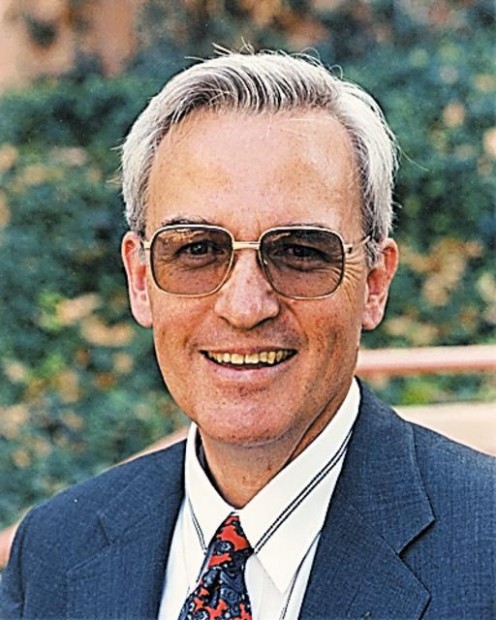
Memo Grassman was 5 years old when he received the calling to dedicate his life to God.
His decision came after the Irish-Catholic youngster had two powerful, mystical experiences — one a vision, the other auditory.
Grassman entered the seminary when he was 13. He was ordained at 26. And he got married at 45.
After serving parishioners in California, Hawaii, Mexico and Southern Arizona for nearly two decades as a Roman Catholic priest, Grassman realized he could continue doing God's work as a married man.
"It was clear why he left the Catholic Church. He wanted to marry. He wanted to not live that solitary life anymore," said friend Gordon McBride, the retired rector of Grace St. Paul's Episcopal Church in Tucson.
"It didn't alter his being a priest. I always understood and saw him as a priest."
People are also reading…
Though Grassman explored new spiritual realms after leaving the priesthood, he maintained the rituals of his Catholic upbringing.
Grassman continued his service to the community, providing mental health counseling to prison inmates, work he continued almost until his death Nov. 29 from brain cancer. Within three months of diagnosis, Grassman succumbed to the aggressive disease. He was 67.
William Grassman, the second of four siblings, grew up in Altadena, Calif., and entered an Oakland seminary in 1955. In 1969, he adopted the name Memo — shortened from Guillermo, which is Spanish for William — at the insistence of one of his Tucson parishioners.
The Rev. Ricardo Elford was three years ahead of Grassman in the seminary and remembered the young man as friendly and outgoing.
"He was extremely talented linguistically, musically," said Elford, of Tucson. "The first six years were humanities, language, literature. You could tell this guy was talented."
Grassman also attended seminaries in Wisconsin and New York and earned a master's degree in theology. Soon after his ordination, he was sent to Mexico City, where he worked as a parish priest. He quickly became fluent in Spanish.
"He had a tremendous facility for languages," said his wife, Jill. "When he spoke, people had no idea he was a gringo."
His outgoing personality, humor and fluency in Spanish endeared Grassman to Petra Munguia, a parishioner in Duncan, where he spent time after returning to the United States.
"I met him at the church functions and right away he was so impressive, so beautiful, such a friendly and warm person," Munguia said. "All of us were so hungry for somebody like Memo. We just flocked around him like a bunch of flies. Nobody ever felt ignored by him. He made time for everyone."
At that time, Munguia said, parishes in Graham and Greenlee counties were underserved and Grassman's weeklong mission to the small town of Duncan made an impression on the Catholics in the community.
"In this community we have never had a priest. They come in from Clifton or Morenci, sometimes from Safford. Once in a while one might come in from Tucson because there aren't enough to go around," she said. "When Memo came, we were like a dried sponge."
It didn't matter to parishioners in the small Eastern Arizona town that Grassman didn't look like a typical priest. "He looked just like Kenny Rogers with the beard and he had a big smile and dimples," Munguia said, comparing Grassman with the country crooner.
Grassman looked much the same when he met his future wife, Jill, at a baptism in 1978.
"He kind of looked like a hippie cowboy," Jill Grassman said.
The priest was as comfortable in a work shirt, jeans and cowboy boots as he was in his vestments. But it was his straw hat decorated with feathers that really made an impression.
"I told him it looked like a turkey dropped dead on his head," his wife said.
Unfazed, Grassman continued wearing the hat.
For much of the 1970s, Grassman worked alongside Elford in Tucson's barrios, saying Mass in Spanish, campaigning on behalf of the United Farm Workers and taking on social-justice projects. In 1976, he was appointed vicar for Spanish-speaking members of the Roman Catholic Diocese of Tucson.
Simultaneously, Grassman led retreats at the Redemptorist Renewal Center in Picture Rocks Road, and, eager to expand his liturgy, became bi-ritual, performing some services in ancient Slavonic.
"This guy was so friendly, outgoing. He was really close to people. Sometimes he'd go to St. Mary's Hospital and he wouldn't come back. He'd stay there all night" visiting ailing parishioners, Elford said.
After their first meeting in 1978, Memo and Jill saw each other occasionally, at dinner parties and social engagements hosted by mutual friends. A few times Grassman attended personal-transformation workshops she taught and incorporated some of the lessons into his sermons. Their acquaintance remained casual, but gradually an attraction formed.
The prospect of their growing affection worried them both.
Grassman began avoiding Jill, hoping to quell his attraction. When that didn't work, he requested a transfer to a parish in California. After a brief assignment in Hawaii, Grassman realized the separation only solidified his feelings for Jill.
In 1984, he requested a leave of absence from the church. Although, Elford said, "I'm sure, with his outlook, he wouldn't see it as leaving the church."
Eight years after their first encounter at the baptism, the couple wed in 1986.
In a 1988 Tucson Citizen article, Grassman said: "Someone asked me how long it took me to get used to being married and I said about 30 seconds. There are many means of gaining satisfaction (as a priest), but there's an underlying loneliness."
After leaving the priesthood, Grassman rose hours early each morning to pray and meditate before work. On Sundays, he still donned his vestments — what his wife called his "sin-fightin' clothes" — and said Mass for himself at the kitchen table.
Eventually Grassman joined the Orthodox Catholic Church and became a bishop. The Orthodox church is similar in many ways to the Roman Catholic Church, Elford said, but it allows women to be ordained and priests to wed.
"Memo was a very talented priest. He had a subtle kind of human theology that combined his thinking about God and his caring for people," McBride said. "He was always a priest. He may not have been officially part of the Roman structure, but he was always a priest."
The Grassmans worked two jobs each to pay the bills and returned to college, where they each earned a degree in counseling. For a dozen years before going to work at a prison in Florence, Memo Grassman worked for Child Protective Services.
Dr. Akhtar Hamidi met Grassman in 2000 after the psychiatrist was hired to work at the Florence prison.
"He is one of the most compassionate, most caring persons I've ever seen in the mental-health field," Hamidi said.
One example: When a group of Portuguese prisoners were transferred to Florence, Grassman used books and language recordings to teach himself Portuguese so he could communicate with the new inmates.
The reason he made the extra effort, Grassman told colleagues: the peace of mind he got from helping someone.
On StarNet: Did you know Memo Grassman? Add your remembrance to this article online at azstarnet.com/lifestories Find a photo gallery of this Life Story at azstarnet.com/slideshows
Life Stories
This feature chronicles the lives of recently deceased Tucsonans. Some were well-known across the community. Others had an impact on a smaller sphere of friends, family and acquaintances. Many of these people led interesting — and sometimes extraordinary — lives with little or no fanfare. Now you'll hear their stories. Past "Life Stories" are at go.azstarnet. com/lifestories

 Second wall planned across Arizona as Trump administration doubles down on border