

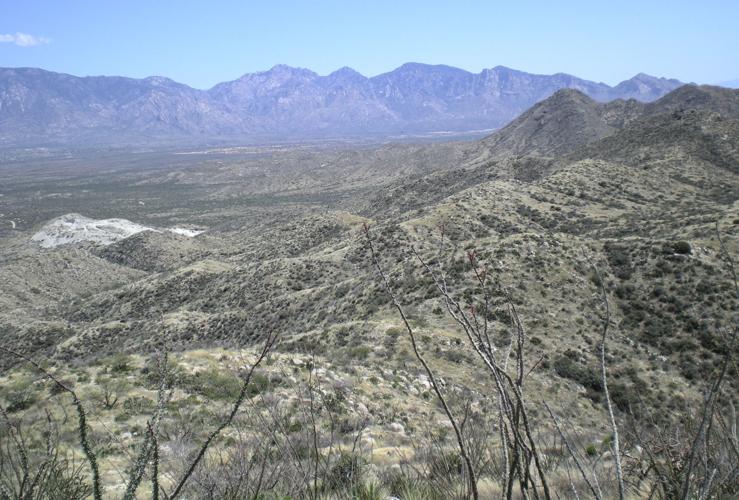
Entrepreneurs continued to invest in claims in and around the Owl Head district in the Tortolita Mountains throughout the 20th century.
Beginning in the 1920s, the local press sensationalized the findings, comparing the Owl Head district to another Comstock Lode and claiming that $2,000 per ton of gold could be found in the ore beneath the ground.
However, no significant bonanza developed.
A similar situation occurred when the Arkota Steel Co., and later the Krupp Arms Co. of Germany, saw fit to investigate the profitability of mining placer magnetite from some of the washes. When removed from the sand in the washes, magnetite could be sent to a concentrator, where afterward it could be converted into iron by a smelter.
Again, nothing substantial occurred with these ventures.
People are also reading…
There is also a history of oil exploration in this area.
Continental Oil Co. undertook additional mineral exploration along the western boundary of Owl Head Buttes and the Suizo Mountains. Boring 16 rotary drill holes extending more than 2,000 feet in depth, the company concluded that it was not profitable to undertake a major mining operation at the site.
Perhaps the most recent attempt to find wealth in the Owl Head district occurred in the 1970s and 1980s when the exploration company Arizona Western Mines Inc. staked 250 claims and built a mill to process ore from the Old Eagle Mine.
Bill Ewing — an aeronautical engineer and former service manager of a car dealership in Tucson — and his three-man crew rebuilt and salvaged old mining equipment, with the hopes of overcoming problems that hindered mining operations in the past.
One of the major problems, according to Ewing, was flooding up to 12 feet that occurred in some of the mine shafts.
Ewing was an optimist, believing that he could acquire $50,000 from the muck piles, more than doubling his initial $15,000 investment.
He regularly kept his shareholders up to date with his company’s mining operations, including planning a lunch at his mining camp with 275 investors with the honored guest Nino Cochise, grandson of Cochise, the famous Chiricahua Apache chief.
According to Ewing, Nino Cochise was a good friend of Captain Tom Jeffords, a former mine owner and homesteader in the Owl Head district.
Ewing continued to mine, shipping a few tons of high-grade silver and gold ore.
Ewing would later expand his operation to many of the mountain ranges in southeastern Arizona, including the Patagonia and Whetstone mountains. He also planned to mine south of Arivaca in the Oro Blanco district.
Ewing was determined to profit from his mining ventures.
However, no evidence surfaced that any of his claims around the Tortolita Mountains uncovered a substantial find.
Perhaps the silver and gold veins beneath Ewing’s claims were not economically profitable to mine over a long period.
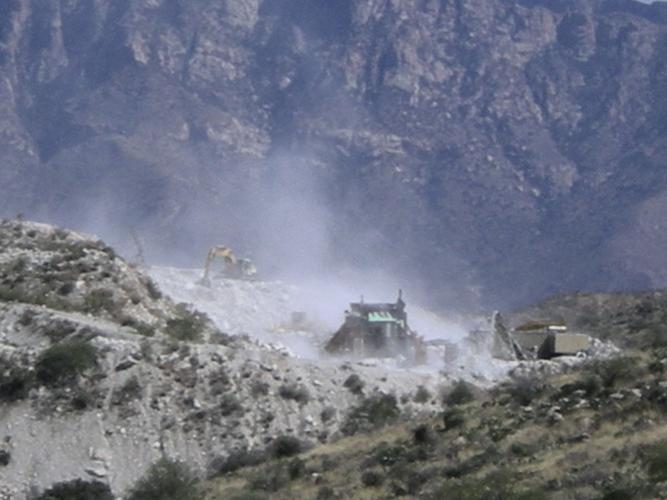
Evidence remains of the impact on the landscape where Ewing’s operation and those of others have mined.
A trek across the Transmission Line Road several miles east of Owl Head Buttes reveals the remains of an extensive small-mining operation.
Overall metal returns in the Owl Head district proved marginal, with a reported production of 52,000 ounces in silver between 1879 and 1880 and 1,600 tons of base and precious metals, including 41,000 pounds of copper and 8,000 ounces of silver, between 1911 and 1974.
Active mining carried out today in the Tortolitas includes a chalk mine and several small prospects.
Only economics and time will reveal whether future mining exploration and findings may bring renewed interest in the minerals of the mountain range.
Archivist, historian and author William Ascarza’s forthcoming book is “In Search of Fortunes: A Look at the History of Arizona Mining.” For more information, contact M.T. Publishing Co. at (812) 468-8022


 Nancy Guthrie's Tucson neighbors: Life with streamers 'unbearable'


