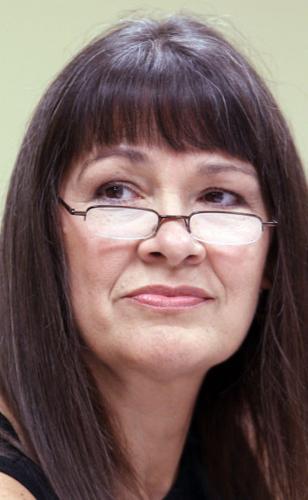
Rep. Victoria Steele’s story of incest changed the tone of a hostile committee debate, but it didn’t accomplish the rare feat of altering the course of a bill, at least not right away.
Last Wednesday, Steele, a Tucson Democrat, had already stated the dry reasons for opposing the abortion-restricting bill, SB 1318, when committee chair Rep. Kelly Townsend, a Phoenix-area Republican, asked her: “Would you describe for the committee why you think medically induced abortion is health care?”
Steele, 58, started to speak, paused, then went on: “When I was a child, I was molested, for years, by one particular person.”
The room grew quiet, and Steele struggled to go on.
“It turns out he had many, many victims. One of the other victims told me, when we were adults, she asked him one day, ‘What if I get pregnant?’,” Steele went on. “And he said, ‘Don’t worry, we’ll just stick a pencil up there and take care of it.’ “
People are also reading…
It was one of the most dramatic moments of the legislative session. On Tuesday, six days later, Steele was still receiving flowers, commendations and requests for interviews about the episode.
But the question is whether it will have any effect on the bill being considered. Normally, legislative debates take up hour after hour, day after day in committees and on the floor but have no influence on the outcome of the legislation considered, legislators told me.
“The great majority of the deals here are struck behind the scenes in the background,” said Rep. Bruce Wheeler, a Tucson Democrat who is also the assistant minority leader in the House. “By the time we get on the floor, the decisions the vast majority of time are already made, no matter what the testimony, no matter what the debate.”
The most important legislation pushed through without effective debate are the budget bills. Four days before Steele’s disclosure at the Committee on Federalism and States’ Rights (yes, that’s where the abortion bill was heard), the leaders of the House and Senate kept their members up all night to hear and vote on the budget bills.
Passionate debate occurred, but it was all symbolic.
“By the time we sat down at 12:18 a.m., every deal had been struck,” Wheeler said. “No matter what was brought up, the votes were locked in and the budget passed.”
This year was not exceptional, Rep. Chris Ackerley noted. He’s a Tucson Republican serving his first term representing some of Tucson’s south side as well as Santa Cruz County, but he has been watching the legislative process for years, even sitting in the gallery for all-night budget debates.
“Ideally we would have a fully deliberative process where the budget is built from the ground up based on subcommittees of the various areas,” said Ackerley, who voted against the budget bills.
But it’s been a decade or two since the budget was built in that organic, old-fashioned way, in which open debate could change the budget.
Now those episodes are by far the exception, even for bills that aren’t about spending. One happened in February when Rep. Bob Thorpe, a Flagstaff Republican, proposed mandating that the owners of service dogs carry identification cards. Testimony against the bill was so convincing that even Thorpe voted against it.
The same is unlikely to happen with SB 1318. It would prohibit the coverage of abortions under insurance plans purchased on the health-care exchanges created by Obamacare. It would also require doctors who do abortions to have their personal information submitted to the Arizona Department of Health Services, where it could be obtained via a public-records request.
Perhaps most troubling to opponents of the bill, an amendment would require doctors to tell patients who have taken the RU-486 abortion bill that it is reversible. An anti-abortion obstetrician testified that a pregnant woman who has taken RU-486 can have its effects reversed by taking progesterone.
This was one of the key claims Steele was arguing against before she decided to tell her story of molestation by a family member.
“It’s not even based on junk science,” Steele said that day. “There is no science around this particular approach.”
On Tuesday, Steele said what really motivated her to tell her story was the part of the bill that gave an exemption to the prohibition on insurance coverage of abortions for women who have been victims of rape or incest. She and other opponents of the bill argued these exemptions would require rape victims to convince their insurance carrier they were really victimized.
“I said, ‘OK, it’s time to get real, it’s time to get beyond the rhetoric,’” she told me Tuesday. “We should not have to bare our souls like this in public to take advantage of our legal right to health care.”
Despite her testimony, the committee passed SB 1318 and the amendment that would require notification of progesterone treatment. However, the bill was pulled back after being scheduled to be considered on the floor of the House on Tuesday.
The word circulating at the Capitol was that the bill either did not yet have enough votes to pass or that amendments were being prepared to remove some of the most controversial parts.
Steele’s dramatic and personal entry into the debate didn’t kill the bill, but it altered its course and gave her a shot at something rare: a discussion that actually influenced the outcome.


Rep. Victoria Steele
Contact columnist Tim Steller at tsteller@tucson.com or 807-7789. On Twitter: @senyorreporter

Tim Steller
Columnist