

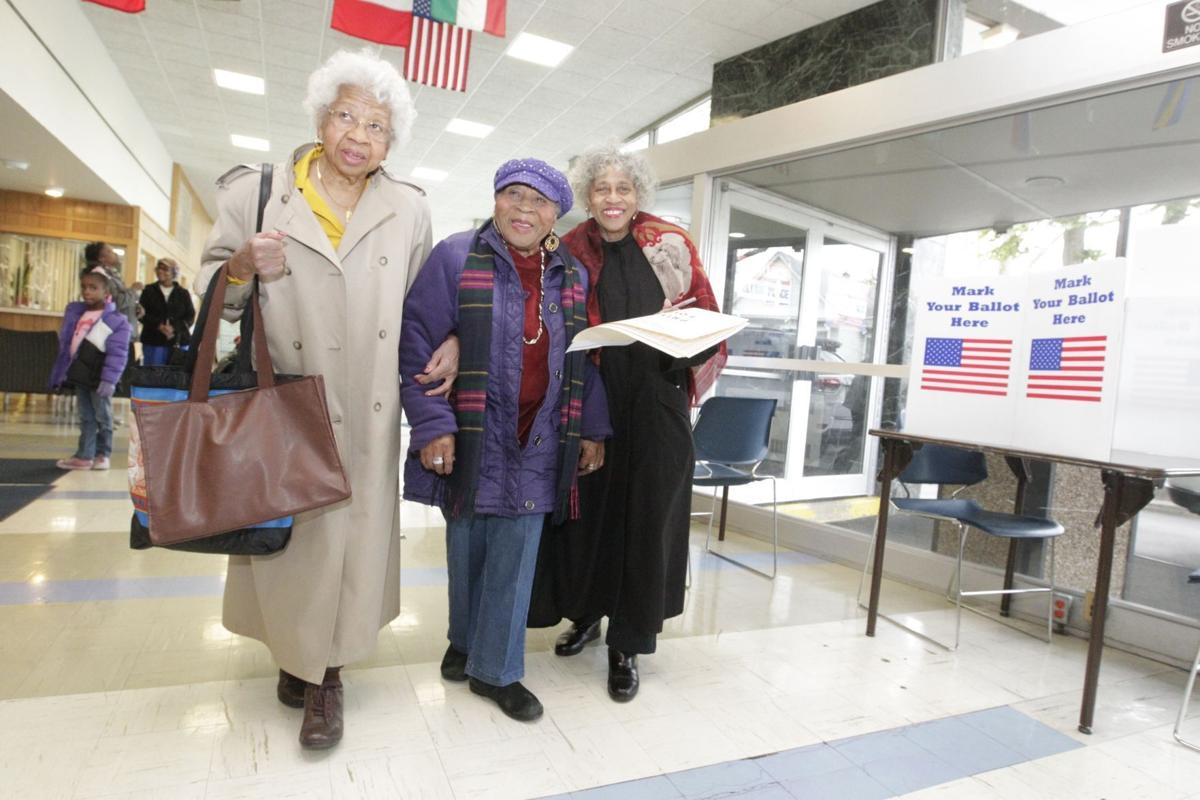
Mamie Kirkland shines on Election Day. She makes sure her nails are polished, her clothes are pressed and her makeup is applied perfectly.
At 106, Kirkland rarely has missed a chance to cast her ballot, for one simple reason.
“People died so I can vote. Years ago, people didn’t have a chance to vote,” she said. “I’m 106 and I get out to vote. The young and old should do the same, because it means a lot to everyone.”
On Tuesday, Kirkland was driven to her polling site at Canisius College by her daughter, Jeanette Clinton.
At around 1 p.m., Clinton’s Volvo drove up the ramp leading to the Richard E. Winter ’42 Student Center on Hughes Avenue. It’s where Kirkland has been voting for the past 50 years, her family says. Tuesday was no exception.
After a little help getting out of the car, Kirkland walked into the building unassisted wearing her favorite color: purple. Her purple coat matched her sequined hat, which complemented her scarf in shades of violet, lilac and amethyst.
People are also reading…
She didn’t forget her jewelry, either. A ring, a gold necklace, gold dangling earrings and a couple of gold bracelets completed the ensemble.
The centenarian carefully signed her name in the ballot book, letting the poll worker know it wasn’t a scribble, either. Kirkland then sat at a desk and read and filled out the ballot by herself. A poll worker gave her a helping hand feeding it into the machine, and within a few minutes Kirkland had completed her civic duty.
“It’s truly amazing,” said Sonya Russell, a poll worker for the past 20 years at the site. “She’s here for every primary, every school board race, and she doesn’t even have kids in school. Whatever election there is, this woman is here faithfully.”
Mamie Kirkland’s remarkable story was told by Tarabu Betserai Kirkland – who at 64 is her youngest child. A writer and community filmmaker in Los Angeles, the younger Kirkland chronicled the tumultuous years of his mother’s early decades in a family video that marked her 100th birthday celebration at Adam’s Mark Hotel.
“What she witnessed was a part of history in this country when it was impossible for African-Americans to vote,” said the younger Kirkland. “Today, she cherishes the opportunity.”
Mamie Kirkland, who was born Sept. 3, 1908, was 6 when her father burst into their Ellisville, Miss., home and told his family to pack their belongings and leave for East St. Louis, Mo., her son said.
“He told them to leave immediately, that they should pack up and follow him out the next morning. He had been working at a factory and had a conversation with his boss,” said Tarabu Kirkland. “They threatened to lynch him.”
The family took a train to East St. Louis because their father, the Rev. Edward Lang, feared for his life, Kirkland said. Two years later race riots tore the city apart.
“She was still a young girl, and the National Guard came in,” Tarabu Kirkland said. “They witnessed a black man being killed on the street. Apparently, the man was deaf and dumb, and ordered to stop. He did not, and he was killed.”
The East St. Louis riots scarred Mamie Kirkland, who did not want to talk much about them.
“It was awful terrible,” she said. “It happened before I got married when I was a teenager. It’s too long of a story to tell.”
The family would later move to Alliance, Ohio, where her father operated a boarding house for African-American railroad workers in a somewhat integrated neighborhood, according to her son. The year was 1922 or 1923, when another disturbing event occurred.
“They were visited by Klansmen who burned a cross on their lawn,” recounted the son. “Their landlord was armed and protected them, but my mother remembers very distinctly seeing the Klansmen on their lawn burning the cross.”
Albert Kirkland, who worked on the railroad, stayed at the boarding house and fell in love with his landlord’s daughter. He and Mamie were married Dec. 15, 1922, when Mamie was 15. The next year, they moved to Buffalo and lived on Jefferson Avenue.
“I would have graduated from eighth grade if I would not have met my husband,” she said.
Raising a family during the Depression taught Kirkland how to get the most out of a dime, which is what 3 pounds of neck bones cost, she recalled. With it, she made stew that would help feed her husband and their six children.
“A man from the country would bring buttermilk and sell it to me for 25 cents a gallon,” she said.
Kirkland carried 10 children, losing one to a miscarriage. She lost three more children to sickness. When her husband passed away in 1958 at age 55, Mamie Kirkland was left to support her family. In 1964, she became an Avon representative.
“She quickly gathered the skills to sell anyone a fragrance for any occasion,” said her son during a telephone conversation from Los Angeles.
Today, Mamie Kirkland attends First Shiloh Baptist Church. She eats a bowl of vanilla ice cream every evening, and she calls snow awful, though she claims to have gotten used to it.
In addition to her daughter Jeanette Clinton and son, Kirkland has three daughters: Juanita Kirkland Hunter; Beatrice Kirkland of Corona Calif., a retired professor at Erie Community College; and Margaret Kirkland. Her daughter Mildred Kirkland Byers is deceased.
Kirkland also has 17 grandchildren and, as of April 2014, 24 great-grandchildren, 70 great-great-grandchildren and nine great-great-great-grandchildren, according to her son, who shared this message.
“She has an endless commitment to life,” he said. “Her message is that if you have an opportunity to participate and you don’t, you don’t have an opportunity to complain.”
News Staff Reporter Deidre Williams contributed to this report. email: jkwiatkowski@buffnews.com


