Lt. Gov. Kathy Hochul has been a public face for the state's response to the coronavirus pandemic in Western New York. She helped drive home Gov. Andrew Cuomo's messaging when the region was shut down last spring and was ostensibly responsible for assessing the reopening of Western New York as the weather warmed.
She's a named leader of the Western New York vaccine hub. She held news conferences and showed up at pizza joints, hospitals, shops and churches to help explain the state's position on the Covid-19 response, state reopening guidance and pop-up vaccination clinics.
But Hochul plays a limited role in setting or directing state policy regarding the Covid-19 response, reopening decisions and vaccination distribution process. Those major decisions are being made in Albany by the state Health Department, the Governor's Office and vaccine czar Larry Schwartz.
People are also reading…
When asked about Hochul's policymaking contributions, her chief of staff pointed to the state's reopening guidance on garage sales.
Her bigger role is as a communicator.
"Kathy is a constituents person," said Mark Sullivan, CEO of Catholic Health and a leader of the local vaccine hub. "She’s out and about in all the regions and all the five counties, so part of our job is to keep her informed, so when she’s traveling to these other counties, she can explain what the hub’s working on."
The lieutenant governor's leadership, particularly as it applies to the public health crisis, is falling under a brighter spotlight now that the potential exists for her to step into the governor's shoes if Cuomo is unable to survive the sexual harassment allegations against him.
Those who have worked with Hochul say she's been a convener-in-chief; a sympathetic ear for local leaders, business groups and unions; and a public explainer for the priorities laid out by the governor. In the past, she's talked herself hoarse after speaking all day with stakeholders and reporters.
Since the allegations against the governor surfaced, however, she has granted no interviews and taken no questions at her public appearances, many of which are now virtual and sometimes prerecorded. Her office said she had "limited availability" and did not make her available for more than two weeks prior to this story's publication.

Lt. Gov. Kathy Hochul
Jeffrey Lewis, Hochul's chief of staff, described her role as "remaining engaged and coordinating with county and local elected officials."
Given her relationships with local leaders throughout the region, she can navigate rough political waters when elected officials want to vent about the state's response. Those who have worked closely with her over the course of the crisis said Hochul helps shine a light on local priorities in her conversations with Albany.
But she's not calling the shots.
Last April, Cuomo said he was appointing Hochul to oversee the gradual reopening of Buffalo's economy, part of a region-by-region effort that would be "data-driven." Hochul was to "take charge" of the region's public health outlook and work on "re-imagining" and restarting the economy here.
Hochul's phone exploded with callers after that announcement. But as months passed, it became clear that reopening decisions involving this region and all others weren't being made by Hochul; they were being made in Albany.
In the beginning
Hochul's role has never been a policymaking one. But when the public health crisis first broke here, she and her staff worked to locate personal protective equipment and address shortages in testing supplies, Lewis said.
She also participated in a daily "control room" call with the region's county executives, city mayors and business leaders, and joined daily calls with other members of the state cabinet.
"It was like a military operation, in the beginning, for the emergency services response," Lewis said. "She was there to listen in live time. It was all a dissemination of information game."
When Erie County Executive Mark Poloncarz was asked early this month about Hochul's role in the pandemic, he referred to the many conversations he's had with her.
"She knows all of us very well in Western New York. I think she knows us even more than she ever thought she would," he said. "Kathy and I talked a lot during the past year about getting resources, what we need in county government, especially early on when it was very difficult to try to just get testing kits and the like."
Hochul said in a prior interview that she played a role in the decision to expand the Western New York vaccine hub from Catholic Health alone to a core team that also included the University at Buffalo medical school and Erie County Medical Center.
"When we start getting out there in the community, I've got a whole army of people now," she said in January.
The control room group, which Hochul chairs, still meets once a week, but the lion's share of the region's vaccine rollout work is now done by the vaccine hub.
In the vaccine rollout
The Western New York vaccine hub is a key player and primary troubleshooter in the region's rollout efforts. Through the hub's work, unused vaccine doses in this region can get redirected – sometimes within hours. The hub makes daily proposals to the state and has spent weeks advocating for certain priorities, such as pushing for more vaccines to rural areas or to local physician providers.
They work together to gather data, make the case for local priorities and get vaccines in arms as efficiently as possible.
Hochul is one of four named leaders of the hub, along with Catholic Health's Sullivan; Dr. Michael Cain, dean of UB's Jacobs School of Medicine and Biomedical Sciences; and Thomas Quatroche, head of ECMC.
But Hochul is not involved in building or receiving vaccine hub proposals and doesn't usually attend hub meetings. Lewis, her chief of staff, attends them as her representative to the team.
“We meet periodically to give her updates as to our progress," Sullivan said, "but really, the Department of Health, the governor’s liaison and her chief of staff are directly involved in our weekly calls that we do together.”
The other members of the vaccine hub don't lobby Hochul when they want the state to listen to them. They make their case to their contacts in Albany. Sullivan pointed out that Erie County is in the middle of the pack when it comes to vaccine allocations and is not directly advantaged or disadvantaged by the lieutenant governor's role.
"We have not yet, since Dec. 8, called Kathy Hochul and said, 'Can you get this done for us?' Because it’s not appropriate," Sullivan said.
Lewis noted that Allegany County, which has long had the lowest vaccination rate in Western New York, was allocated 3,000 vaccines last week, a huge boost. Though the vaccine hub has been pushing on this issue for weeks, Lewis said, "We helped make their case."
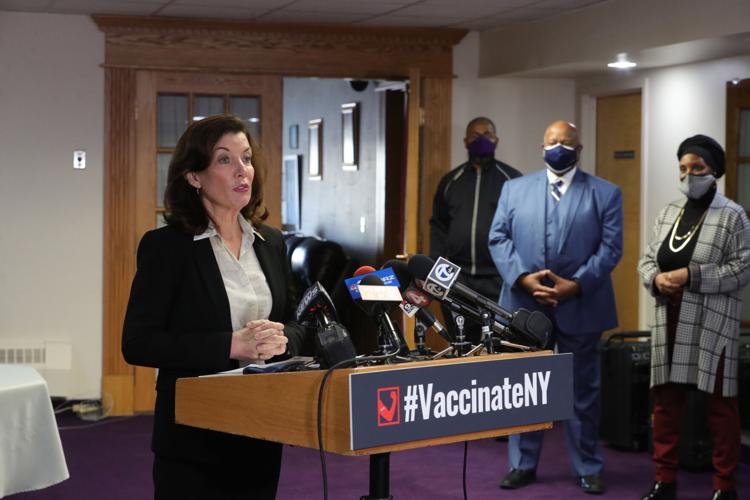
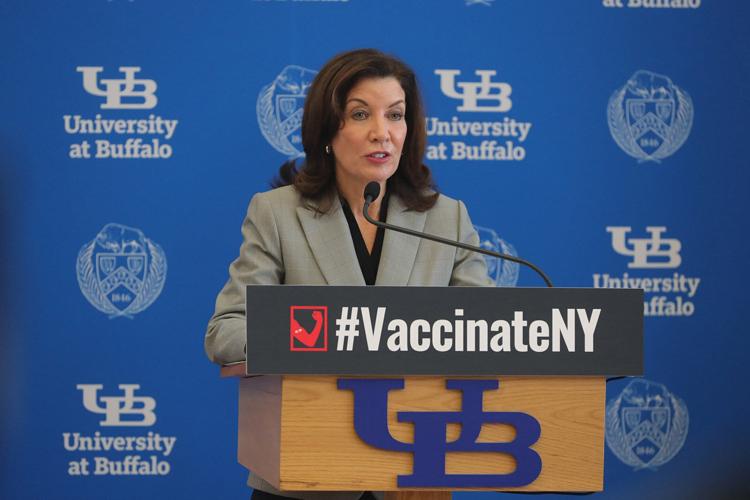
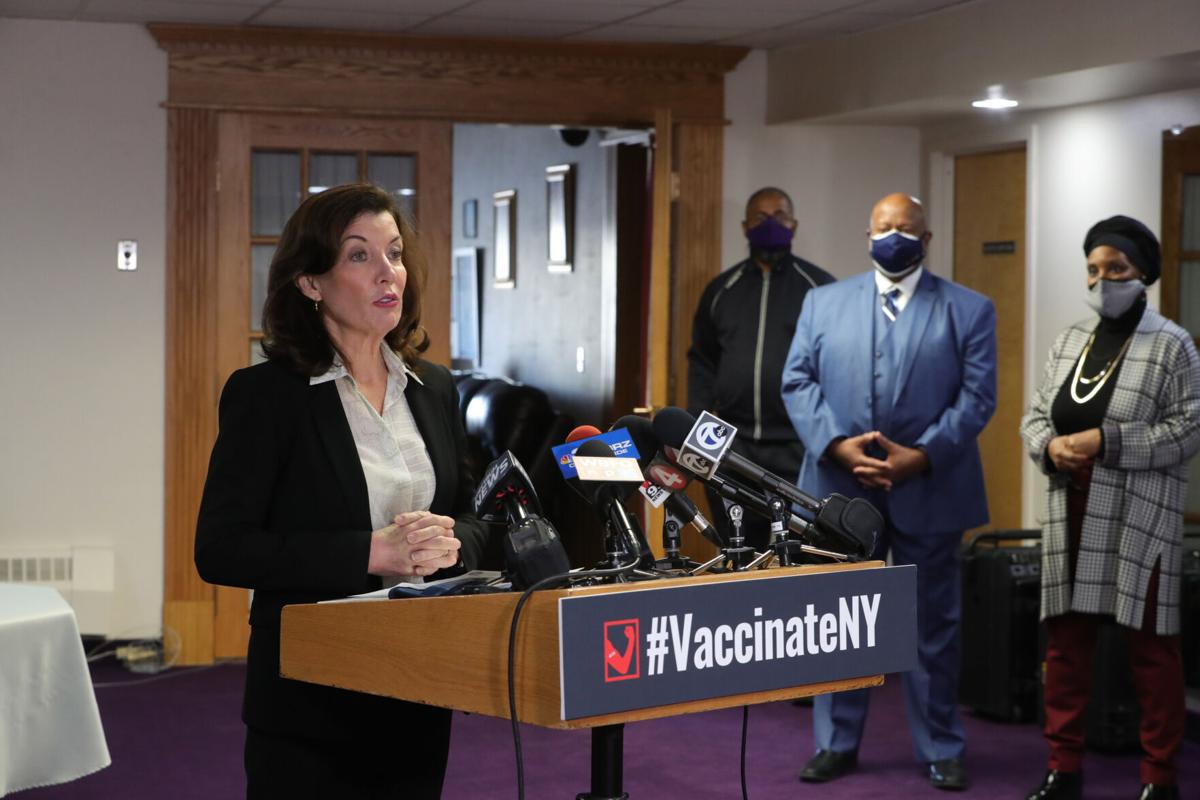
Lt. Gov. Kathy Hochul highlights New York State's commitment to equitable vaccine distribution at a pop-up site in Buffalo on Monday, Jan. 25, 2021.
He acknowledged that he has no way of knowing how much influence Hochul personally had over the state's actions, but Cain said it helps that she's aware of the issues that matter most locally.
"I think she amplifies our message," he said.
Other efforts
When it comes to shaping policy, Lewis referred to the lieutenant governor's success in getting the state to set reopening guidance for yard sales. For many residents cleaning out their homes while the economy was shut down, he said, that was a big deal.
"She was very vocal in that, and that blew up," he said.
Hochul also added her voice to lobby Albany decision-makers when it came to allowing local hospitals to reopen for elective surgeries after a long and unnecessary delay, he said.
Hochul has been active on social media, promoting parks, attractions, neighborhoods and businesses through her "staycation initiative," he said.
On the business end, he said, she has offered feedback regarding local businesses to Steven Cohen, chairman of Empire State Development.
He also pointed out her daily schedule, talking with local elected leaders; working with businesses, chambers of commerce and nonprofit organizations; reaching out to union leaders and clergy; and "being human" in getting the state's message out.
Though Hochul is avoiding the news media these days, those who have worked with her over the course of the health crisis said her overarching role of listening and sharing information and injecting empathy into difficult circumstances has value.
"I can't speak about other places, but I know what she's done here and how she's worked on our behalf," Poloncarz said. "And she's worked very hard."