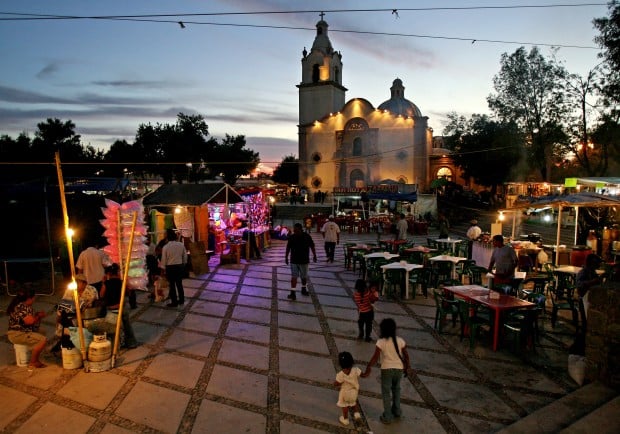
The escalating shootouts between Mexican drug gangs in Sonora have created another casualty.
Kino Mission Tours, which for 35 years has taken thousands of people on weekend trips to get to know and appreciate the history and culture of northern Sonora, is on the brink of discontinuing the tours.
"It's very, very sad," said Nicholas Bleser, a retired National Park Service historian at Tumacácori who often led the tours since his first one in 1978.
With two bloody shootouts in less than a month in the Sáric-Tubutama area, about 40 miles south of the border, and the killing of two town officials in Tubutama, the previous tranquillity of the Altar River Valley has been ruptured. Fewer people are signing up for the tours. Tucson families that have ancestral ties to the region are traveling less, and residents of the towns are afraid to venture out of their homes.
People are also reading…
"The damage is terrible," said Bernard Fontana, a retired field historian at the University of Arizona Library.
In all the years the tours took visitors to Sonora, no one was the victim of violence, and no Mexican official demanded a bribe, Bleser said.
But the news of gunbattles and killings among drug factions, and their confrontations with the Mexican military, has scared people away.
We stand to lose our connection to the shared culture of Southern Arizona and northern Sonora, collectively known as the Pimería Alta, said Fontana, a noted expert on the Tohono O'odham, the indigenous people of the Pimería Alta.
The tours took visitors to the Sonoran towns where in the late 1600s Jesuit missionary explorer Eusebio Francisco Kino laid the foundation for a culture and way of life in the region, which remains beautiful despite being choked by the clash of drug cartels vying for the lucrative U.S. market.
In nearly 200 tours, more than 6,000 people from Southern Arizona, from across the country and from abroad discovered the uniqueness and warmth of the inhabitants of small communities along the Magdalena and Altar rivers in Sonora, said Bleser, who lives in Tubac.
Visitors discovered the commonalities of life and history from Tucson to Caborca, Sonora. And in many cases, Southern Arizonans with deep roots in northern Sonora reconnected or discovered their ancestral ties in the small towns of Tubutama, Oquitoa, Pitiquito, Átil, San Ignacio and Magdalena de Kino, where Father Kino was buried in 1711.
The tours offered more than an education on the Jesuit missions, which later came under the domain of Franciscan missionaries. They offered more than an understanding of the architecture, plants, animals and dates.
The weekend entradas were about getting to know people.
"Quite aside from history, we felt we introduced thousands who never crossed the border and by Sunday night didn't want to come home," Fontana said.
The tours were the idea of Lea Ramírez Ward, a former Tucsonan living in Sonoita. She organized the first tour in 1974 under the sponsorship of the League of Mexican American Women and the Tucson Museum Art League. The late Southwestern historian James Officer helped Ward organize the trip.
"These missions are just as beautiful as those in California," Ward said. Moreover, she wanted to help Tucsonans make their historical and cultural connections to the Sonoran towns and their people.
By 1976, the tours were under the sponsorship of the Southwestern Mission Research Center at the UA. The late Jesuit scholar Charles William Polzer, a founder of the research center, helped lead early tours.
There have been others, from within and outside academia. Among them are Mary Lee and George Malaby; Mardith Schuetz-Miller; "Big" Jim and Loma Griffith; Roberta Stabel; Susan Smith; Thomas Sheridan; Carmen Villa and Tom Prezelski; Don Garate; the Rev. Greg Adolf; David Yubeta; Nick Fontana; and Bob Vint; as well as this writer's parents, Ernesto V. and Julieta B. Portillo, and brother, Carlos Portillo. I went on a number of tours, beginning in the late 1970s, when I was at the UA.
With the violence holding the towns and its inhabitants hostage, it is left to wonder what will become of Tucson's cultural ties with the southern half of the Pimería Alta.
Ernesto Portillo Jr. is the editor of La Estrella de Tucsón. He can be reached at netopjr@azstarnet.com or 573-4187.