

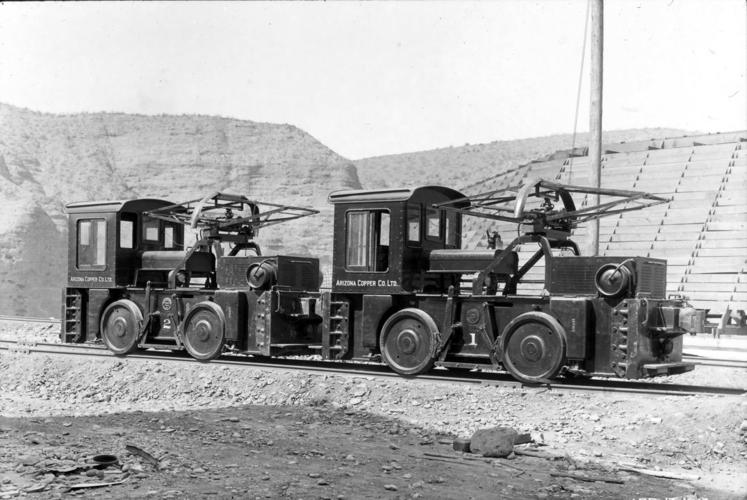
James Colquhoun, a skilled metallurgist renowned for his innovation in porphyry copper production, started out as an assayer for the Arizona Copper Co. and also for non-company affiliates.
He charged $2.50 for assaying their gold, silver or copper specimens.
Colquhoun is also remembered for Arizona Copper Co.’s transport and copper processing during his affiliation with the company.
In 1905, gravity and mule haulage proved inefficient in the Coronado and Humboldt mines because of their long tunnels. Those methods were replaced with electric haulage.
Another pioneering, cost-effective practice of the Arizona Copper Co. involved acquiring copper from the mine waters that had been naturally leached from the surrounding ores. Long sluiceways composed of tin were built, enabling the passage of water from which the copper was captured by adhering to the tin and subsequently removed by electrolysis.
People are also reading…
This process was later expanded on by Phelps Dodge Co. when it financed the pumping of mine waters to the top of the mountain and redirecting it into abandoned mine tunnels leaching the copper as it traveled toward manufactured sluiceways coated with tin to enhance copper precipitation.
Another innovative method of capturing copper while reducing smelter smoke in Clifton involved the building of a tunnel through a 450-foot mountain above the town and against which the Arizona Copper Co. smelter rested. Residual copper could be gleaned from smelter smoke by the use of a settling chamber while sulfur smoke released above the mountain gave the appearance of an active volcano to the town’s residents.
During 1904, the Arizona Copper Co. alone produced 29 million pounds of copper.
That same year, Colquhoun retired from active management yet remained on as a member of the board of directors until Nov. 30, 1907. Health problems led Colquhoun to retire from the company.
The success of the Arizona Copper Co. was reflected in the early 20th century by the substantial dividends offered to its stockholders.
But challenges in the form of strikes, whose resolution necessitated wage increases, and periodic flooding from the San Francisco River led to declining profits.
The collapse of the copper market in 1920, coupled with high taxes imposed by both the United States and Scotland, led to the company’s acquisition by Phelps Dodge for the price of $18.2 million.
On Oct. 3, 1921, stockholders of the Arizona Copper Co. met at the local YMCA and agreed upon the sale of their property to the Phelps Dodge Co. This corporate merger was the largest of its time in Arizona.
In that final year of operation, the company produced 17,846 tons of copper. Its assets included eight mines, a mercantile, several railway properties, a mill, smelter and perhaps its greatest asset, the Clay ore body containing 450 million tons of copper reserves, which later became the nucleus of Phelps Dodge’s future open-pit mine operations.
From 1882 to 1921, the Arizona Copper Co. produced 419,863 tons of copper.
Colquhoun later developed the copper mines near Dzansul, in southern Russia, when he served as chairman of the Caucasus Copper Co. He was also involved in the reconstruction of the metallurgical plant at Borçka in present-day Georgia, near the Turkish border.
However, the Russian Revolution of 1917 forced his departure from the country and its mines containing reserves of 3.6 million tons of 3.1 percent copper ore.
In retirement, Colquhoun continued to faithfully contribute $100 every year to purchase Christmas candy for the children in Clifton. They in turn reciprocated in 1943 by contributing small change toward a gold watch that was given to Colquhoun, who then resided at San Jose, California. Colquhoun passed away on June 17, 1954, at the age of 97. His legacy involving the efficient processing of low grade porphyry copper ore deposits contributed to modern mining methods throughout the 20th century into the 21st century.
Archivist, historian and author William Ascarza’s forthcoming book is “In Search of Fortunes: A Look at the History of Arizona Mining.” For more information, contact M.T. Publishing Co. at (812) 468-8022
or visit http://bit.ly/1KdZ8y4
Archivist, historian and author William Ascarza’s forthcoming book is “In Search of Fortunes: A Look at the History of Arizona Mining.” For more information, contact M.T. Publishing Co. at (812) 468-8022
or visit http://bit.ly/1KdZ8y4

 Historic bank vault now new Tucson speakeasy