

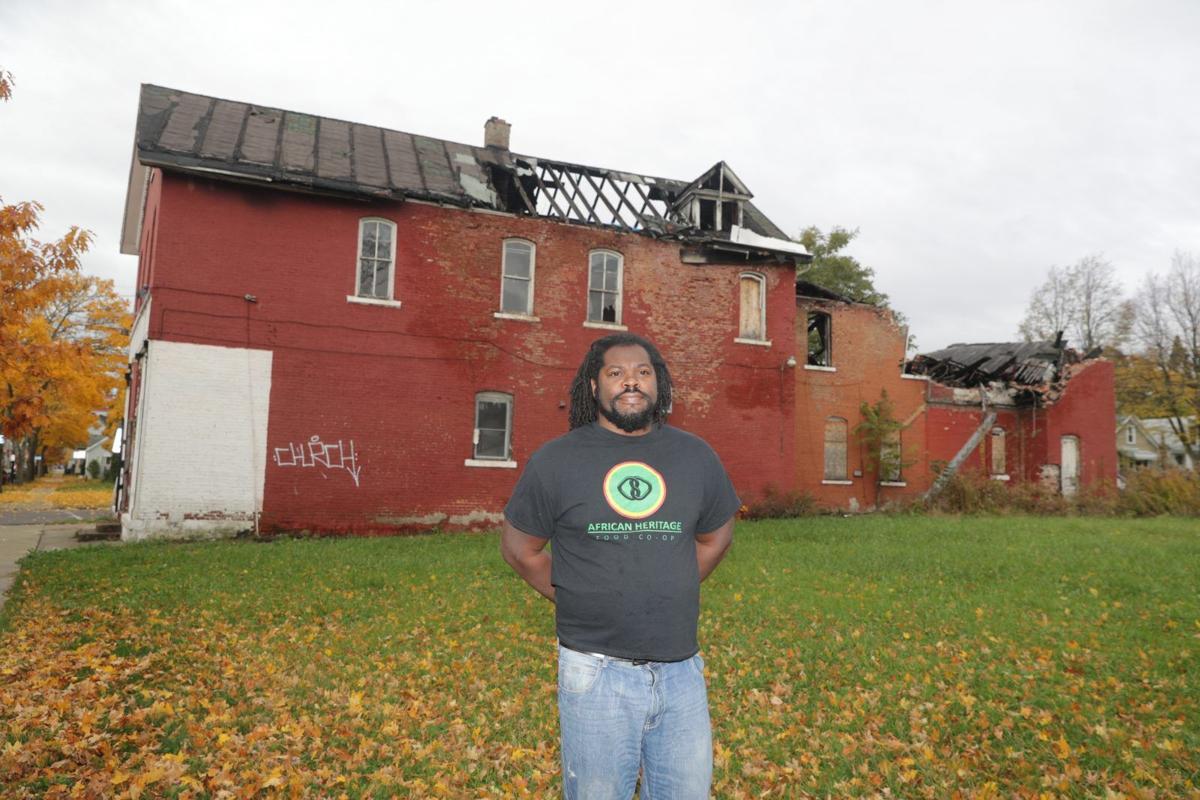
The big, red-brick fire-damaged building at 238 Carlton St., just off the Buffalo Niagara Medical Campus, represents both the best and worst of what the near East Side could become amid the city’s resurgence.
At its best, it could be the home of the African Heritage Food Co-Op, a 2-year-old venture grounded in community commitment and control that has made its name through mobile food distributions and now seeks a permanent site.
At its worst, the badly neglected building could embody the land speculation and exploitation that is the dirty underbelly of gentrification as profiteers descend on the neighborhood to capitalize on proximity to the health care campus.
Put another way, it’s community vision versus free-market – some would say exploitative – capitalism.
People are also reading…
Alexander Wright started the food co-op in 2016 to solve a variety of problems: give young people of vision of African-Americans owning enterprises, have the community control its own food system instead of relying on overpriced corner stores, and provide healthy foods to combat the high levels of stroke and diabetes in the community,
"The co-op is a microcosm of a macro issue," he said of the challenges facing the community.
With no permanent site open yet, he has been offering monthly food pickups at East Side community centers, an effort that proved so successful that he said health care institutions including Independent Health and GBAUN invited the co-op to some of their events and offered $5 produce coupons. Customers buy in for $30 for a full box or $15 for a half box of food he gets from farms and distributors.
Wright said the co-op had 250 buying into the monthly distributions, but with the other community efforts he estimates it has reached nearly 30,000 people over the past 2½ years.
With federal grants and one from the United Way, he said, the co-op has purchased a building in Niagara Falls and has begun leasing space in the former Willowbrook Farms site at Bailey Avenue and Clinton Street, while looking for volunteers and donations to build out the sites.
But rather than lease, he would like to buy the 108-year-old, two-story Carlton Street building with its 3,838 square feet of space, and then raise money to rehab it. He has the backing of groups such as Preservation Buffalo Niagara and the Fruit Belt Advisory Council.
The co-op could help eliminate the "food desert" that still engulfs large swaths of the East Side, though Open Buffalo’s Harper Bishop notes the term is a misnomer because deserts are natural while the scarcity of healthy food options is the result of deliberate decisions about where and where not to develop.
Jessie Fisher of Preservation Buffalo Niagara said the city issued an emergency demolition order right after the April 2017 fire, but that city officials have been working with the community in hopes that a sale and rehab could take place.
The sticking point, as it usually is, is money.
Borderland Advantage LLC bought the building for $24,000, sticking with the deal and closing just days after the fire because the owner had serious health issues and the family would have been stuck with an estimated $45,000 demolition cost, said Kamalie Liyanage, Borderland’s attorney. She credited the corporation with stepping in to save the building from imminent demolition.
But since then, it appears Borderland – which lists a P.O. Box address in Getzville, where records indicate one of its principals also lives – has done virtually nothing to protect the building since buying it a year and a half ago. Sections of the roof are missing and nothing has been put over it, meaning rain and snow can get in. A tarp on the floor of the second story compounds the problem, activists say, because water accumulates there and has caused the bricks to bow. Broken windows also have yet to be covered.
Even in that condition, Borderland is asking twice what it paid 19 months ago.
"It’s listed for $50,000," Liyanage said, dismissing the co-op's various counter proposals so far as "peanuts."
She said the owners had planned to convert it to a restaurant and apartments, but those plans were derailed when the building was given Local Landmark status earlier this year, which she said would have hiked the rehab cost to $300,000.
Still, why would Borderland double its purchase price for a fire-damaged building it has done nothing with?
Liyanage pointed to expenses such as closing costs and taxes, while repeatedly making the point that these are private owners.
"Considering the location that it’s in, I see vacant land is being sold for $75,000 in that neighborhood," she said.
And that makes this impasse a microcosm of what residents and community groups have feared – and fought – since the blossoming of the Medical Campus: Outsiders are swooping in to buy up property and price it beyond the community’s reach.
Co-op backers see 238 Carlton as part of a larger vision of a community-controlled economy buttressed by mechanisms like the city’s transfer of vacant parcels to the Fruit Belt Community Land Trust and the sale of vacant lots to adjacent homeowners. It’s an antidote to being pushed out or priced out and a vision that has the neighborhood share in the city’s rebirth rather than become its victim.
"This is your store, you have say in how it’s constituted," Wright says of the co-op he envisions at the site. "It’s giving people power back in their community. We want it to start with us, but we don’t want it to stop with us."
But now the two sides seem at impasse, with each blaming the other for the breakdown in talks. And unless they can get together on a reasonable price for the fire-damaged building – and $50,000 isn’t it – it will stop here, with Wright’s vision falling prey to the nightmare scenario community activists have been warning about.


