

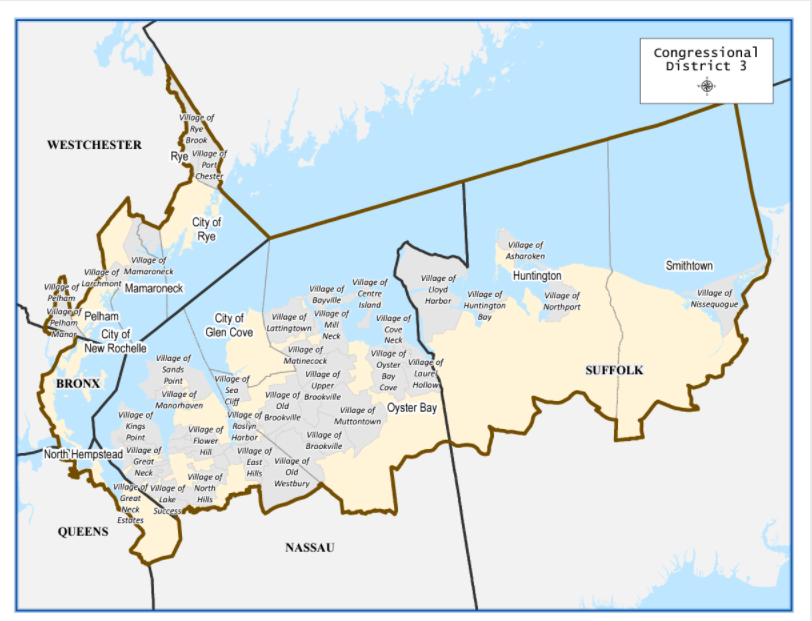
WASHINGTON – Members of Congress often use campaign funds to rent cars to travel around their districts, but former Rep. John Faso suggests that the new lawmaker from New York's redrawn 3rd congressional district might want to try another form of transportation to navigate – and he means navigate – the territory he or she represents.
"I don't know if that district comes with a sailboat or a yacht," said Faso, a Republican lawyer who is working on a pending legal challenge that could upend the new congressional map that Democrats in the State Legislature are scheduled to vote on Wednesday.

"The fact that New York could end up with such an egregious congressional map represents a failure for the state’s new redistricting process," wrote Nathaniel Rakich, a senior elections analyst at the FiveThirtyEight election blog.
The 3rd district is a prime example of why Faso thinks the courts should throw out the map. Currently a compact land mass on the northwest shore of Long Island, the redrawn 3rd district would connect communities on both the north side and the south side of Long Island Sound.
People are also reading…
Yes, the same district connects parts of Suffolk, Nassau, Bronx and Westchester counties, so maybe the new member of Congress would want to sail around the district. After all, it's 35-mile drive from Glen Cove in Nassau County to Rye in Westchester County – but it's only an 8.6 mile boat ride.
The 3rd district is by no means the only oddly shaped district in the map Democrats drew to maximize their chances in New York's congressional elections this fall. Several analysts have said the map could trim the number of Republicans in the state's House delegation in half, to only four – that is, if the plan withstands legal challenges.

While the Buffalo-based district in the proposed plan would be largely Democratic, the other two districts including parts of Erie County consist largely of smaller communities and rural territory and are most likely to be represented by Republicans.
Faso thinks it won't, thanks to a 2014 constitutional amendment New York voters approved banning partisan redistricting.
Without that constitutional amendment, "I think they could have gotten away with this under state law," Faso said. "But now we have a constitution that says you can't do that. So really, the question is going to be, both on the congressional and the legislative map, whether the courts pay attention to the the amendment that the people put in the Constitution."
That constitutional amendment created an independent commission to draw up New York's new districts. That commission failed at its job, leaving the map-making in the hands of the heavily Democratic State Legislature.
But lawmakers still have to abide by other provisions of the constitutional amendment, which say:
• Each district shall consist of contiguous territory.
• Each district shall be as compact in form as practicable.
• Districts shall not be drawn to discourage competition or for the purpose of favoring or disfavoring incumbents or other particular candidates or political parties.
The new 3rd district doesn't look contiguous or compact to Faso, who said it's just one of several districts Democrats drew up that, in his opinion, are designed to elect Democrats. Among the most egregious, he said, is the 22nd district in Central New York, which unites Syracuse and Ithaca.
To do that sort of thing, map-makers jammed as many Republicans as possible into four districts: the 23rd and 24th in Western and Central New York, along with districts in the North Country and Long Island.
That left Republicans in misshapen districts like the 24th, where Rep. Chris Jacobs, an Orchard Park Republican, plans to run. That district stretches from the shores of the Niagara River to the Thousand Islands region.

Watertown might be about to get a new congressman from Orchard Park, and Hamburg might be about to get a new congresswoman from the Utica area.
That district "is extremely non-compact, and doesn't serve the public interest to have a district where a congressman has got to traverse 250 miles in four hours to come from one end to the other end," Faso said.
Democrats, however, dismiss such complaints as partisan Republican carping. Mike Gianaris, the deputy majority leader of the State Senate, Tuesday defended the remap as an attempt to right historical wrongs.
"As we unravel the gerrymanders of the past, it doesn't make it a gerrymander of today," Gianaris said Tuesday on WNYC radio. "These are districts drawn fairly."
As for the limits on partisan gerrymandering approved by voters in 2014, Gianaris said: "Our lawyers have looked at this backwards and forward so we have great confidence that what we did is appropriate."
Independent experts aren't so sure.
While the maps don't violate the federal Voting Rights Act, "the rest of the lines are so heavily gerrymandered they will be non-competitive," said Susan Lerner, executive director of Common Cause New York, which advocates for fair voting laws. "It's a major disservice to the voters."
Michael Li, redistricting and voting counsel at the Brennan Center for Justice at New York University, said it's unclear how state courts would handle a challenge to the map's constitutionality, given that they've never ruled on a case involving that 2014 constitutional amendment.
At the same time, he said some districts do seem like Democratic gerrymanders, such as one that links Syracuse with Ithaca and another that renders the Staten Island district Democratic by linking it with Park Slope and other liberal parts of Brooklyn.
Courts will be up against the clock in ruling on any case against the remap, Li added.
"Litigation takes time, so even if they're successful, it may not be successful for 2022," he said.
Faso said, though, that the June primary could be moved back to as late as September if a court orders the map to be redrawn.
Gov. Kathy Hochul said Tuesday that she will review the congressional map after the state Legislature votes on it.
But at a news conference in the Bronx, she seemed most interested in getting the map approved as quickly as possible.
"We need to make sure that the redistricting process is moving forward at a rapid pace so we can answer these questions: What do the districts look like? Who is running?" she said. "So we don't want to see further delays in this."


