

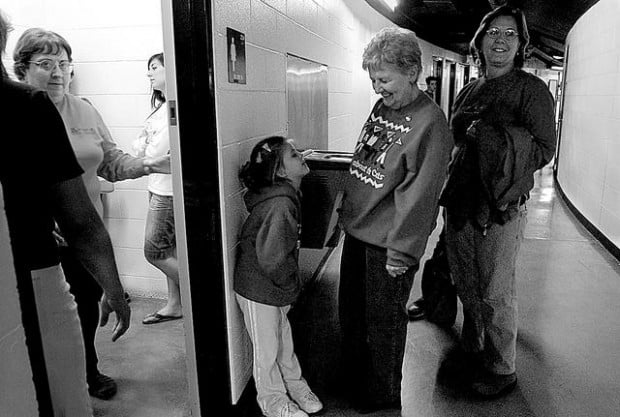
It's called the Disneyland line, the one that doubles back and forth at intermission outside women's restrooms.
"It's infuriating when you have to wait twice as long, when the men's bathroom is empty," says Tucsonan Ann Marie Dike.
She isn't the only one fed up.
Across the country, women — and some men — have taken up the issue of "potty parity," the idea that equal space for restrooms is, in fact, unequal.
Men's with both urinals and stalls, parity pushers say, offer more choices than stall-only women's rooms.
"We call them 'opportunities,' " says Tucson Convention Center Director Rich Singer. "The first convention center I opened, they had no clue. They drew a square where the restrooms go, took a ruler and cut it right in half."
People are also reading…
That alone creates more "opportunities" for men. Now add in the extra time many women need to unbutton, unzip, pull down, pull up, tuck in, rezip and rebutton. And that doesn't even factor in pantyhose wrestling — or waiting for a little one to "go wee-wee."
Cries for potty parity have grown so loud that several cities and states have approved codes requiring higher ratios of women's to men's toilets in all new construction. Among them: New York City and Honolulu, which both passed such measures last year.
Closer to home, Tucson, Pima County and the state all have adopted the International Building Code, which lays out specific numbers for new construction of men's and women's public bathrooms.
For restaurants and nightclubs, it's still a 1-1 ratio. But for churches, museums, theaters, large stadiums and arenas, it's about 2-1 in favor of the women.
This is little help, of course, in older buildings — a category that includes just about all of Tucson's major gathering spots.
So until those new buildings come online, women can still expect to loiter in line. Interminably, if they have small children in tow.
"Kids are always slower," says Ann Marie Dike, who has four children, ages 7 years to 18 months.
During a recent live performance of "The Lion King" in Phoenix, says Dike, "I got into my daughter's face almost before intermission and said, 'You have to run with me or you won't get to go.'
"But when we got there, 30 people were already in line. After 10 minutes in line, the chimes started that intermission was ending. I made my husband stand guard in the men's room while my daughter used it. It was completely empty. How pathetic is that?"
Men, too, suffer from the inequities of potty disparity, cooling their heels while waiting for their significant others to emerge from the ladies' room after the concert or ballgame.
Perhaps that's what's spurring on John Banzhaf, a law professor at George Washington University in Washington, D.C.
"I'm pushing the idea of filing federal complaints, in other words, making a federal case out of potty parity," he said.
A prime example of what's wrong in older plumbing design is the 35-year-old Tucson Convention Center, which holds 93 stalls and urinals for men versus 74 stalls for women at its music hall and arena.
"Woeful situations"
Though much of that inequity occurs in the 8,500-capacity arena, it's the 2,200-seat music hall where the most "woeful situations" arise, says the TCC's Singer.
"When you go to the symphony or opera, you can only avail yourself of the facilities at intermission. The crunch is huge."
They know that crunch all too well over at the University of Arizona's Centennial Hall. Built in 1936, the hall, with a seating capacity of 2,456, has one women's room with 14 stalls and one men's room with five stalls, seven urinals.
"You'll see a woman who looks like she's 12 months pregnant, she sees the line and her face drops," says Staci Santa, audience services coordinator for UApresents. "It's like, 'I'm a grown woman and I'm not going to make it.' "
During one particularly crowded intermission about 3 1/2 years ago, says Santa, "One of the female ushers said, 'I'm going in and see if I can help.' "
That led to an official bathroom program, using an usher to help move the line along. Ushers stationed outside the bathroom also help disabled and pregnant women cut in line.
"It's so fun and the women are so appreciative," says University of Arizona senior Samantha Scaife, 21, a bathroom usher for the last 18 months. "I tell the women to wait and I'll let them know when a stall opens. Then I'll say something like, 'Ma'am, stall No. 4 is open to your left.' "
While she hurries women into the stalls, there's no rushing them out. "I will check if there seems like a problem, but I don't have a stopwatch."
As for using male ushers in the men's room, Scaife says, "We have attempted to do that but the men in line think it's strange. And with the urinals, there's a question of privacy."
Ingenuity can suffice
Ingenuity often substitutes for a dearth of toilets. "When Mary Kay is in the house, we don't need men's urinals," says the TCC's Singer, who slaps "Women" on the outsides of the men's bathrooms.
And when Promise Keepers takes the arena, they do the opposite, designating all the bathrooms as men's.
When the genders are mixed, location, location, location can be everything.
On the concourse near first base at Hi Corbett Field, there are restrooms with 10 opportunities for men but just seven for women, says Reid Park Superintendent Carlos Guzman.
However, the women's room near third base has 31 stalls — triple the number in the men's room — added in the early '90s.
At McKale Center, women are more likely to stand in line for restrooms on the upper and middle concourses, says Suzy Mason, associate athletic director for events and operations. There is a total of 30 opportunities for women and 34 for men.
Some relief may be on the way at Arizona Stadium, which at 56,500 seats is the largest venue in town. Its bathrooms hold a total of 219 stalls for women compared with 179 stalls and eight trough urinals for men.
There is a possibility of new restrooms — both men's and women's — at the stadium in the next five years, Mason says.
The TCC's Singer is also hoping for new bathrooms — in a proposed new arena.
"We're planning to build generously for both men and women," he says. But the women, he adds, will get twice as many opportunities.
So will that do it? Will we, at last, achieve potty parity?
Answers Singer: "What I perceive to be an adequate supply is when there's not a line out the door."
62 stalls 19 stalls
43 urinals
14 stalls 5 stalls
7 urinals
38 stalls 6 stalls
14 urinals
51 stalls 29 stalls
40 urinals
23 stalls 10 stalls
14 urinals
219 stalls 179 stalls
8 trough
urinals
 $25M distribution center to be built in Tucson


