

When I was 10, I was at the McKinley Mall in Hamburg when I spotted a man grabbing an after-work coffee from The Original Cookie Company.

I had no idea who he was, but my father immediately recognized him as a recent transplant who had moved to the area for a new job.
I walked up to him and said, “Excuse me, sir, are you Marv Levy?”
“Why yes I am,” he said. “And what’s your name?”
I introduced myself and days later sent him a letter to wish him luck on the new job. Marv wrote back with an autographed team photo. Back then, I thought it was simply a kind gesture by a nice man. Now, I see it as something more: He realized, early and quickly, that Buffalo Bills fans are a community, and he was a central part of it. Even with the tiniest of interactions, he was embracing that role.
People are also reading…

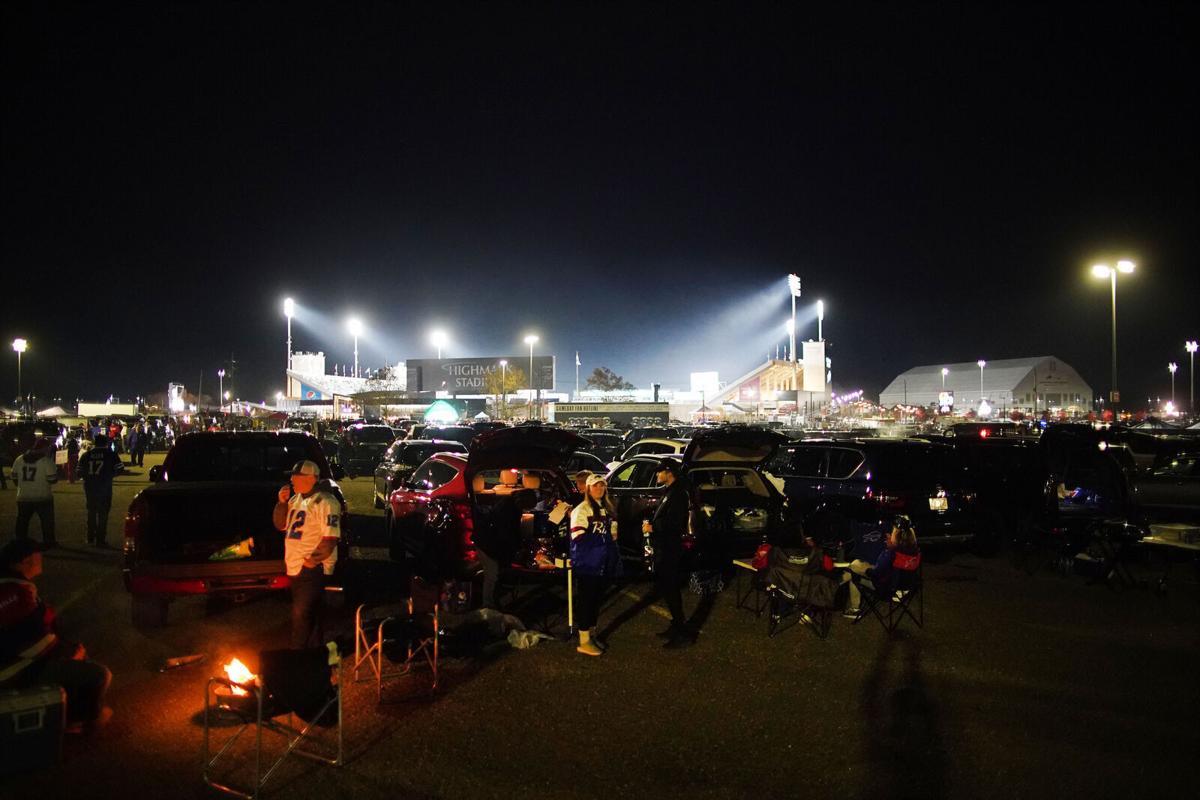
Bills fans prepare to watch the playoff-bound Bills take on the Jets at Highmark Stadium in Orchard Park. (Derek Gee / Buffalo News)
Nowhere is that sense of community with the Bills quite like it is in Hamburg and Orchard Park, home to tens of thousands of people – some of them players, coaches and front-office personnel – and the Home of the Buffalo Bills.
That place, formerly known as Rich Stadium, turns 50 years old this week. It opened to the public on Aug. 17, 1973 with a preseason game against Washington. The word “inauspicious” fits nicely for its inaugural event: The first time the clock on one end of the building started counting down from 15:00 during a game, a player on the opposing team was returning a kickoff for a touchdown.
There would be many more lows and plenty of highs over the next half-century.
All of them happened in my neighborhood.
I lived in four homes during my childhood and young adulthood, each of them in neighborhoods off Southwestern Boulevard, the main thoroughfare cutting through Hamburg and Orchard Park. Highmark Stadium, as we call it today, is at the intersection of Southwestern and Abbott Road.
Every Monday morning at Frontier High School, I would gaze into the distance, my vision cutting through the October fog as I tried to catch a glimpse of the stadium lights. They were never actually on; the action had happened the day before. I only looked out the window for a flicker of a moment on those mornings, imagining Jim Kelly and the K-Gun offense, Bruce Smith bearing down on Dan Marino, Marv Levy sharing war stories and poetry with his players and asking them, “Where else would you rather be than right here, right now?”
Living near the stadium meant the Bills were my neighbors, figuratively and literally. I went to preschool with the daughter of running back Curtis Brown. I played Hamburg Little Cagers Basketball against General Manager Bill Polian’s kids, who themselves went on to become successful coaches and front office leaders. As a town recreation worker in college, I tossed a football on the playground with Kyle Smith, whose dad A.J. was then the Bills’ pro personnel director. Kyle is now the assistant general manager of the Atlanta Falcons.
This article is supposed to be about the stadium’s opening and here I am telling you about people. And that’s about right:
The stadium has never been an architectural wonder. The renovations that took place in the late 1990s and first couple of decades of the 2000s maximized its ability to be luxurious, but in the end, it is very simply a concrete bowl dug into the ground, a wide-open arena where football is watched and played and cursed and celebrated. It’s the equivalent of a favorite dive bar; it’s not fancy, but it’s home.
The new Highmark Stadium, which will be built across the street and is scheduled to open by 2026, will be much more than that. It will have a partial canopy roof that will retain sound and shield some fans from the rain and snow. It will have fancier clubs and crisper colors and Instagram-worthy statues and designs. The future Highmark Stadium is being built with an eye toward driving revenue with every possible square foot. The experience of attending a game there will be wholly different than the current stadium, which will likely be torn down and turned into parking or tailgating space sometime around its 53rd birthday.
But it will still be home, because here’s what will never change: The stadium is a workplace for the players and coaches and a Sunday home for the fans, which makes it the town square, the central point for everything Bills. Players and coaches will still live and shop among the fans who live nearby. Kids will still look out their windows at the silhouette of the stadium and think about a quarterback and sacks and a Super Bowl.
But more important than anything else, there will still be game days. That’s when the stadium, no matter its aesthetics or architectural qualities, becomes a community center. The actor William Fichtner, who left his hometown of Cheektowaga a half century ago to pursue his art on stages and screens in New York City and Los Angeles, captured this experience several months back.
Fichtner told me a story about coming home to Western New York for a game, and trying to find his friend among the tailgaters in the Highmark Stadium lots:
“I walked about 20 minutes to try to find this friend of mine. I didn’t end up finding them, but I was walking about a half hour, 40 minutes just through the parking lots. I’ve been to sporting events all over the world. I’ve lived in Europe. I’ve been to sporting events all over this country, and I marveled as I was walking along that I never had so much fun trying to find my friend in this parking lot that Saturday night. And it’s not just that Saturday night. It’s every weekend. I was walking through these parking lots and it was freezing out. There were Christmas lights hanging between trucks and cars and grills and people and I was walking by people I didn’t know and some people might recognize me: ‘Hey, duuuude, glad you’re back for the game! Here, take a beer!” When I finally got back to the stadium, I called my wife and I said to her, ‘I never experienced anything so wonderful in my life.’ This fan base – what happens to these people in this parking lot – is so festive. It’s unlike anything I’ve ever seen. It’s so amazing.
“The town is amazing.”
Fichtner has it right: The fans make the team. The team defines the town. A town needs a center.
For 50 years, the stadium has been it.
The #BNDrone takes you on an aerial tour in the sky over Highmark Stadium, built in 1973, as the home of the Buffalo Bills. The team recently announced a partnership with New York State and Erie County to build a new stadium in Orchard Park, across the street on Abbott Road on land that is now part of SUNY ECC.


