
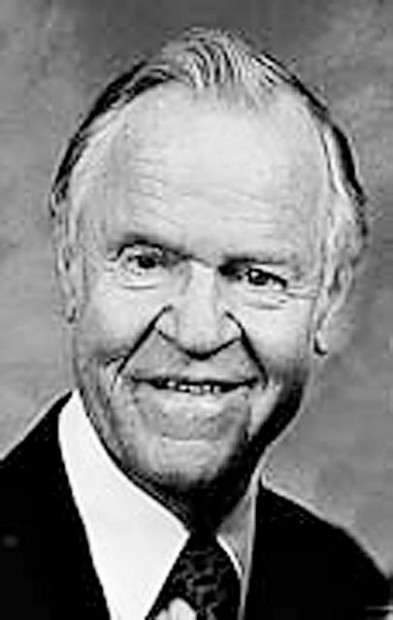
Chaplain Harold Ray Nelson didn't impose his religious beliefs on anyone.
Nor did he preach about sin and repentance.
As founder of the Clinical Pastoral Education program at University Medical Center, he lent an ear, offered counsel and let patients discover the depths of their own spirituality.
He trained thousands of laymen and seminarians to do the same during his 35-year career.
Some patients recuperated and went home. Others spent their last days in the care of hospital staff.
All who connected with Nelson received guidance free of judgment.
Nelson entered his own last days wanting to live but unafraid to die. From his sickbed, Nelson offered blessings to his family — his seven children and his wife of 57 years, Marguerite — and taught those closest to him how to die with dignity.
People are also reading…
Nelson died Sept. 8 from complications of diabetes and heart failure. He was 81.
Nelson was born in Marquette, Kan., to parents active in the covenant church. At 17, he enlisted in the Navy to serve during World War II. After being discharged, Nelson earned a bachelor's degree in geology with a minor in education from Kansas State University.
It was at Kansas State that he met his wife, Marguerite.
Nelson taught high school for a year in Kansas before rethinking his career choice. He felt called to the ministry, his wife said, and enrolled in North Park Theological Seminary in Chicago, where he earned a master's degree in divinity.
He would later go on to earn a master's in pastoral counseling from Northwestern University.
Nelson served as minister at several churches before joining the staff of Chicago's Swedish Covenant Hospital as director of the chaplaincy and ran the Clinical Pastoral Education program. He held the post for 21 years.
It was at Swedish Covenant in 1966 that Nelson met William Killian Sr., then an intern in the pastoral program.
After Killian finished his training, Nelson recommended his protégé for a job in Indiana. Later, after Nelson moved to Tucson, he brought Killian west to fill an opening for a chaplain at Tucson Medical Center.
"Harold is one of the most celebrated leaders in our hospital chaplaincy movement," Killian said. "In terms of awards and honors and leadership, he is The Man."
Nelson was an early leader in the College of Chaplains, now called the Association of Professional Chaplains.
He received the organization's Distinguished Service Award in 1987 and the Chaplain Emeritus Award in 1993.
He was recruited in 1979 by UMC to establish the Clinical Pastoral Education program in Tucson. At the time, there was only one such program in the state, in Phoenix. A year later, Nelson co-founded the Tucson Chaplains Association.
Nelson talked about what students could expect from his pastoral-education classes in a 1979 Tucson Citizen article:
"A lot of time will be spent learning to listen to what patients and families are saying. Those enrolled in the program also gain an understanding of what it is like to be hospitalized, the dynamics of what people go through. They will be exposed to crisis situations and be with a patient and family even at the time of death."
Nelson's approach to counseling was holistic and non-judgmental.
"He wanted the students to minister to the person rather than imposing their agenda on the patient … get into a kind of relationship whereby you utilize the patient's understanding of spirituality rather than yours," Killian said. "It is patient-centered, and you have to get through your own ego and your own baggage and get out of the way so ministry can occur."
Nelson made his position clear in a 1980 Arizona Daily Star article: "The main point is to find a way to reach people and help them through crisis.
"You can't always go up to a person with a problem and say, 'Hey, you need to pray about that.' Sometimes people are too hurt to pray. Sometimes the issues are too clouded to pray.
"What will help people is a relationship in which they can work through one layer of problems and get to the point where they can use those important spiritual resources."
Nelson imparted his philosophy to his children as well.
"One of the things he most taught me was to be very open-minded about all types of people. He was always very accepting of all people," said his daughter, Amy Nelson, of Michigan.
Said his son, Jim Nelson of Phoenix: "He didn't emphasize a denominational spirituality. His spirituality was one that would welcome different denominations."
Nelson continued to reach out to people after he retired to Green Valley with his wife in 1992. He wrote a book, "Senior Spirituality: Awakening Your Spiritual Potential," that was published in 2004 and is still in stores and online.
Psychotherapist Adolfo Quezada knew Nelson for 23 years and has counseled clients who were helped by Nelson's approach and by his writing.
"He was spiritual, yet very practical and very sensitive to the issues of life, death and loss and illness," Quezada said. "He always brought in the support of the spiritual, but not in any kind of heavy-handed way."
Nelson approached his own failing health — diminished eyesight and physical deterioration — the same way.
"When he first dealt with his loss of vision and had to give up driving, it wasn't an easy process," said his wife.
"He never lost hope, but he did adjust his focus. He was fully aware of the indignities that came with giving up independence, and he was ever grateful about whatever he had left.
"As he dealt with one limitation after another, he released anger and any bitterness or self-pity," she said.
Nelson shared his final lesson, not with students but with family and friends.
"He ministered to us in his dying process," Killian said. "He walked us through it almost right up until the end.
"He blessed his children. His bed was placed the way he wanted so he would be facing toward the light. He was grateful for his life and anticipating the journey."
Nelson declined aggressive treatment that may have extended his life, yet, said his wife, "He never lost hope, even at the last."
In a poem Nelson penned in 2002, he wrote: "The best mentor of all is drawn from the timeless wisdom of your own soul."
Said Killian, "Even though he had a passion for life, he was totally accepting of his death."
Life Stories
This feature chronicles the lives of recently deceased Tucsonans. Some were well-known across the community. Others had an impact on a smaller sphere of friends, family and acquaintances. Many of these people led interesting — and sometimes extraordinary — lives with little or no fanfare. Now you'll hear their stories. Past "Life Stories" are online at go.azstarnet.com/lifestories


 Historic bank vault now new Tucson speakeasy