At 86, Sylvia Clayton has seen enough to know that history has a way of repeating itself. On Monday, she became living proof.
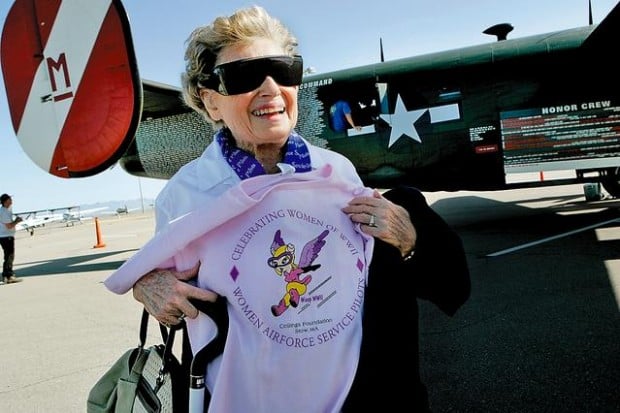
The silver-haired grandmother from Oro Valley cruised above the city in a B-24 bomber for the first time since 1943, when she served as one of America's first female military aviators.
"After all these years, I just love it!" gushed Clayton, steadying herself with a cane after emerging from the World War II warplane she once co-piloted.
"It was very windy and noisy up there," she said, grinning and patting her hair. "Somehow I don't remember it being that bad before."
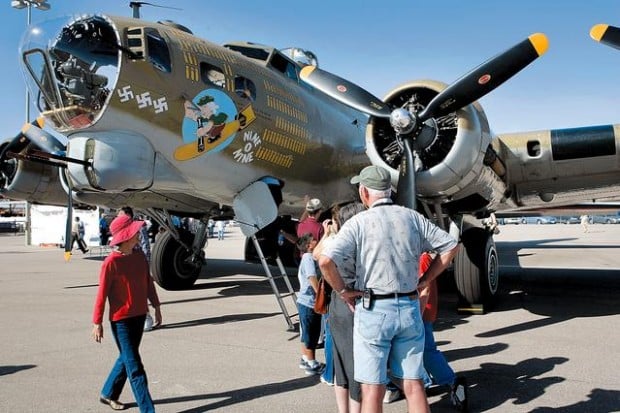
Clayton and other 80-somethings were stars of the show at Tucson International Airport when a trio of World War II warplanes touched down to sell rides to the public.
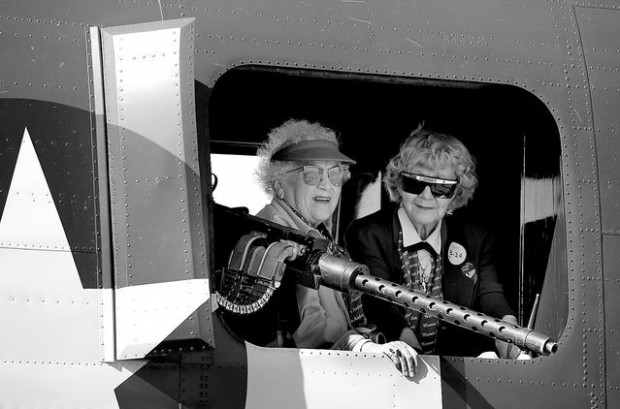
Aboard were a half-dozen former Women Airforce Service Pilots, or WASP— a select group of just more than 1,000 women briefly allowed to fly for the military in the 1940s, when the idea of female pilots was deemed preposterous by many men.
People are also reading…
The Collings Foundation, the outfit selling the vintage aircraft rides for about $400 per half-hour, gave free flights to Clayton and her cohorts on opening day.
The female pilots served their country for two years — from 1943 until the program was canceled in 1944 — and only on domestic flights.
Some, like Clayton, fetched bombers and fighters off factory assembly lines and ferried them to rendezvous points for military pickup.
Others, like Tucsonan Anna White, flew in somewhat more perilous circumstances.
She piloted an AT-6 training plane that was used in target practice for new military gunners.
Her plane towed a target through the air at the end of a rope. Gunners in other aircraft would shoot at it to test their skill at hitting moving objects.
White, now 86, said there was only one close call, when a gunner shot her tow rope by mistake, cutting it and sending the target plummeting to Earth.
She said it never occurred to her then to worry that she might get shot.
"You just had to trust those fellas," said White, who wore flight wings pinned over her heart when she took to the skies Monday.
Passer-by Michelle Sanders of Tucson got tears in her eyes as she lingered to listen to the women's stories.
"Thank you for being strong" said Sanders, 37, gently urging her two daughters, Kali, 9, and Eden, 2, forward to shake hands with the former fliers.
"It's very inspiring to hear about what you went through," Sanders said. "I want my girls to know about you. You're amazing."
Some of the aviators said it seems surreal now to recall the discrimination they once faced because of their gender.
"It's kind of hard to remember how chauvinistic things were then," said Tucsonan Alberta Kinney, 86, who also piloted a training aircraft used in target practice.
Kinney and others said they rejoice each time they hear about strides being made by modern female aviators, such as Lt. Col. Martha McSally of Davis-Monthan Air Force Base, who recently made history as the first woman to lead a fighter squadron in combat.
"It does my heart good to see women going forward in the military," Kinney said.
"If we had goofed up, maybe they wouldn't be where they are today. That was our accomplishment, to prove that women could do it when the men said we couldn't."
● The Collings Foundation is selling rides on a B-24, a B-25 and a B-17 aircraft between 9 a.m. and 5 p.m. today and from 9 a.m. to 1 p.m. Wednesday. For flight information, call 1-800-568-8924.

 Faculty concerned about changes to U of A admissions policy