
They rolled pills, compounded suppositories and ointments, and made their own eyedrops.
"When we took our state licensing exams, we had to make all our powders, ointments and lotions," recalls Yvonne Anderson Windham.
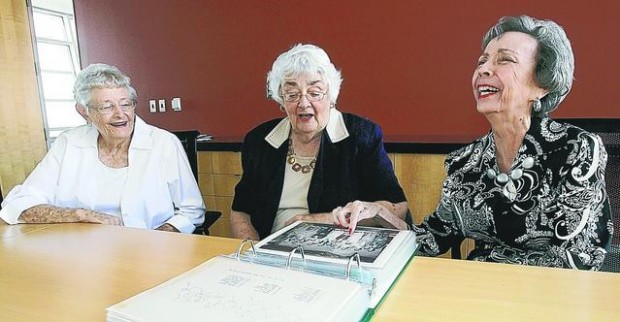
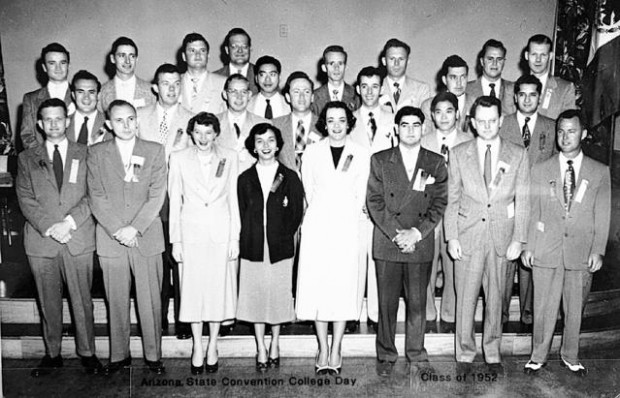
In 1952, Windham, Frances McKinney Duncan and Lorraine Proctor Anderson were all members of the third graduating class from the University of Arizona's College of Pharmacy.
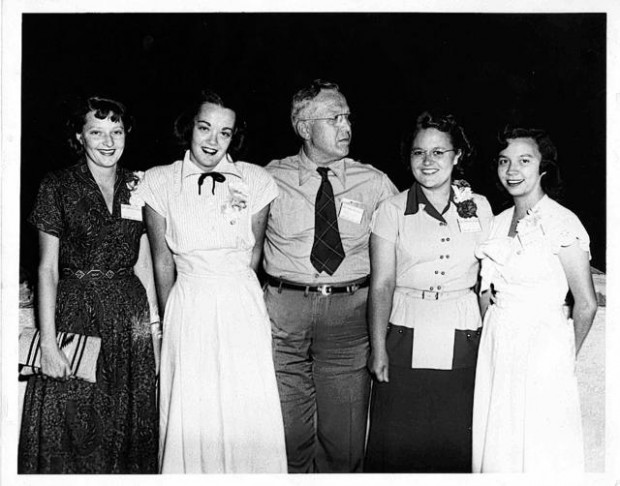
They were its only female graduates in a class of 30 or so. "There were two other women in the class, but they did not graduate," says Windham.
Only a handful of women, including several WACs, had ever enrolled in the pharmacy school, which began in 1947.
Many of the men in the Class of '52 were returning veterans, says Windham. "Most were medics from World War II, and 80 percent were married. We would meet in the basement of Old Main, and they would tell us the most gruesome war stories."
People are also reading…
Windham, Duncan and Anderson all graduated from Tucson High School in 1948, enrolling that fall at the UA.
Organized within the College of Liberal Arts, the pharmacy school was not given separate status as the College of Pharmacy until 1949.
"We went right after high school and went into regular college classes the first two years," says Windham.
She and her two fellow grads, all age 78 now, had varying reasons for enrolling in pharmacy.
"My mother was a teacher, and my dad was a school administrator. I knew every teacher in town," says Windham. "I did not want to be in education."
For Duncan, it was a way to stay off the ranch. "I grew up on a ranch, and I did not want to have anything to do with that life anymore," she says. "We prayed for rain. The bank owned us. Then I heard about this college of pharmacy and thought I'd give it a shot."
For Anderson, now living in Phoenix, it was runner-up to her real goal. "I would have liked to go to medical school, but we could not afford it."
Classes were held in Quonset huts next to Bear Down Gym. Later, the school moved to the Chemistry and Physics Building.
The classes, says Anderson, "were challenging." And long, running six days a week.
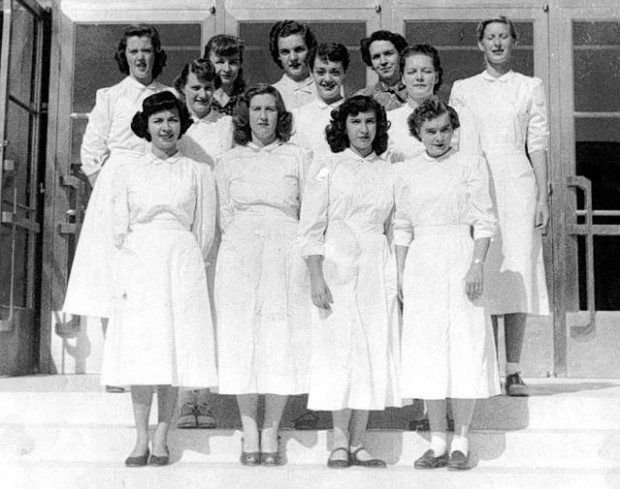
Dress was informal until 1950, when pharmacy Dean Haakon Bang put in a dress code, forbidding Levi's for men and mandating white, nurselike uniforms for women.
That sparked a retort from the Arizona Daily Star, defending Levi's as cheap, sturdy and "part of the tradition of the Wildcat school."
The dean was unmoved.
All three of the women got jobs after graduation. Anderson worked briefly at Martin Drug Stores in Tucson, then worked at a hospital pharmacy in Flagstaff. In the early '60s, she moved to Phoenix and worked there.
"It was a whole different type of pharmacy," she says. "I remember soaking and washing the bottles thoroughly and then reusing some of the bottles for prescriptions."
Windham and Duncan both headed to Phoenix after graduation, rooming together and getting jobs as hospital pharmacists — Windham at Memorial Hospital, Duncan at Good Samaritan. Starting pay was less than $400 a month.
"I worked in the basement," says Duncan. "We shared it with central supply. It was down in the dungeon."
After a few years, both were back in Tucson, where Duncan worked for Matthias Pharmacy and Windham worked first at the old Pima County Hospital and then at the Ryan-Evans chain.
Those were the days when drugstores were hopping with customers, at both the lunch counter and the cosmetics counter. "Grocery stores weren't even carrying toothpaste back then," says Windham.
Meanwhile, attire for the pharmacists, says Duncan, was often a starched shirt with a high neck. "You felt like your neck was going to fall off."
Both Windham and Duncan remember when condoms were kept in a drawer in the back of the pharmacy.
"Some guys would stand there for an hour, waiting for a man to appear," says Windham.
Doctors' handwriting also had to be deciphered at times.
"We would call them up, and sometimes they were not too nice about it," says Windham.
"But we had to make sure we were giving patients the right thing," adds Duncan.
All three women married and had children during their careers, sometimes taking off work for a time.
"It was a great job for a woman with a family, because she could always work part time," says Duncan, who moved back to Phoenix and worked from 1971 to 1992 in a professional pharmacy.
Windham retired in 1996 after 15 years with Pima County. Duncan, who moved back to Tucson in 1992, worked for a couple of years for Drug Emporium, then retired. Even so, she continued to work as a temp everywhere from Morenci to the Wilmot prison.
Anderson, who worked for two decades as a pharmacy manager with Walgreens in Tempe, retired in 1990.
Only she has a child who followed in her footsteps — a daughter and UA grad who works at a women's compounding pharmacy.
DID YOU KNOW
The Pharmacy Museum at the University of Arizona's College of Pharmacy contains more than 60,000 bottles, books and artifacts from Arizona, dating from 1880 to 1950, including several wads of Black Jack gum reportedly chewed by bank robber John Dillinger and left beneath the counter of Tucson's old Owl Drug Store.


 Second wall planned across Arizona as Trump administration doubles down on border