
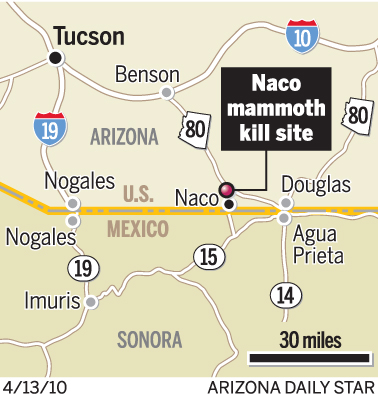
More than 10,000 years ago, a group of prehistoric humans stalked a 10-ton mammoth through moist grassland near what is now Naco. Then, in a bold move, the humans attacked the 13-foot-tall tusked beast, thrusting eight stone-tipped spears into its ribs, neck, chest and back.
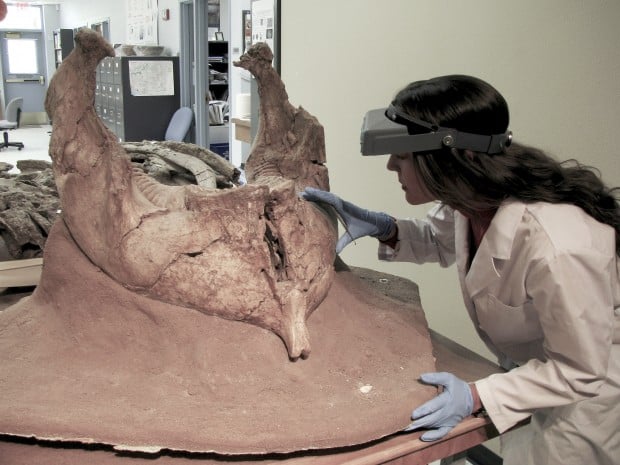
While the Columbian mammoth escaped the fray, it didn't get far, and its remains, riddled with spearheads, are now on display at the Arizona State Museum.
"The Naco site is arguably the best evidence for human killing of a mammoth in the world, in all of human prehistory," said Jesse Ballenger, a doctoral student in the University of Arizona School of Anthropology, whose thesis is on the topic.
The display is part of the museum's Ice Age Arizona exhibit, which opened on April 1 and also features spearheads from the first people to enter North America, known as the Clovis people.
People are also reading…
It is thought that the Clovis people, named after the first site where their artifacts were found, near Clovis, N.M., followed game, including mammoths, across the Bering Land Bridge, which connected Siberia to Alaska. The prehistoric humans then made their way south.
"They were in a new world; if there were any people here before them, they were scarce," said C. Vance Haynes, professor emeritus in the UA School of Anthropology. "These people were exploring."
The exhibit also displays photographs of Emil Haury and his team of students excavating the site in 1951. The late archaeologist Haury was then the director of the state museum. The Naco site was the first evidence of Clovis people uncovered in Arizona and one of the first in North America.
"It really put Arizona on the map as far as Clovis archaeology goes. They really added to our original understanding of Clovis, because there just weren't that many sites," said Vance T. Holliday, a UA professor of anthropology and geosciences.
Over the years, another five Clovis sites were uncovered in the San Pedro Valley, giving Arizona the highest concentration of such sites anywhere in North America.
However, the Naco site remains one of the most important because of an approximately 3-by-3-foot block cut and preserved from the site that shows Clovis spearheads in and among mammoth bones.
Typically, it is difficult to find conclusive evidence that humans killed a mammoth and didn't just scavenge an already dead carcass, Ballenger said.
"When archaeologists excavate these sites, we don't see the whole picture; we have fragmented pictures," he said. "In most cases, we can't show that people actually killed the mammoth."
For this reason, the archaeologists at the Naco site knew they had discovered something monumental, said George Cattanach, the last surviving member of the excavation team.
"The significance lies in proving conclusively that these points were associated with the mammoth and seemed to undoubtedly indicate that the mammoth was killed by these points," he said.
Soon after the Clovis people arrived in North America, many species of animals, including the mammoth, the saber-toothed cat and giant ground sloths, became extinct. The cause of their demise is unknown, but some believe that the Clovis people may be responsible.
"That's been an ongoing debate for 50 years. What caused the extinction? Is it just coincidence that human hunters show up in the country at the same time that mammoths and many other large and small animals go extinct?" Ballenger asked.
Others attribute a drastic climate change, and a recent theory suggests that a comet or asteroid impact may have wiped out the prehistoric creatures.
Whatever the cause, these animals no longer are with us, but their remains can still teach us about the history of the first people in North America, said Nancy Odegaard, conservator and head of the Preservation Division at the museum.
"The big deal is that Naco represents the very best evidence of the interaction of people with the mammoths in the world."
On StarNet: Find more coverage of science and technology at azstarnet.com/news/science
If You Go
• What: Ice Age Arizona exhibit and lecture series.
• Where: Arizona State Museum, 1013 E. University Blvd.
• When: Through Oct. 15, with remaining evening lectures this Thursday and April 22.
• Cost: Admission to the exhibit is $5 for adults; free for UA and Pima College staffers and students. Lectures are $10 each.
• For more information: 621-6302, www.statemuseum. arizona.edu
DID YOU KNOW
Some of the mammoth bones were originally prepared to go on display at the now-defunct downtown arm of the Arizona State Museum as part of the Rio Nuevo project. Conservators at the museum recognized that the bones still would need to be conserved and planned the current exhibit to display them to the public.
Contact NASA Space Grant intern Otto Ross at 573-4125 or oross@azstarnet.com



 U of A acceptance rate rises to 90% as applications plunge