
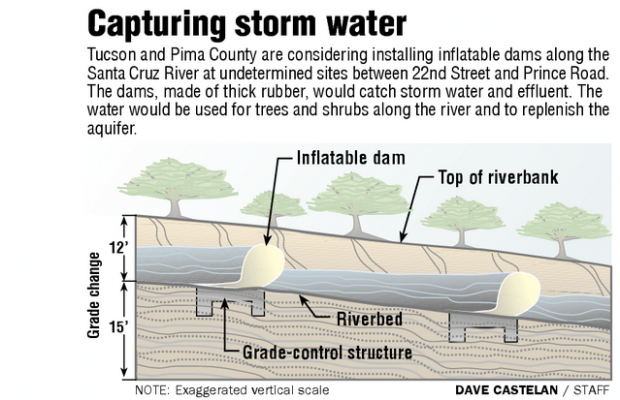
Local governments are considering building inflatable, rubberized dams along the Santa Cruz and Rillito rivers, to capture rainwater runoff and treated sewage effluent.
The water would be used to replenish the aquifer, and to restore the rivers' once-lush natural environments. However, the idea has several potential problems, including environmental concerns, that would need to be addressed.
Tucson and Pima County are studying the possibility of building such dams, partly to improve the Santa Cruz's appearance as part of the Rio Nuevo Downtown rehabilitation project.
The study was started before the latest storms that sent huge flood flows along both rivers.
But with this week's floods on their minds, officials hope that the dams could capture some storm water in the future before it leaves for Marana and southern Pinal County.
People are also reading…
The balloonlike dams would not be able to capture all the rushing water during storms as large as this week's, because they aren't strong enough.
It's also not technically feasible to build a large concrete dam such as those along the Colorado River to capture all the storm water, according to Suzanne Shields, the county's flood-control chief.
But dams made of the same material as old inner tubes — but much thicker — to capture smaller amounts of water may be feasible, officials say.
The cost and number of such projects are unknown. Shields said she hopes to take a proposal to the Board of Supervisors next year.
While the current studies are looking primarily at the Santa Cruz, officials hope that the effort could ultimately be expanded to include the Rillito.
Authorities have studied or are looking at placing the dams in two areas on the Santa Cruz:
● From 22nd Street north to St. Mary's Road.
● From St. Mary's north to Prince Road, which would be close enough to the Roger Road sewage plant so treated effluent, or reclaimed water, could be pumped into the river.
About 10,000 to 12,000 acre- feet of water a year leave the Tucson area via the Santa Cruz, and much is used by downstream farmers, Tucson Water officials say. An acre-foot is enough water to serve about three families a year.
"We've got two significant sources of water that are disappearing out of our control," said City Councilman Steve Leal, who is pushing the idea. "We should take a look at how we capture both in our aquifer, so we have access in the future."
Whatever is done here would not be a replica of Tempe's $40 million Town Lake, officials say. That lake holds Central Arizona Project water that is pumped into the river, then repumped from underground after it seeps into the aquifer.
The Tucson dam project would capture rainfall runoff and treated reclaimed sewage water from above ground.
Town Lake has dams running 14 to 16 feet high, but those in Tucson would presumably be much smaller because the Santa Cruz and Rillito rivers are much narrower than the 1,500-foot wide Salt River in Tempe, and not as deep.
The dams would have to be tough enough to withstand the elements — which are now wearing down Town Lake's dams faster than expected — and be puncture-proof.
But obstacles stand in the way of these projects, Tucson Water officials say. They include the need to obtain water rights, now owned by downstream farmers, and the possibility that recharging the water may unearth toxic chemicals now buried in long-closed landfills along the Santa Cruz.
A preliminary Tucson Water report recommended against recharging storm water or effluent in the Santa Cruz channel. It suggested putting recharged effluent in basins outside the main river channel.
"You really have no rights to impound that water," said Tucson Water director David Modeer. But he said, "If you could reach agreement, anything is possible."
Other city and county officials say they will continue to pursue the idea of building the dams and try to overcome the obstacles raised by the study. Even that would require more detailed feasibility studies.
"Everybody understands there are complexities and problems and we might not be able to overcome all those problems along all places of the river. But there might be sections where it is worth taking a look at," Leal said. "I don't think we can stand by and waste 10,000 acre-feet of water a year.."
One reason the county is interested is that it has captured storm runoff at its 125-acre Ajo Detention Basin and Kino Environmental Restoration Park, north of Ajo Way near Country Club Road. The basin recovered 195 acre-feet of storm water in 2004 and 343 acre feet in 2005 for use on trees, shrubs and the ballfields in various sports parks.
While dams could draw mosquitoes if the water stays stagnant, the Ajo basin project uses pumps to recirculate the water. The river dam projects could do the same, said Shields.
But the presence of contaminants in nearby landfills and in surrounding Downtown areas is the biggest obstacle to any kind of river recharge or dam project, said the Tucson Water report. Toxic chemicals such as trichloroethylene and the dry-cleaning solvent perchloroethylene have been found in two landfills on the Santa Cruz's west bank, the report said.
In addition, the aquifer under Downtown is contaminated by diesel fuel from old railroad operations, Modeer said.
Recharge of water into the river and the aquifer could alter the size and extent of these contamination plumes, the report said.
As for water rights, the county hasn't had a problem obtaining them for the Kino restoration project because that water would probably never get downstream to Pinal County, Shields said. For the same reason, officials could choose to dam only the water from tributaries, to avoid that problem, she said.
Modeer isn't convinced. ". . . I don't know what downstream users would say," he said. "It's not our water."
"It's not a waste," Modeer added. "It goes to ag users."

 U of A president declines to sign shared governance contract with faculty