The new Buffalo Bills stadium will be one of the biggest public investments ever in the Buffalo Niagara region.
With state and county taxpayers on the hook for $850 million in upfront construction costs, and $280 million in ongoing maintenance and operating costs over 30 years, the funding package will be worth about 15% more than the state spent to build the Tesla plant in South Buffalo, which now employs 1,600 people.
Sports economists and stadium experts say that's the price the region had to pay to keep the Bills, but whether it is a good deal for taxpayers is up for debate.
“These stadiums have become outlandishly expensive,” said Victor Matheson, sports economist at the College of the Holy Cross.
“Owners would never build these stadiums that way themselves – at least in most cases," he said. "You certainly wouldn’t build a stadium like that in Buffalo without someone footing most of the bill.”
People are also reading…
Kevin Reichard of Football Stadium Digest believes securing a deal was important for Bills fans who feared losing their team. But he also thinks it was a miss to not move the stadium downtown or where spinoff development would have been easier.

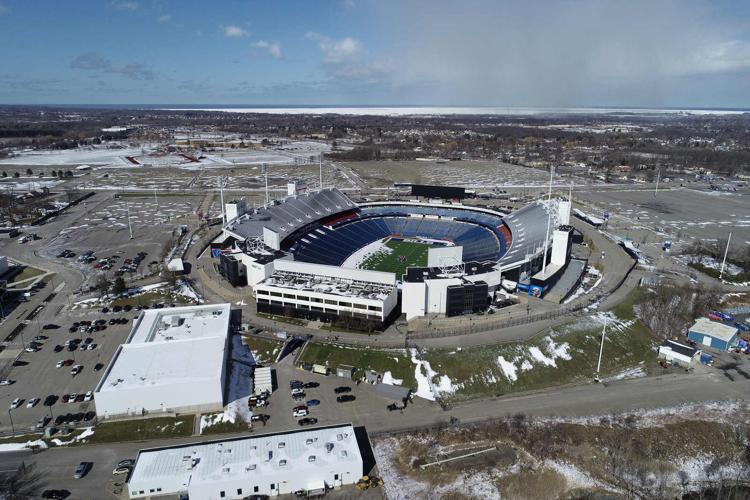
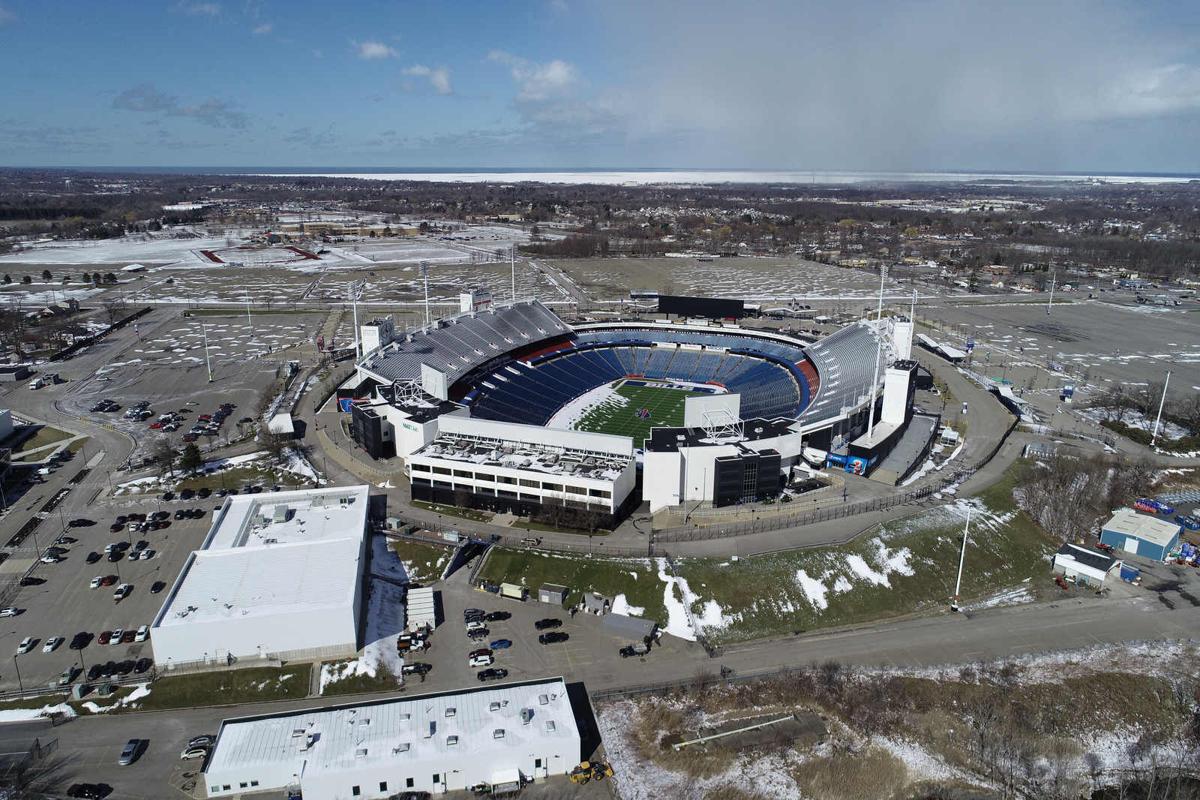
An aerial view of Highmark Stadium in Orchard Park, Tuesday, March 29, 2022. (Derek Gee / Buffalo News)
Reichard doesn’t see additional investment flowing to areas around the stadium or any greater use of the facility because it is planned for a site across Abbott Road – and little spinoff development has occurred since the team moved to Orchard Park in 1973.
As part of the agreement, the public would pay $850 million in upfront construction costs for the $1.4 billion stadium project. The state also would pay $280 million over 30 years to cover annual maintenance and repair costs.
“Looking at the big picture, it just seems it’s a very retro plan, designed to placate existing ticket holders,” Reichard said. “They’re missing out on the chance to leverage $850 million of public spending on a greater economic impact.”
While the Bills never pushed for a downtown stadium, as recently as this past weekend the Buffalo chapter of the NAACP and the Bills in Buffalo group were continuing to push for the stadium to be built downtown to have greater economic impact.
A downtown stadium would have cost an estimated $1 billion more than in Orchard Park, according to consultant reports.
Building the stadium in Orchard Park will be "one of the most short-sighted and irresponsible uses of taxpayer dollars in New York’s history," the Bills in Buffalo group wrote in a letter.
Another group, Business Backs Buffalo Football applauded the deal. One of the main focal points of the group has been to keep the team in Western New York for the long haul, according to Matt Davison of The Martin Group, who is chairing the organization.
Combined with the team’s recent success – making the playoffs the past four of five years – and its star power with quarterback Josh Allen and newly signed defensive end Von Miller, this is an even bigger win for the area, Davison said.
“I would argue that no NFL team is more important to their community than the Bills are to Western New York and upstate New York,” Davison said. “It seems like it is all coming together at a good time.”
Fear of team leaving
That wasn’t always the prevailing feeling in Buffalo.
When Ralph Wilson Jr. died in March 2014, fears grew that the team would leave town.
"There was a real concern in Buffalo, especially after Ralph Wilson passed away,” said Nellie Drew, a professor of sports law at the University at Buffalo. “That was when we were really at risk of losing our team.”
But Terry and Kim Pegula, who already had a stake in Buffalo by owning the Sabres, stepped in and bought the team later that year, bringing some relief to Bills fans.
When it came time to negotiate a new stadium deal over the past few years to replace the five-decade-old structure in Orchard Park, those fears returned again, to some degree.
It was only recently revealed by Hochul that the Pegulas were frustrated with the inaction of the state on a potential deal. Covid concerns ruled the day for most of 2020 and 2021 and former Gov. Andrew Cuomo was dealing with sexual harassment allegations that eventually led to his resignation.
Cities have lost their teams
Three NFL franchises have moved since the Bills last negotiated a lease deal in 2012 for their current facility, Highmark Stadium, so the long process of completing a deal was far from a given, according to Erie County Executive Mark Poloncarz.
“This ensures the Buffalo Bills will be the Buffalo Bills through at least my lifetime and people who haven’t even been born yet will be able to enjoy the Bills,” said Poloncarz, who’s 54. “We’re keeping the team in town when other places have lost their teams.”
The NFL teams that have relocated in the past six years are the St. Louis Rams to Los Angeles in 2016, and the Oakland Raiders to Las Vegas and San Diego Chargers to Los Angeles, both in 2020.
Drew said this deal is typical of the type of subsidies small market teams receive to build a new stadium. With Buffalo being the NFL’s second smallest market and the 49th largest metropolitan area, the Bills held much of the leverage in the negotiations.
While it exceeds the past high of government subsidies given for a new stadium – the $750 million that went toward the building of the $1.9 billion Allegiant Stadium in Las Vegas for the Raiders who were moving from Oakland – it is not the highest percentage of a public share for a new NFL stadium built over the past two to three decades.
Warren Sharp, an NFL analyst, said there are nine franchises that have received a higher percentage of public subsidies when their stadiums were built.
They include Tampa Bay, which had 100% of its stadium that opened in 1998 paid for by the public, followed by Cleveland (94%), Baltimore (90%) and Indianapolis (86%). All of those stadiums were built before the first billion-dollar stadium was completed in 2008 for the Dallas Cowboys.
Drew is glad that this process didn’t play out for Buffalo like it did for St. Louis, which lost its team over a disagreement about funding for a new stadium and, according to the team's owner at the time, a lack of resources and backing to maintain a team. The Rams had spent 21 years in St. Louis.
Team ownership rejected being responsible for at least $710 million in private financing of a new stadium, with $355 million coming from the public, as was being proposed, according to reports.
“Whether you like it or not, this is the way the market works right now,” Drew said. “I watched the St. Louis situation play out over a period of years. It’s the classic example of how not to do a stadium deal.”
Value of a team
According to Matheson, the value of a team to its fan base can be estimated through hard-to-quantify measures that take into account ideas like the civic pride that comes with having a team and being able to go to games.
A study conducted in Jacksonville with Jaguars fans before they built a new stadium two decades ago found that the fan base valued their team at about $80 million in government subsidies.
While it may be higher for the Bills because there is more of an attachment to the team in Western New York, that number still would not come close to $850 million, Matheson said.
“There’s tons of things that economists can value easily, and we’ve thought about ways to do it and the people who have done it have not found intangible value that’s immeasurable,” he said.
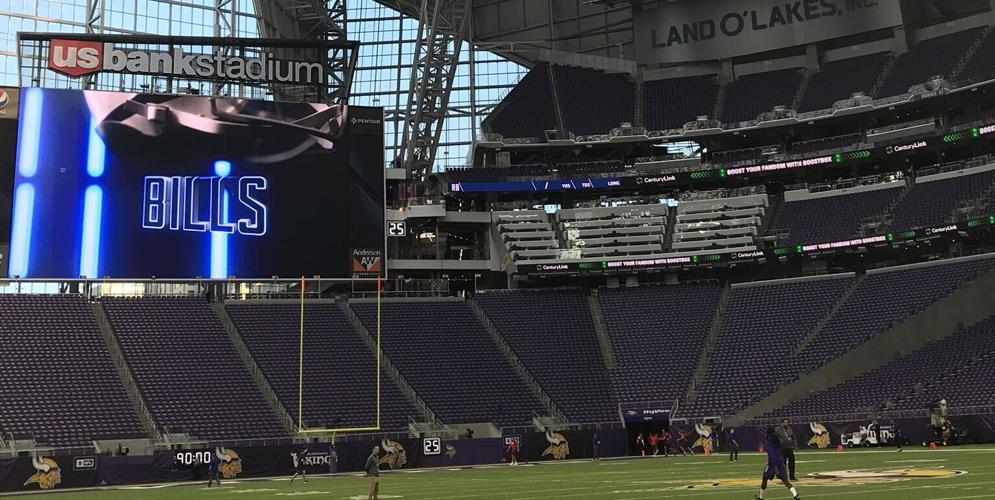
Reichard lives in Minneapolis where he has a front-row seat to all the development that has popped up around U.S. Bank Stadium since the Minnesota Vikings downtown facility was completed in 2016. The difference in the stadium’s surrounding area from the days of the Hubert H. Humphrey Metrodome have been “breathtaking,” he added.

Minneapolis has seen changes to its downtown area after building U.S. Bank Stadium there.
“What used to be a sea of grungy warehouses and surface parking is now filled with condos, restaurants, a theater, parks and events,” Reichard said. “There has been a definite impact on downtown Minneapolis.”
Davison said he would argue that Western New York has already benefited more from the Bills being in town than almost any other NFL city, pointing to the philanthropic efforts of the Ralph C. Wilson Foundation. Also, the John R. Oishei Children's Hospital received more than $1 million in donations from Bills fans following the death of Allen's grandmother, Patricia Allen.
“That hasn’t happened in any other NFL community,” Davison said. “When you think about that, I think the taxpayer investment makes more sense.”
Drew credited the commitment of the Pegulas to Buffalo in agreeing to a non-relocation structure in the tentative deal, prohibiting the team from moving. If the team is allowed to move by a court, it must pay back all Erie County and state contributions in full during the first 15 years of the deal. The relocation payback declines for the final 15 years, according to Poloncarz. The Bills would also have to pay to demolish the stadium.
Documents outlining the terms of the tentative deal between the Pegulas, New York State and Erie County have not been released.
“Certainly, it’s a lot of money, but I think relative to marketplace and what we’ve seen elsewhere, it’s a pretty fair deal," Drew said. “The big piece for Bills fans across Western New York is that it is being described as an ironclad non-relocation agreement. And that’s huge.”