

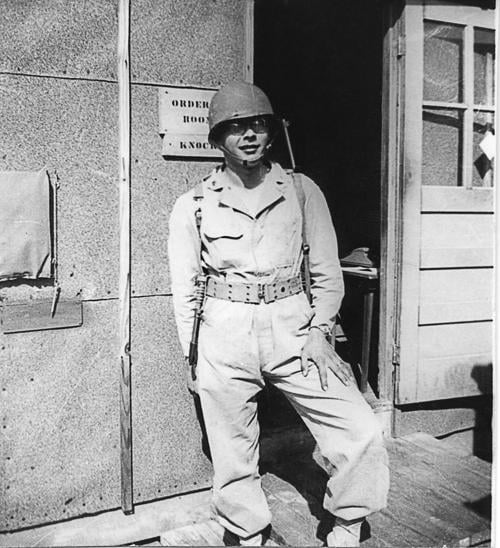
Former Star reporter Sara Hammond shares the story of her father, U.S. Army infantryman Carroll “Sam” Sammetinger, on this Memorial Day:
Dear Dad,
I’m thinking of you on this Memorial Day, as I do every year, and of course on many days throughout the year. But this special day is a time that was set aside a few years after the death of your hero, Abraham Lincoln, to specifically honor the soldiers lost in the Civil War (in which your great-grandfather fought in the Union Army).
That tradition has continued for 153 years. It used to be called Decoration Day because families placed flowers on their loved ones’ graves in the spring, as they still do.
While this day’s purpose is to honor those killed in battle, it’s not too far fetched to remember and honor the sacrifices made by all those who have served in our country’s armed forces — including Mom, who also wore Army boots!
People are also reading…
And I can’t help but think that your experiences while a U.S. Army infantryman — years of training, a voyage across the Atlantic Ocean, several months waiting on the English coastline before arriving at Normandy just 49 days after the D-Day invasion, seeing combat a mere eight days later, fighting the Axis armies through France, Belgium, Holland, Luxembourg and finally into Germany during the Battle of the Bulge where you were captured — took a toll on you and shortened your life.
But how do I know all this? You, like many, many veterans of that time — and perhaps in wars since — just didn’t talk about it.
Your stories are lost to the ages, and what we know is put together like a jigsaw puzzle, from documents, and records, and a few oral histories shared by veterans later in their lives, after the horrors of war had dimmed.
But you, the history major, did keep some written records in your hand. For years, I wondered how you got the thin notebook where you kept notes. Did you receive it after you were released and put together the timeline from memory?
Alas, I got an answer to that question just a few weeks ago as a participant in the National World War 2 Museum’s online class: “Captive: American POWs in WWII.” The notebook likely came in a Red Cross parcel, provided to prisoners of war through agreements among the warring nations.
The Museum graciously accepted a select few of Lt. Carroll E. Sammetinger’s military artifacts — the diary, your correspondence, several cigarette cases fashioned out of ration tins by fellow Russian prisoners. The Museum posted your Dec. 24, 1944, letter home to your parents from Stalag 11B on its Facebook page a few years ago at Christmas.
I can’t wait to visit the New Orleans museum later this year to help fill out your story, Dad.
So what of your time in uniform, once you knew you were headed to Europe and likely battle? Again, your history education at The Ohio State University equipped you to keep what records you could.
I am especially grateful for the business-sized cardboard card on which you recorded each locale you passed through, from your arrival in Glasgow, Scotland, to landing at Normandy, and making your way toward the momentous battles of the Hurgten Forest and the Bulge.
Marking your capture with a line of “x x x x x x” across the card, you then chronicle the journey as a prisoner at Stalag 11B in Bad Fallingbostel, a hamlet about halfway between Hanover and Hamburg.
Your diary records two arrivals at 11B, with 13 days in between at Dulag Tarmstedt, a naval transit camp near Bremen. Another mystery to be solved! But I can only guess that the Germans at that point had so many Allied prisoners they had to place them where they could.
Throughout those cold months from January to March 1945, you wrote:
Jan. 21 – Went to church – dreamed of home
Feb. 21 – Bath & New Clothes
Feb. 27 – Black Tuesday
No parcels
No potatoes
7 men per loaf of bread
News however is good
But — I have been thinking of home for 3 days
March 6 — Red Cross Parcel!
Took a walk — damned tired
Cigarette case — Russian — 12 cigs for it
News is good
March 9 — Good News
Good news? How did you come by it? Ah, I think I have a clue. While you didn’t talk much about your experiences, your British fellow POWs, Jimmy Whiteing and Albert Bibby, did. You only saw these chaps one time after the war — in 1976 when you and Mom traveled to Britain. But I was fortunate to see them nearly a dozen times between 1973 and 2000, by which time both of them had died.
Jimmy and Albert had been in Stalag 11B for several years before you arrived. I don’t remember the circumstances of their capture, but I do recall they felt the Germans found them trustworthy enough to allow them passage between the various barracks at the prison camp, trusted intermediaries between the camp officials and the prisoners.
My favorite story is this — and it ties in nicely to your “good news” entries.
The French prisoners somehow cobbled together a radio, hidden under the floor boards of their barracks. This was confirmed in the POW class I just completed and also in photographs I saw when my husband Dave and I visited the Stalag 11B museum at the site of the prison camp in 2015, the 70th anniversary of the camp’s liberation.
As Jimmy and Albert told me, the French prisoners would pick up snippets of news. Someone would write the news on a slip of paper (I don’t know in which language, but I assume it was English as the broadcasts were likely from the BBC). One of the English chaps would slip the paper in his shoe, and while making rounds delivering scarce firewood or other provisions to the barracks, drop off the news bulletin.
Now that may sound farfetched, but I remember many evenings watching “Hogan’s Heroes” with you … and what did the French prisoners have in their barracks? Yes — a radio!
You may have already left 11B by the time this happened, but another recollection from Jimmy and Albert is this: As the Allied troops were pushing ever eastward, the German prison camp guards — many of them veterans themselves who had been wounded in the war or were too old to serve in combat — became fearful, realizing the end was near. The prisoners awoke one morning in April to find the guards gone. Gone! The prisoners got ahold of paint and wrote “POW” atop the barracks so the Allied aircraft would not strafe the building and wound or kill the prisoners.
When we visited the 11B museum, sure enough, there were photos of the barracks’ roofs with “POW” painted on them.
By April 5, you “received orders to leave Stalag XIB,” and the next day, you left for Brunswick (Braunschewig) and Oflag 79, an officers’ camp from which your liberation would come.
From your diary, April 12:
It’s now about 1630, and I shall attempt to capture the day —
Up early and had a brew of coffee
Up to the roof with Nick when we spotted (illegible), the Yanks had arrived. It was an awe-inspiring sight. The Kriegies (slang for prisoners) had tears in their eyes.
How can this sort of thing be put on paper
Wrote home …
Your service did not end with your arrival back in the United States, for which I am thankful.
You were assigned to Fort Indiantown Gap in central Pennsylvania where your duty was to discharge returning service members, including your own brother.
You chose enlisted WAC Audrey Goyer to be your clerk, and the rest is history. Mom had been training to be a cryptographer and would have been sent to the Pacific Theater when the war finally ended there.
After your discharge, you went to law school on the G.I. Bill and set up a one-man legal practice in a tiny farm town in central Ohio. Perhaps your fellow American Legion members knew of your time as a POW, but most of the townspeople were not aware until you got a POW license plate from the state of Ohio a few years before your death in 1985.
I do recall that one Thursday afternoon (I was in junior high, maybe) — you took Thursday afternoons off and worked Saturday mornings — when you had pulled your Army footlocker (which I still have) out of the storage area above the washer and dryer. All of the artifacts came out, we looked at them and you probably talked a little about them. Then they were all packed away.
But your heroism and bravery and tenacity is forever remembered.
Sara Hammond is a retired journalist and public relations professional. She was a business writer at the Star from 1993 to 2000.



 Tim Steller's column: New info justifies recall against Sheriff Nanos


