

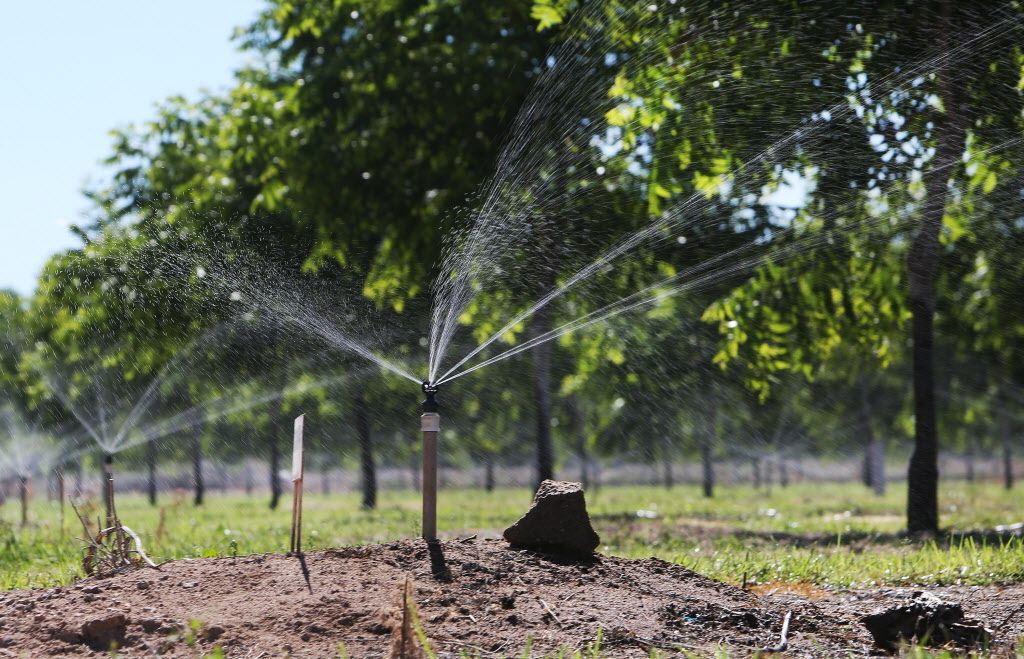
Agricultural pumping can continue without limits in the far corner of Southeast Arizona.
The Arizona Department of Water Resources has denied a petition from five major growers that the Bowie-San Simon area be closed to new irrigation. The request had touched off a bitter, emotional conflict in which those growers were denounced as “tree barons” and monopolists as they fought new landowners and potential new irrigators from drought-stricken California, Phoenix and other places.
Wednesday’s state order was a big victory for dozens of landowners in that area who said the big growers were trying to squeeze out smaller ones. The big growers said they feared an influx of new farmers would threaten the stability of the aquifer. Opponents feared their property values would crash because they wouldn’t be able to sell their land.
It also means that a temporary freeze on new irrigation triggered by the filing of this petition last March will be lifted once the decision becomes final, which could happen by mid- to late September.
People are also reading…
Among the petitioners was Farmers Investment Co., the Sahuarita-based pecan grower that cultivates the same crop near San Simon, about 100 miles east of Tucson. The decision affects the San Simon Valley Sub-Basin, covering about 1,930 square miles across parts of Graham and Cochise counties and a small section of southwest New Mexico.
More than anything, however, the state order shows the limits of Arizona’s pioneering Groundwater Management Act of 1980 in regulating irrigation away from population centers. Restrictions on pumping are much tougher in urban areas such as Tucson and Phoenix that are governed as “active management areas” with conservation requirements.
Kathleen Ferris, a Phoenix attorney who chaired the state commission that wrote that law, said last week that the water department’s hands in this case were tied by the law’s language. “Maybe we weren’t foresighted enough to anticipate what would happen,” added Ferris, formerly a state water director and now executive director of the Arizona Municipal Water Users Association.
“This situation is an example of something I’ve been wrestling with for some time: How do we find the right balance between existing and new uses of water?” Ferris said. “It’s something we as a state will have to deal with in ever-increasing ways in the near future.”
In his decision, State Water Resources Director Tom Buschatzke said the law requires petitioners to show “insufficient groundwater to provide a reasonably safe supply for irrigation of the cultivated lands in the area at the current rates of withdrawal.”
Buschatzke concluded the opposite is true, as opponents had argued all along. The department found the sub-basin has enough groundwater to support continued irrigation for at least 100 years, although state law doesn’t require the agency to look that far ahead, Buschatzke wrote.
In some areas, impenetrable bedrock beneath water-bearing aquifers is relatively shallow. But the aquifer is about 8,000 feet thick south of the town of San Simon and about 6,000 feet near unincorporated Bowie, Buschatzke said.
Across the sub-basin, water levels declined only an average of 1.7 feet a year since 2007, although petitioners said water levels have declined much faster in areas of heavy pumping.
Buschatzke refuted those who argue that a lot of acres with newly planted pistachio and pecan trees will need more water as they mature.
A typical commenter along those lines was Raj Rajendran, a Bowie-area landowner who bought 160 acres in 2012.
“During that time, only cows were enjoying the ranch land,” Rajendran wrote to the state. “Not a sight of farmland around me. Properties stayed on the market for years before any sale. ... So this made it feasible for a small farmer like me.”
But starting in March of this year after the petition was filed, but before the state temporarily shut off new irrigation, “the world woke up overnight and people bought properties around me ... and began clearing the land with big bulldozers,” he wrote, adding that 1,000 acres near his property have been cleared and about 2,500 acres are under sales contracts.
“I will be the first to see starving trees for water in South Bowie if more wells (are) drilled and pumped by other farms in the San Simon Valley since my farm is located at a higher elevation,” he wrote.
“Who will be responsible if small farmers like me run out of water?”
But Buschatzke wrote that state law is clear: He must consider only current rates of withdrawal, “and may not speculate about or try to predict how rates of withdrawal will change in the future.”
Cheering his decision was Lee Storey, a Phoenix attorney who represented growers and other landowners who opposed the petition. Concern about impacts of future farming is misplaced, said Storey, because farming activity in that area is a fraction of what it was in the 1960s and ’70s.
“There was no indication in 1960s there was a water problem. Even if agriculture increases in the San Simon basin, there’s a long way to go before it reaches where it was then,” Storey said. “In other words, there’s room for growth.”
Dennis Krache, an opponent of the petition, now hopes he can sell his land south of San Simon — a sale he put on hold after the petition forced a hearing on the irrigation limits. At 89, he farmed the area for many years until his wife became ill in the 2000s.
“The way they put the petition in stunk. They’re taking the water away from a lot of people,” Krache said.
“The whole deal was phony, but I’m glad they ruled against it.”
Farmers Investment Co. President Dick Walden commented, “Naturally, I’m disappointed for the farming community and I’m disappointed for the water resource. We all know we need to balance our resources. Farmers all know they can’t eat their seed corn.”
It’s premature to say if another petition will be filed if more new irrigators move in, added Walden. He said his allies have to do a lot more public relations work with the community to gain consensus.
Ferris said she doesn’t know if the state law needs changing, but said that anytime water users are fighting over a limited supply, it suggests that things are not quite right. As new pumping happens, competition for groundwater will keep increasing, said Ferris.
“In the long run, as we’ve seen in California, it’s better to address groundwater management in advance of a dire condition rather than wait for it to happen.”




 For sale: Tucson's Park Place mall


