
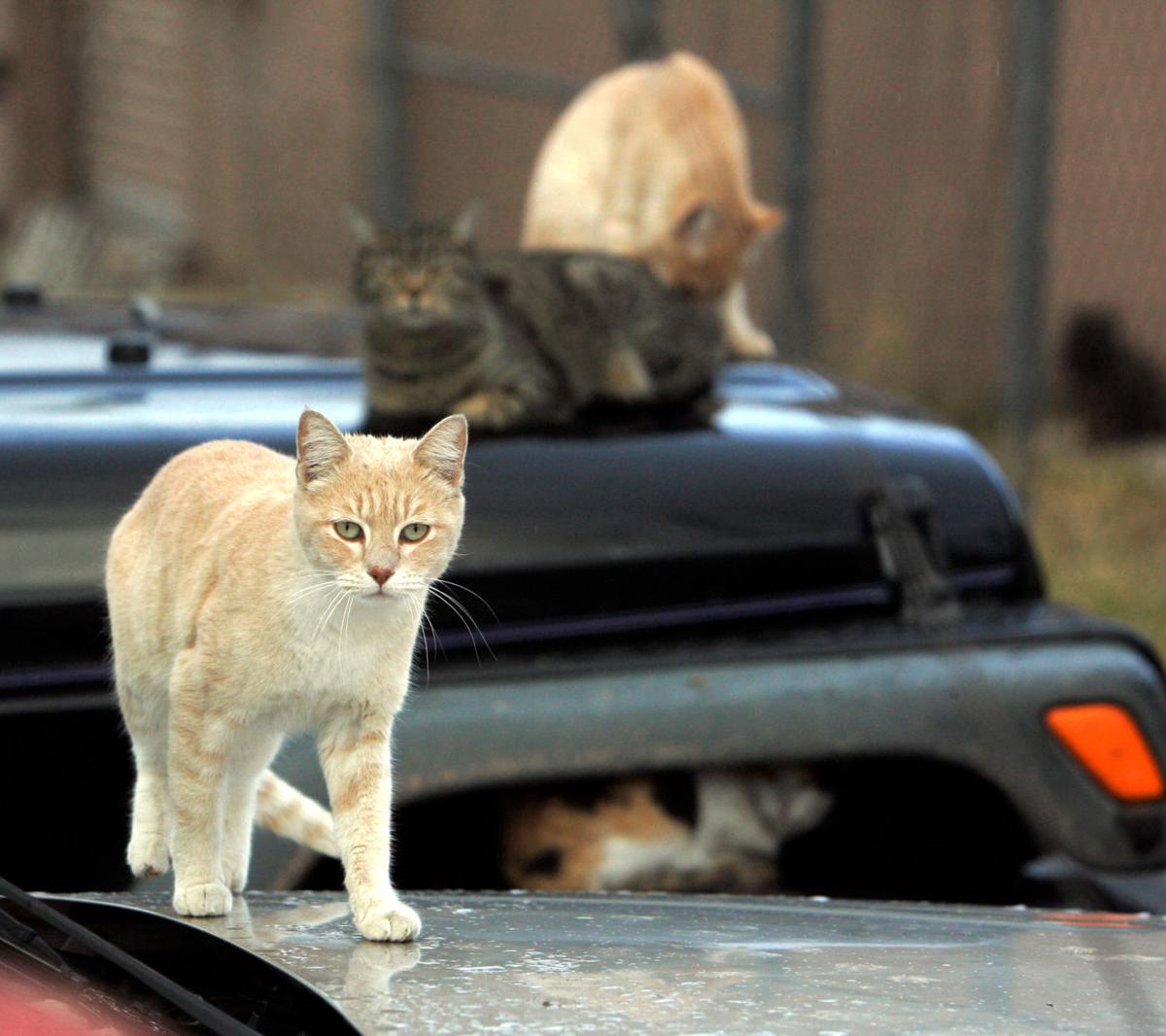
After Pima Animal Care Center paused its in-house trap, neuter and return program in March, other animal shelters acted quickly to handle the situation on their own.
The TNR program, which stands for trap, neuter and return, aims to trap feral and community cats in Pima County. After the cats are trapped, they are spayed or neutered and then returned to the location in which they were found, according to a Pima County website.
PACC has begun TNR field work again, according to Nikki Reck. The program, which was scaled back from March to November, officially started again on December 8.
During the nine-month hiatus, PACC loaned traps to citizens and community members to trap and then take to participating clinics for the procedure, instead of having PACC crews trap the animals themselves. PACC began planning to resume the program full-time in November.
People are also reading…
Although PACC traps both feral and community cats, there is a difference between the two.
Feral cats are cats that prefer to live on their own and do not like socializing with people. Community cats, however, don’t mind people, but still would rather live on their own, Reck said in an email.
PACC faced backlash for the decision to pause the program.
“It’s not that we don’t want to, it’s not that we’re being lazy, it’s not that we’re trying to do something, you know, nefarious,” Reck said. “We’ve been accused of not caring about the cats. That’s not at all what it is.”
The number of community cats at PACC has dramatically decreased, according to PACC reports.
Before the pandemic, in February 2020, the PACC accepted 14 community cats. Similarly, in February 2019, the PACC accepted 16 community cats, the reports say.
This year, the PACC accepted 13 community cats in March and only one community cat in April, according to Pima Animal Care Center monthly reports.
From May to October 2020, the PACC accepted 28 community cats, nearly an 83% decrease from the previous year during which the PACC accepted 164 community cats, according to the reports.
The cats that were brought in and accepted during the pandemic had “very special circumstances,” Reck said in an email.
Sheryl Campbell, the founder and executive director of Pawsitively Cats Inc., a no-kill shelter, believes that the county, and the PACC specifically, should be doing more TNR work.
“They’re not really doing anything right now (PACC) and they should be the largest. They have nothing but a spay/neuter clinic going six days a week, at least 12-hour days because that’s what we need,” Campbell said. “And the problem with stray cats, unaltered cats, free roaming, whether they’re social or not, has not really resolved.”
Before opening her shelter in 2010, Campbell used to do TNR work on her own.
“I started doing TNR in 2003. Well, I think it’s just as bad now as it was then,” Campbell said.
She said she believes that there are not enough dependable TNR programs in the community.
Some of the programs now are simply not feasible, explained Campbell.
Many clinicians and vets are now requiring trappers to schedule spay or neuter surgeries ahead of time, she explained.
Clean up following a rollover motor vehicle collision at the intersection of Kolb and Sabino Canyon in Tucson on January 22, 2021. Kelly Presnell / Arizona Daily Star
However, if a trapper has already caught a cat, you can’t let it go, and then hope to catch it again two days later, according to Campbell.
“You can’t tell the cats, “‘All right, we can get you in on Wednesday,’” Campbell said.
Some people like Clara Lee Arnold are still out trapping cats.
Arnold, who was recently appointed the Community Cat Coordinator for the Humane Society of Southern Arizona is working to create a coalition to get all cat rescues to work together and to try to have an “Unwanted Kitten Free Zone” by 2025.
Because of Arnold’s efforts alone, the HSSA spays between 50 to 70 cats a week, she said.
“There are literally tens of thousands of community cats wandering the streets in Pima County alone,” Arnold said.
Arnold and the HSSA work to spay and neuter both domesticated cats, as well as feral and community cats.
There are a variety of reasons that cats need to be spayed or neutered.
One major reason is to protect the health of humans and their pets, according to Arnold.
For example, if a community or feral cat had not been spayed or neutered and were to come in contact with a pet, there is a possibility of reproduction, Arnold explained.
Additionally, the community cat or feral cat might be a rabies carrier that could then be passed along to a pet or its owner.
Not only does spaying and neutering help prevent the overpopulation of cats in the community, but it also prevents the possibility of communicable diseases, Arnold said.
Spaying and neutering can also prevent illnesses in the cats themselves, like mammary cancers or issues in the colon, according to Reck of the PACC.
However, Arnold explained that the cost of spaying and neutering is not cheap.
“You can provide a lot of love and food and water and all of the good things for the cost of a spay,” Arnold said.
Many people want to pay to have their animal spayed or neutered but simply cannot afford it.
“The cost of spaying and neutering cats and dogs for the most part has risen above where a lot of people are able to afford it. If you are faced with a situation where you’re like ‘Do I pay my car note or spay my animal?’ I don’t think it makes anyone a bad person when they go ‘I’m going to pay my car note,’” Arnold said.
A cat spay generally costs $100 or under, according to Arnold.
Alicia Carrizoza, the shelter manager at Pima Paws for Life, says that although her shelter has not been affected by the PACC’s TNR pause, the community has been affected.
Because of the pandemic, Pima Paws for Life has seen an uptick in the number of cats but has even less resources to help, Carrizoza said in an email.
“We get several calls daily of people wanting to bring in cats. Our donations have been cut almost in half since the beginning of the pandemic also, which affects how quickly we can provide their alters, chip and tests. We pay at a discounted rate, but we still pay. Nothing is free,” Carrizoza said.
While Pima Paws for Life takes its animals to local vets to be spayed or neutered, Carrizoza believes there is a need for additional resources.
“The Humane Society does not get funding from the county and shouldn’t be the only shelter providing this,” Carrizoza said in an email.
Others, like Wendy McFeely, are feeling a direct impact. Since the pandemic began, McFeely has trapped nearly 300 cats, she said in an email.
In addition to pausing its TNR program, the PACC is not taking in as many kittens and is not taking in friendly strays, she explained.
Because of this, McFeely has even more cats that she needs to deal with.
The trapping process is difficult in general, and especially now that resources are stretched thin.
“Trapping is hard work. It’s frustrating. It’s not easy, and it’s unpredictable. But, it’s really rewarding when that one stubborn cat finally goes into your trap. You have to always have Plan A and B and C,” McFeely said.
The trapping process usually begins a few days before the cat is actually trapped and then transported to a clinic for the spay or neuter procedure, she explained.
“Ideally you feed the cats in the same spot for a while. Then, you stop feeding for a day before you trap,” McFeely said.
The traps, which include tuna in oil for food and covers and liners, are placed near the cat’s feeding site.
“Then we wait. Usually traps are set at dusk and checked every few hours,” McFeely said.
She explained that there are additional challenges, like using a drop trap for savvy cats or catching a mother and her babies.
Despite the difficulties, she believes that the cats need her.
“I want to try to save those we can and get them off the street, and I want to slow the population,” McFeely said. “I feel like they needed to communicate (the situation) to the community — both to the public and to others that are involved in TNR. The one-sided stopping of the program without offering other means of help was kind of abrupt and left the rest of us trying to pick up the pieces."
As of now, the PACC does not know when it will be bringing the TNR program back to full capacity. It is currently discussing how to do it safely, according to Reck.
Photos: Baseball legend Hank Aaron in Tucson, 1975
Hank Aaron, Tucson

Baseball legend Hank Aaron is besieged by young fans during a Spring Training game between the Cleveland Indians and Milwaukee Brewers at Hi Corbett Field in Tucson on March 23, 1975, a year after he broke Babe Ruth's major league record for home runs in Atlanta.
Hank Aaron, Tucson

Baseball legend Hank Aaron smiles from the dugout during a Spring training game between the Cleveland Indians and Milwaukee Brewers at Hi Corbett Field, Tucson, on March 23, 1975, a year after he broke Babe Ruth's record for career home runs.
Hank Aaron, Tucson

Hank Aaron of the Milwaukee Brewers gets a base hit during a Spring training game against the Cleveland Indians at Hi Corbett Field, Tucson, on March 23, 1975, a year after he broke Babe Ruth's home run record.
Hank Aaron, Tucson

Hank Aaron of the Milwaukee Brewers jogs to first base during a Spring training game against the Cleveland Indians at Hi Corbett Field, Tucson, on March 23, 1975, a year after he broke Babe Ruth's home run record.
Hank Aaron, Tucson

Hank Aaron of the Milwaukee Brewers in the on-deck circle during a Spring training game against the Cleveland Indians at Hi Corbett Field, Tucson, on March 23, 1975, a year after he broke Babe Ruth's home run record.
Alyssa Grabinski is a journalism student at the University of Arizona.
 101 homes to be built on NW Tucson corner