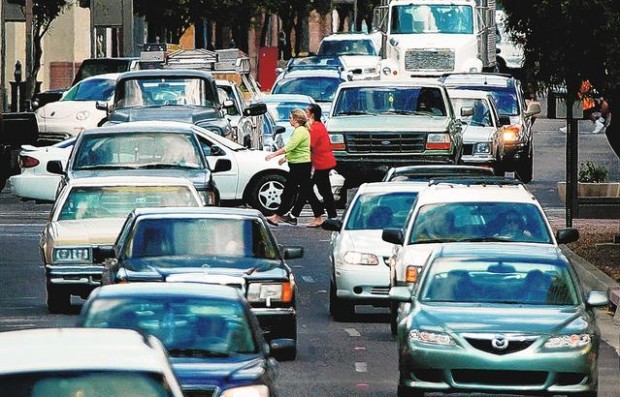
Every day, Tucsonans drive enough miles to get more than halfway to Mars.
The number of miles driven each day in the Tucson metro area hit 22 million in 2005 and should top 26 million this year, says the Pima Association of Governments, a regional planning agency.
To put that in perspective, it's 36 million miles from Earth to Mars, the agency notes in a new report this week.
"Wow, I think it's terrible," said resident Beth Slater, who commutes to Tucson and Casa Grande from Red Rock, when she heard how far our mileage would take us.
"We don't have enough mass transit; one person in one car is terrible for the environment and terrible for our relationship to the world," she said. "I don't like it, but I'm not in a position to fix it."
Even the Mars comparison probably won't jolt people out of their cars, said Dan Sullivan, a Marana resident who's a consultant to PAG.
People are also reading…
"Even if it were twice to Mars and back, most of us would get up tomorrow and go where we have to go," he said.
The metro area's overall mileage shot up about 42 percent from 1996 to 2005, the report says.
The problems caused by increased driving are well-documented: more gasoline guzzled and money spent on it, more traffic congestion and more pollution and carbon-dioxide greenhouse gases spewed into the air.
More driving also has its upsides, PAG says: greater mobility and broader housing choices for people. It's also a sign that the economy is growing, so people can buy more cars.
The main reasons our overall mileage is growing so much are population growth in general and the continued march of homes and businesses to the edge of suburbia, where land and homes cost less, PAG officials say. They're trying to promote alternatives, such as carpooling and buses.
Slater moved with her family seven years ago from Tucson to the Red Rock area in southern Pinal County in search of privacy and a place to keep horses. She regularly drives 40 minutes to Casa Grande or an hour to Tucson from their 8-acre homestead to work as an abstractor who searches titles and mortgages for lenders.
Sometimes she makes both drives in a day. Because her home is reachable only by dirt roads, she drives an SUV that gets 17 to 20 miles per gallon instead of a less sturdy, higher-mileage car.
"I hate it. I'd like to afford a hybrid car but they are just not affordable yet," added Slater, referring to cars that run on gasoline and electricity. Her husband recently began carpooling to a job at Davis-Monthan Air Force Base.
People's reasons for living where they do don't necessarily correspond with the drive to their job, said the PAG's Tom Cooney. When people first get here, he said, they tend to move to the outskirts of town and drive more.
"But those are lifestyle choices our constituents are making," Cooney said. "We are left with the problem of how to accommodate those lifestyle choices."
Robert Knoerr's lifestyle choice forces him to drive 65 miles daily from his Eloy home to his Tucson International Airport job as an aircraft maintenance technician. He moved to Eloy five years ago because he's a sky diver and the area is a prime drop zone.
"I know it sounds crazy, but have you ever jumped out of an airplane?" asked Knoerr, who sky dives 300 times a year and says that thrill makes his daily commute worthwhile.
"I suppose I could quit working and just ride a bicycle around, but it's just not feasible at the moment," he said.
Paul Agola, who has worked at Raytheon Missile Systems for five months since moving here from Huntsville, Ala., is already looking for a shorter drive.
He said the drive from his Northwest Side apartment is bothersome enough that he plans to move to an East Side apartment closer to work when his lease runs out in two months.
"It's a good thing to be closer to where you work. It's less stressful. You can get longer hours of sleep or do more before leaving, like go to the gym or have a better breakfast," he said.
And maybe cut our regional mileage back to moon levels.
Solutions offered by Pima Association of Governments officials, including Lee Comrie, air quality planning manager:
• Get out of your car and ride the bus, carpool or bicycle to work.
• Design cities and suburbs so homes and businesses are closer together or in the same buildings.
• Make cities more bicycle- friendly, with more off-street bike paths to accommodate kids.
• Improve the transit system.
• Make multiple purchases at the same store rather than driving from place to place.