

The road up Sabino Canyon will be repaired in time for winter visitors to ride the popular tram to the end of the line, but restrooms there, buried under a rock slide, won't be rebuilt.
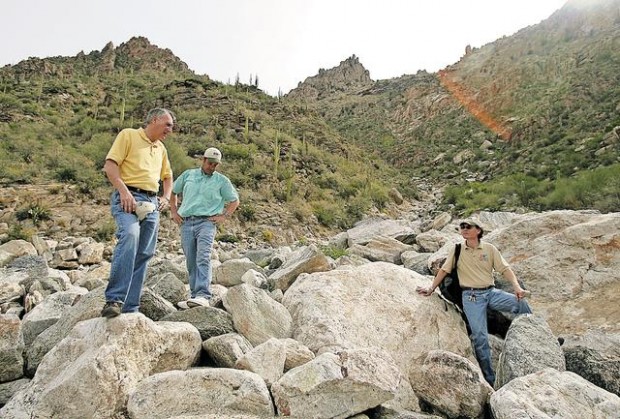
The boulders that tumbled down the fractured canyon walls during massive rains on July 31 have formed a natural dike that the canyon's managers hope will detour future rock slides away from the road and down to the Sabino Creek streambed.
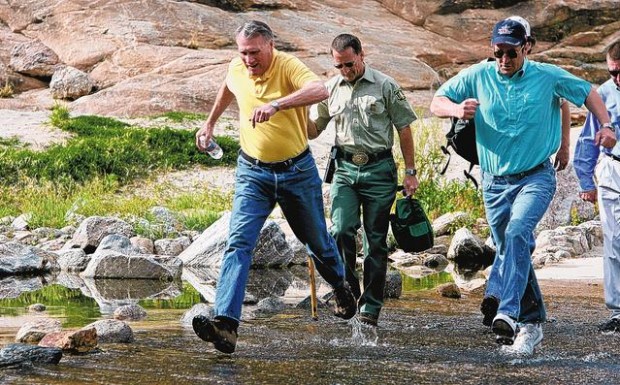
Sen. Jon Kyl, R-Ariz., who toured the area Thursday, said the federal government has approved $1.2 million to repair the road "so that people can have access the way they did before the flooding."
That was the overwhelming request of Tucsonans in public meetings held after last July's floods sent waves of water and rivers of rocks and mud through the canyon, said Heidi Schewel, spokeswoman for the U.S. Forest Service, which manages the Sabino Canyon Recreation Area.
People are also reading…
Schewel said those attending meetings — even after being told that multiple fractures in the canyon walls could allow future debris flows — wanted the tram service restored.
No timetable has been set for reconstruction of the 3.7-mile road, accessible now to hikers and bicyclists but blocked to motorized tram traffic above Tram Stop 4, halfway up the canyon.
Schewel said the Forest Service hopes to complete repairs before winter visitors flock to the popular recreation area later this year. The canyon, northeast of central Tucson, attracts 1.5 million visits annually.
The road into the upper canyon was initially closed to all users after heavy rains flooded Sabino Creek on July 31, undercutting the road in places and covering it in others with silt and boulders. It reopened to hikers in October.
The floods and rock slides also wiped out trails and buried picnic areas. A drive to raise private funds for restoration and enhancement of Sabino Canyon's recreation sites will be announced on Tuesday.
Pima County Supervisor Ray Carroll, who hiked in the area with Kyl on Thursday, said, "Something big is going to happen out of all of this."
Carroll said a group of civic leaders, including Canyon Ranch founder Mel Zuckerman and car dealer Jim Click, has agreed to mount "a major capital campaign" for canyon improvements. "I really love the idea," Carroll said.
Schewel said the Forest Service also is seeking money to plan alternatives to the diesel-powered trams that carry visitors. Electric- and natural-gas-powered trams have been discussed, she said, but all ideas will be considered.
Carroll said he has even heard talk of an aerial tram in the upper part of the canyon.
"Sometimes it seems Sisyphean to rebuild that roadway and know there is going to be a reoccurrence of rock slides," he said.
Floods last summer caused major damage to Sabino Canyon. In September 2006, volunteers worked to clean up the area. See a slide show of their efforts at azstarnet.com/environment
Did you know?
Sabino Canyon was included in the Santa Catalina Forest Reserve, which was established in 1902 by Congress. In 1908, when the Coronado National Forest was created, it became part of that.
There have been at least three attempts to flood the upper part of the canyon through dams. A movement in 1937 was approved by the U.S. Army, with the majority of the cost to be covered by the Works Progress Administration, but as Pima County's share of the cost grew, the outlook for the dam dimmed.
During the Depression and immediately afterward, Civilian Conservation Corps workers dug rock in Sabino Canyon to build bridges in the upper canyon. They also built outhouses, picnic tables, roads and a ranger station.
In the late 1970s, the road into the canyon was closed to all motorized traffic except a shuttle to take sightseers and hikers into the canyon.
Sources: Arizona Daily Star archives and U.S. Forest Service


 $25M distribution center to be built in Tucson


