

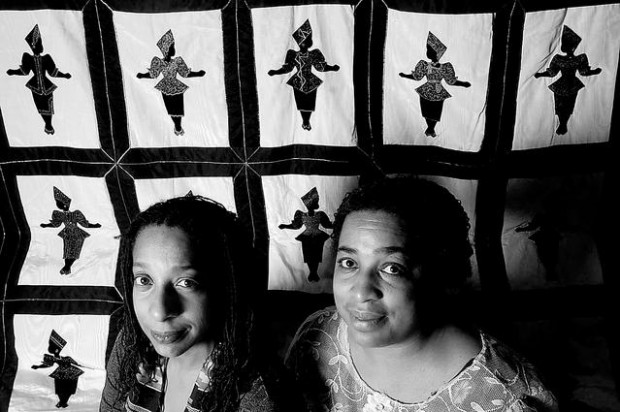
A sample of DNA swabbed from inside her mouth has given Tani Sanchez a deeper connection to the beautiful quilts her grandmother made, and those her sister makes today.
Genetic markers from that DNA linked Sanchez back 10,000 years or more to the Akan people who lived in the part of Africa known today as Ghana.
And guess what the Akan people are known for: their development of cloth — not just for something to wear but as a way of telling their stories — including a colorful woven fabric still made today, thousands of years later, called kente cloth. It is fabric that Tani's sister, Derri Sanchez, has used in her quilts.
"It's thrilling," Tani Sanchez said of her experience with "genotyping" — the basis of a $40 million study by the National Geographic Society, the University of Arizona and other research groups attempting to map the migrations of humans over the last 60,000 years.
People are also reading…
Sanchez, a lecturer in Africana studies at the UA, where she will receive a doctoral degree in philosophy next month, has been tracing her family's history for more than 30 years. She has tape recordings, photographs, census records, Civil War military records, marriage licenses and other family documents. But they only go back so far.
And while her cultural roots are firmly planted in this country, Sanchez said, as a researcher she wants to know more of her family's story.
"The obvious thing for us as African-Americans is that slavery really tore us apart from having specific knowledge about who we are and which countries we came from," Sanchez said. "Now I know I can trace at least one line of my ancestry back to Ghana. It's only one line of many, only one piece of the equation. But it's a start."
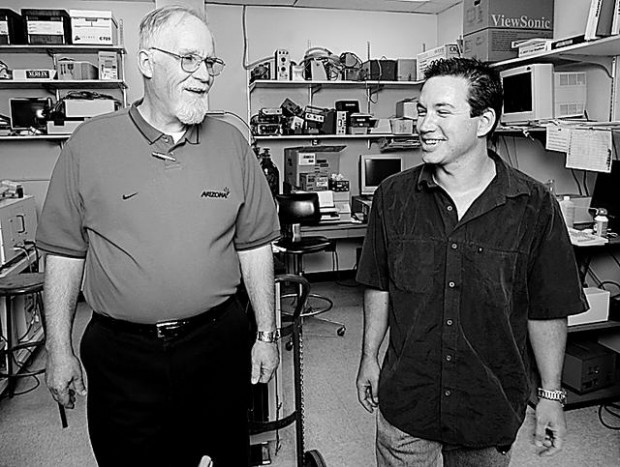
Genotyping is "quite the rage now," said Matthew Kaplan, manager of the UA's Human Origins Genotyping Laboratory, which has processed more than 100,000 DNA samples since the National Geographic project was launched last April.
Human genes are 99.9 percent identical from one person to the next, Kaplan explained. The rest of our genes carry variations that can be used as "markers" to establish our genotypes — to group us with, or separate us from, other people alive today and those who lived tens of thousands of years ago.
Genotyping was available before, and several companies market test kits to the public, Kaplan noted. But the National Geographic project has brought genotyping to people's TV and computer screens.
"It's been a fascinating experience for me," said Kaplan, an evolutionary biologist.
Kaplan's own DNA took him back past the Eastern European Jews from whom he knew he had descended to a population who developed agriculture in the Middle Eastern Fertile Crescent more than 10,000 years ago.
Genotyping has been used to trace male and female DNA back to one man and one woman — scientists call them Adam and Eve — who lived in Africa at different times between 100,000 and 150,000 years ago; researchers are still trying to date these individuals.
The National Geographic project is using genotyping to tell us who our ancestors were — and where they were — as far back as 60,000 years ago. That was when humans began looking for places to live outside Africa, where scientists believe modern humans first lived.
The society is working with 10 laboratories around the world, each of which will process 10,000 DNA samples from isolated groups of people living in such remote places as Afghanistan and the Arctic Circle. Human gene pools there have changed less through the millennia.
The UA's Human Origins Genotyping Lab is processing DNA samples mailed in by the members of the public who want to join the study.
As Kaplan put it, results can take individuals back through their mother or father — or both — to "long lost cousins" who lived thousands of years ago.
Tani Sanchez's Ghana connection could go back 20,000 years.
Michael Cusanovich, director of the UA's Arizona Research Labs, which includes the Human Origins lab, has traced his ancestry back a relatively recent 6,000 years.
That placed him with a group called the Kurgans who inhabited the Russian steppes until about 4,500 B.C. when they started migrating to Europe. They began returning to the steppes about 2,000 years later.
"This is thought to be the group that figured out that horses could be used for transportation, as opposed to just dinner," said Cusanovich, who has been reading everything he can find about the Kurgans.
He also has published his genotype results on the Internet, through which he's identified about 150 people who have a dozen markers identical to his.
"We're related at some point in history," he said. "We don't know exactly where yet but we'll figure that out with time."
The 150 include Kevin Kiesler, a graduate student who used to work in Cusanovich's biochemistry lab and now is with the Human Origins Genotyping Lab.
Kiesler was adopted as a child so knew very little about his genetic background. The markers he shares with Cusanovich do not mean they are related to each other. But they do link them both to a group of people who lived 6,000 years ago.
On a personal level, Kiesler said, "It was more of a curiosity than anything else. I wasn't really looking for any deeper information."
Tani Sanchez is. She has been genotyped twice, through the National Geographic project and through African Ancestry, a private company.
She persuaded her mother, Margeurite Euell Sanchez, to be tested, and her Uncle William Taft Wright — her grandmother's youngest brother, born in 1909 and still living in Louisiana, whose DNA can yield information about the male side of Sanchez's history. His results are not back yet.
The genotyping adds thousands of years of information to the hundreds of years Sanchez has learned about through family photo albums, legal documents and other memorabilia.
"I have the oral stories from my grandparents," Sanchez said. "My younger sister and I are the ones who listened to my grandmother who was born in 1897. I tape-recorded her. These stories are very real to us."
Sanchez's grandmother was a quilter — that's where sister Derri picked up the interest. And it was Sanchez's grandmother's mother who lived in Texas but had family roots in Ghana — where the quilting cloth comes from.
Sanchez, who is half Puerto Rican, cautions against taking any single piece of information — even the DNA results — too seriously. Still, she said, her tests have shown a 99.7 percent match to the Akan people of Ghana.
In addition to all the science, there seems to be a strong spiritual component to the pursuit of one's genetic history.
Jennifer Lawrence, who works with Arizona Research Labs, has lived in several places around the world as the child of an Army father. Genotyping traced her ancestry to North Africa and Central Europe.
"It definitely gives you a perspective of how interrelated everybody is," Lawrence said. "It's always struck me how very similar we are in spite all of our differences, and this just proves it scientifically."
Her statement rings true for the Rev. David Wilkinson of St. Francis in the Foothills United Methodist Church, who sees genotyping as a modern metaphor for God.
"What I love most is that science is bringing us to an awareness of our oneness," Wilkinson said. "God uses different things to get the message through."
Sanchez, too, describes her 30-year family history project as a spiritual pursuit.
"The people who were brought here as slaves, that had to be one of the most horrible experiences that anyone can imagine," she said. "And I think there must have been a fantasy about returning to Africa.
"I can't take them back to their homelands. I can't remove this whole horrible experience from their lives. But on paper I can say 'I remember where you came from. I know it was important to you, and it's important to me.' "
The National Geographic Society's Genographic Project is open to individuals who want to trace their lineage back as far as science can go through DNA "genotyping." Other organizations perform the service also. Costs range from about $100 to $300 or more. Here's a sample:
The Genographic Project www.nationalgeographic.com/ genographic Will mail you a kit that includes a swab that you brush across the inside of your cheek to collect DNA from saliva. The kit includes a mailing envelope to return the swab for processing. The UA Human Origins Genotyping Laboratory processes results, usually in about eight weeks. Your information will be added anonymously to the data being collected for the study.
Family Tree DNA www.familytreedna.com Also part of The Genographic Project. If you are not interested in being part of the project, you can order a testing kit directly from this company.
African Ancestry www.africanancestry.com Was featured on the recent PBS special "African American Lives." Its database targets parts of Africa where slave trading took place.

 $25M distribution center to be built in Tucson


