
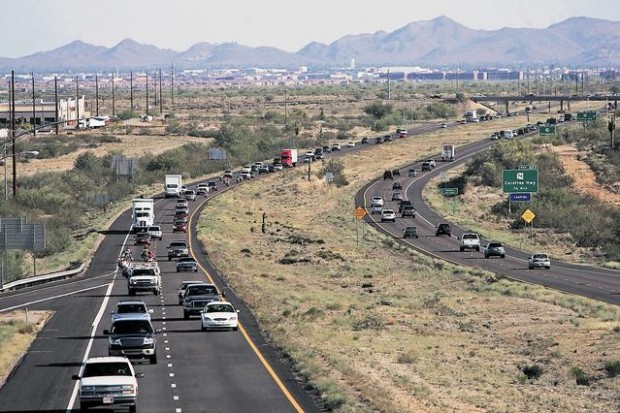
Freeways up to 24 lanes wide, new interstate bypasses, commuter rail — none will prevent a quagmire of traffic congestion through the coming Tucson-to-Phoenix "megalopolis."
That's the warning from a longtime Pima County transportation official, who says there's no way officials can find the money or physical space to build a road-and-transit network big enough to handle Arizona's projected growth over the next three decades.
By then, forecasters have predicted wall-to-wall development along the interstate highways serving this "Sun Corridor," which they say will create a megapolitan area all the way from Prescott to Sierra Vista.
By 2040, up to 13.3 million people will live in the corridor — 8 million more than now, and the freeways are already jammed at rush hour.
Ten years from now, driving on the interstates could be an extremely frustrating experience, says Ben Goff, Pima County's deputy transportation director.
People are also reading…
There will be no point in looking for an alternative route, he predicts, because it will be no better than the one you're already driving.
Other experts are more optimistic, but they agree with Goff that we'll need to put homes and jobs closer together, and find new ways to pay for roads, to have any hope of keeping up with the growth.
Already, the Arizona Department of Transportation is considering widening many existing roads and building new ones to upgrade the overcrowded interstate highway system. It's studying:
● Widening Interstate 10 from the Cochise County line to near Downtown Tucson.
● Bulking I-10 up to as many as 10 lanes from Tangerine Road up to the I-8 interchange near Casa Grande, and to as many as 24 lanes near the Broadway Curve in Tempe/Phoenix.
● Building bypasses so trucks and other long-distance traffic can avoid I-10 through Tucson and Phoenix.
● Creating a bypass — essentially a new, parallel freeway — for Interstate 17 north of Phoenix.
● Laying tracks for a commuter rail line from Tucson to Phoenix.
But while many of these projects are desirable, Goff says, it would take the equivalent of at least three more four-lane freeways the length of I-10 from Tucson to Phoenix — and as many as six such freeways — to handle the projected growth.
The state's Sun Corridor will add at least 4 million people by 2040, if not 8 million, various forecasters say.
Adding 8 million people to the region is the equivalent of taking in eight more Pima counties' worth of people.
Serving that much traffic, Goff said, would require roughly 25 percent freeways and 75 percent arterial streets such as Speedway.
At $25 million per mile of four-lane freeway and $9 million per mile for city arterials, the cost to serve the 13.3-million-person corridor would be roughly $54 billion, Goff said.
"Our current development patterns, how we spread out, rely on easy travel. If you try to put that many people over that much area, you are talking about a system that you can't build," he said. "You couldn't afford it."
"Where will $54 billion come from?" asked Goff, adding that even a major switch to mass transit probably wouldn't be enough to handle that much growth, unless it were on the scale of systems in highly dense urban areas in countries such as Japan.
Goff's warnings are based on what he acknowledges was a personal "back of the envelope" calculation of the amount of new freeway capacity needed to service a rapidly growing population — not a full-fledged study.
Andy Gunning, planning director for the Pima Association of Governments, a regional agency serving the Tucson area, said he believes Goff's estimates are OK on a rough scale.
A statewide study is just getting started of transportation needs for the Sun Corridor, he said. The $250,000 study, being handled by all the various regional government councils, is due to finish later this year.
"I don't think the message is that we need six more I-10s facilitating that travel between Phoenix and Tucson," Gunning said.
Exactly what's needed will depend on a variety of factors, Gunning said, including:
● Future development patterns, particularly in Pinal County, which is still a "pretty clean slate" with only 300,000 people, he said. More job growth in that rapidly growing county could be viewed as a transportation solution because it could reduce travel times if Pinal develops as more than a bedroom community, he said.
● Increasing gas prices and their impacts on personal travel habits, and the timing for when alternative fuels will be available and used on a much larger scale than today.
● Mass transit use, which at least in Pima County is now at an all-time high, and the impact of future high-capacity transit service such as commuter rail.
● Shrinking household sizes and an aging population that likely will travel less by car than in the past.
● The need to move more freight by trucks and rail.
Bob Rodriguez, a West Side Tucson resident and longtime I-10 user, said he isn't convinced the traffic problem will get as bad as predicted because he doesn't believe the desert can sustain that many people.
"It won't happen. How are we going to get water?" said Rod-riguez, who lives in Menlo Park.
Curtis Lueck, a veteran private transportation consultant for developers and government agencies, said he is more optimistic than Goff about the state's ability to raise money for new roads and transit.
The state will probably have to widen the interstate between Tucson and Phoenix to up to 10 lanes to handle interstate and intrastate traffic, he said. Most of that stretch has four to six lanes now.
But he said local governments will have to rely more on impact fees, paid by home builders and often passed on to home buyers, for local arterial roads. They'll also have to find new ways of raising money for freeways and parkways.
He said that could include some kind of per-mile travel tax paid by drivers, for instance.
"The West is changing. People are accepting a bit higher density and you see more people moving into the urban core," said Lueck, who has worked out of his Tucson Mountains home for more than 20 years. "Suburbanization is still important, but you see more people moving back into cities and working at home."
Tucson native Joe Cates, another West Sider, said authorities need to start spreading offices and other job sites more broadly throughout the community "so you don't have all employees pushing to get to the same place."
The Tucson area and Arizona's cities in general need to grow smarter, with jobs placed closer to homes, agreed Jim DeGrood, a deputy Marana town manager.
"You look at the Tucson metro area, where jobs are and where homes are built, and there is a disconnect," DeGrood said.
"If we continue to grow as bedroom communities separate from our jobs, we are destined to have a gridlock nightmare."
On StarNet: Read past installments of the Pima County at 1 million series at go.azstarnet.com/onemillion
"If you try to put that many people over that much area, you are talking about a system that you can't build. You couldn't afford it."
Ben Goff, Pima County deputy transportation director

 U of A president declines to sign shared governance contract with faculty