

Little packets of dried leaves are causing big headaches at Davis-Monthan Air Force Base.
They contain a synthetic marijuana blend known as Spice, an increasingly popular high among local airmen, an Air Force detective testified at a court-martial this week.
Since June, a dozen D-M airmen have been kicked out of the service for smoking the substance, which is legal for civilians- at least, for now - and is sold at many local smoke shops.
Spice use is a thorny problem for the military because it can't be detected by the random urinalysis used to ferret out drug users.
That makes Spice smokers harder to catch - a big concern since they often work with weaponry and intricate military hardware.
In this week's trial of an airman who works in D-M's bomb warehouse, the court heard evidence he often was stoned on the job.
People are also reading…
Airman Basic Christopher Bechthold, 24, whose work involved receiving, storing and inspecting bombs with the 355th Equipment Maintenance Squadron, was sentenced Tuesday to eight months' confinement and a bad conduct discharge.
Bechthold pleaded guilty to multiple drug charges including repeated use of Spice between October 2009 and September 2010. He told the court he smoked it often after work to self-medicate a mental-health disorder.
But fellow squadron member Airman Alex Nofzinger, a former friend of the defendant, testified that Bechthold told him he'd been smoking Spice daily before work and during lunch breaks.
Nofzinger, who inspects the A-10 attack jets flown at D-M, also admitted to smoking Spice several times, though not on the job.
He recently was disciplined for Spice use and faces an administrative discharge.
Nofzinger said he and Bechthold first tried Spice on Halloween last year after buying it in a smoke shop on Fourth Avenue.
When caught, Bechthold gave investigators the names of more than 20 others he smoked Spice with in the dorms that house single D-M airmen, testified Special Agent David Corl, an Air Force detective.
"Is it fair to say it's a pretty rampant problem?" prosecutor Capt. Kyle Hern asked of Spice use on base.
"Very," Corl replied.
Spice typically is sold as incense and comes with a warning that it's not for ingestion. But it is laced with chemicals that can have hallucinogenic effects, ranging from mild to intense, when smoked.
Side effects ranging from headaches to loss of consciousness have been reported.
The U.S. Drug Enforcement Administration may act by year's end to ban the cannabinoid-like substances in the herbal blend.
Lt. Col. Andrew Williams, chief military lawyer for D-M's 355th Fighter Winger, said officials there first began hearing reports last year that Spice use might pose problems for the Air Force.
But it wasn't until this year that local users surfaced, resulting in courts-martial and non-judicial punishments.
Often, users aren't caught unless they confess or someone turns them in, Williams said.
While civilians may legally buy and use Spice, the military ban means airmen who do so can be prosecuted for failing to follow orders.
Other services also have been cracking down. Fort Huachuca, the Army post in Sierra Vista, has disciplined eight soldiers this year for using Spice and similar substances, spokeswoman Tanja Linton said.
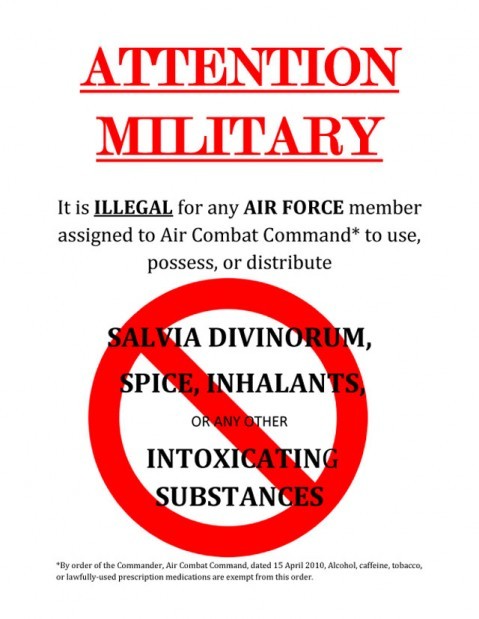
A few months ago, D-M brass became so concerned about Spice use that D-M detectives visited 20 local smoke shops, asking staff to post fliers warning airmen that Spice use is illegal for them.
"The shop owners had a wide range of reactions," said base spokesman 1st Lt. Jonathan Simmons.
"Some of them just put up the flier immediately and others were, like, 'Get out.' "
Williams, the D-M lawyer, said a DEA ban would benefit the Air Force by making Spice harder for airmen to obtain.
In the meantime, commanders and military courts will be stressing the negative consequences of use.
"We take this very seriously," said Simmons, "because of the nature of the missions our people perform."
Contact reporter Carol Ann Alaimo at calaimo@azstarnet.com or at 573-4138.


