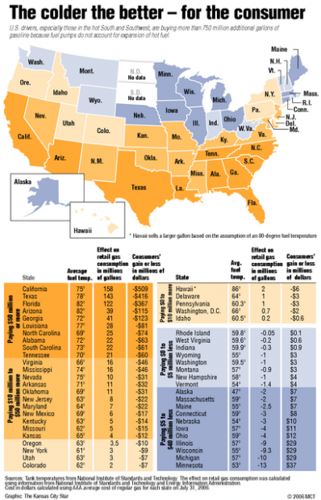

Arizona drivers are spending about $115 million more a year on gasoline and diesel fuel than they would if fuel temperatures were regulated to the federal standard, according to a newspaper study.
The standard says fuel should be dispensed into vehicles' tanks at 60 degrees, but the standard is not enforced federally or in any state, including Arizona.
An investigation by the Kansas City Star revealed that drivers nationwide are spending about $2.3 billion more for fuel this year than they would if the fuel was adjusted for energy efficiency and expansion based on temperature.
Temperature affects fuel because the hotter it is, the less energy-efficient it is, so consumers can't drive as far and must buy more fuel. The newspaper's report said fuel in Arizona is sold at an average of 82 degrees.
The 60-degree standard cannot be enforced in Arizona because it would be cost-prohibitive to change every pump to calculate the cost of a gallon according to the temperature of the fuel, said Dennis Ehrhart, assistant director of the Arizona Department of Weights and Measures, which regulates the pumps.
People are also reading…
The unenforceable standard doesn't make sense to Emily Connally, who filled up her tank Wednesday morning in Tucson.
"If the government is going to have that sort of regulation, they should have a way to enforce it," she said.
But Brian Burris, who also filled his gas tank Wednesday, said he doesn't think the heat is affecting gasoline very much because the underground storage tanks keep it cool.
"It's pretty cool when it comes out anyway, if you get a little on your finger," he said.
Another issue is that the national organization that would certify equipment that could make the adjustment at the pump hasn't approved any such device yet, Ehrhart said.
If it were available, Ehrhart said, he's heard estimates that it could cost $2,000 to $3,000 to retrofit or change each gas pump so it adjusted the price based on the temperature of the gasoline.
"We cannot afford that," said Gurcharan Singh, who owns a Metro Gas station on the East Side.
And that means consumers would pay for the retrofit of pumps.
"That's going to increase the cost to the consumer," Ehrhart said. "If they (gas station owners) invest that per dispenser, they're going to pass that cost along."
That alone could void any savings related to the temperature adjustment, he said.
Gas station owner Joe Martinez said it would surely cost drivers more to pay for the equipment to make the temperature adjustment than they would save.
"It's like anything else — if you sell ice cream, you have to buy a freezer. You have to figure the cost of freezer into the ice cream," said Martinez, who owns a 76 station on the Northwest Side and another Downtown.
Burris said he doesn't favor anything that would further increase gasoline prices.
A driver who fills up with 12 gallons of gas could save about 10 cents for that fill-up if the sale was temperature-adjusted, Martinez estimated.
But if a standard gas station has six pumps and spends $3,000 on each to add equipment to adjust for temperature, the owner probably would have to add about 3 cents to each gallon of gas sold to pay for that equipment in one year. That 3 cents a gallon for 12 gallons would cost the consumer 36 cents.
"I think it's kind of chasing your own tail to do temperature correction," Martinez said.
But the extra expense could be worth it to Connally, who said any extra mileage she could get from a tank of fuel would benefit her tight gas budget.
"I would rather pay a little bit more and get a little more (mileage)," she said. "At least that's a justification for raising prices."
The state Department of Weights and Measures can ensure the volume of gasoline a customer gets, Ehrhart said.
Singh said he's sure that customers are getting what they pay for because of those volume controls, and the temperature changes don't affect most people as much.
The state Weights and Measures Department randomly checks to make sure stations are distributing the proper amount of fuel.
Ehrhart said the department probably does random checks at each station in the state once every four years. Stations are required to keep up on routine maintenance all the time.
To check the volume, the department draws 5 gallons from a station's pump.
If a station is allowing too much fuel out of the nozzle, the owner has 30 days to correct it. If a pump isn't dispensing enough, the agency shuts down the pump until the owner has it fixed. Fines of up to $5,000 can be imposed for cheating customers on fuel volume.
Though temperature corrections cannot be made at the pump, large fuel purchases, such as those made by gas stations of 5,000 gallons or more, are adjusted for temperature, Ehrhart said.
In the long run, some say those who drive in the 100,000-mile range each year would be the only people who would stand to benefit if gas were temperature-corrected. Most drivers, who average about 12,000 miles a year, wouldn't save much from the corrections, Martinez said.
Few Americans realize that fuel is often sold at temperatures higher than the government standard of 60 degrees. It's a standard agreed to nearly a century ago by the industry and regulators.
Collectively, it's costing us billions of dollars a year, according to an investigation by The Kansas City Star.
It works this way:
As a liquid, gasoline expands and contracts depending on temperature. At the 60-degree standard, the 231-cubic-inch American gallon puts out a certain amount of energy. But that same amount of gas expands to more than 235 cubic inches at 90 degrees, even though consumers still only get 231 cubic inches at the pump.
Put simply, every degree over the 60-degree standard diminishes the energy a 231-cubic-inch gallon delivers to the nation's fleet of vehicles — and forces drivers to use more fuel and pay more.
Basic physics rules mean that, depending on the temperature, the difference can amount to just a few cents per gallon. But it adds up to big money — coming straight out of consumers' pockets.
Moreover, it's legal, because even though your local filling station measures your gas as if it were stored at 60 degrees, no law requires retailers to adjust the pump to reflect the expansion of hot fuel.
In Hawaii, a gallon of fuel contains nearly 234 cubic inches — about 3 cubic inches more than is dispensed in the rest of the United States. No other state adjusts for temperature fluctuations when dispensing fuel.
McClatchy-Tribune




 Second wall planned across Arizona as Trump administration doubles down on border