

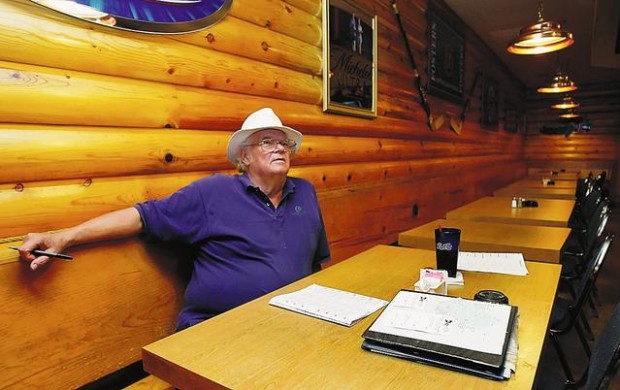
People wanting to place off-track bets on horse racing in Pima County in the past week weren't able to do so because of a dispute between Tucson Greyhound Park and the Phoenix-based horse track Turf Paradise.
The broadcast signal to Pima County was blacked out Tuesday because the two sides failed to reach a contractual agreement, and it's unclear when the signal will be restored.
State law requires that Turf Paradise broadcast horse races to each off-track-betting site in Pima County during its racing season, which began Tuesday. Tucson Greyhound Park, because it holds a gambling license, runs the nine off-track-betting sites in Pima County. Those sites are in privately owned bars or lounges.
A percentage of revenue from money bet is shared among the two tracks and Yavapai Downs, a Prescott Valley-based horse track that controls the broadcast signal during the summer.
People are also reading…
In off-track betting, people can wager on races broadcast from across the country. A percentage of the total amount bet is shared among different tracks. State law requires that people can only bet on races that can be viewed. So, with the broadcast signal down, there is no legal off-track horse betting in Pima County.
The blackout has hardly come as a surprise.
For months, Tucson Greyhound Park and Turf Paradise have been at odds over proposed track legislation that ultimately stalled in the state Senate this spring.
Chris McConnell, general manager of Tucson Greyhound Park, characterized the proposed legislation as an attack on the track. Officials with Turf Paradise did not return messages.
The legislation would have allowed Turf Paradise to set up its own off-track-betting sites in Pima County without the approval of Tucson Greyhound Park, potentially undermining its business.
A section of the legislation called for eliminating "the requirement to obtain permission to bring in simulcast races to Pima County." Current law requires both horse and dog tracks in Pima County to agree before any racing can be simulcast into the county.
The stalled legislation also at one point had an amendment for advanced deposit wagering, which would allow betting via the Internet or telephone. This would likely have brought revenue to the state but would have undermined off-track-betting sites because people would not need to visit them.
This isn't the first time the horse-racing broadcast signal has gone black in Pima County.
McConnell said contracts are usually good for three years, and that blackouts have occurred in the past when the contracts were up for renewal.
In recent years, Tucson Greyhound Park has become increasingly reliant on off-track betting revenue. Its nine off-track betting sites handled about $15 million in bets from horse racing last year, compared with about $6 million in bets on dogs running on its track.
Across the state, off-track betting equaled about $173 million in 2005, according to the Arizona Department of Racing's annual report.
Shutting off the broadcast signal to off-track sites in Pima County has repercussions across the state, said Geoffrey Gonsher, executive director of the state's Department of Racing.
Last year, off-track betting in Pima County generated about $600,000 in purse revenue for horsemen. It also generated about $30,000 for the state.
The racing commission is to hold a meeting Wednesday, and the signal blackout is on the agenda.
In the meantime, employees at local off-track betting sites are feeling the pinch. The lost signal has had a trickle-down effect on service workers.
Tara Schantz, manager of off-track-betting site Jeff's Pub, 112 S. Camino Seco, said the bar had only a handful of patrons Friday. Normally, it's packed.
"Now that we don't have horses, people aren't coming in," she said. "It's devastating to the little people."

 Faculty concerned about changes to U of A admissions policy


