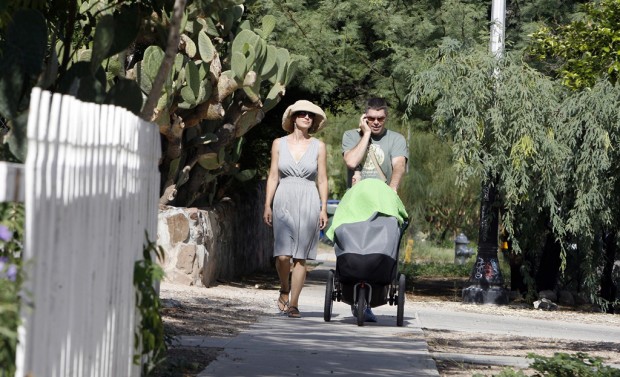
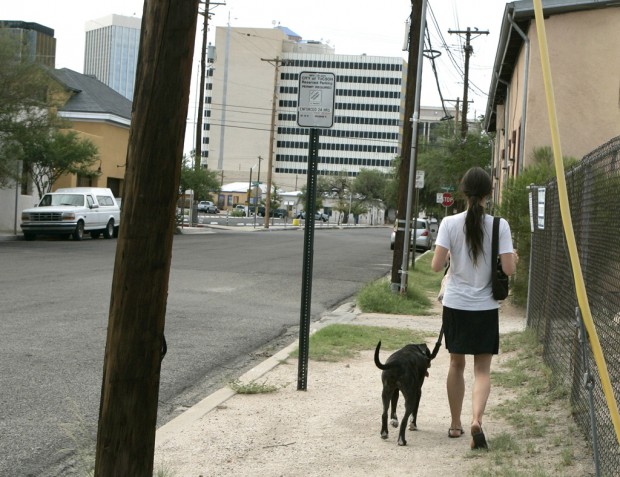
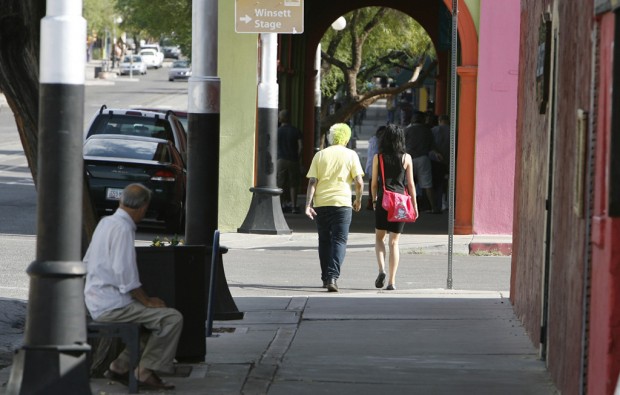
Sure, pedestrians have to steer clear of plummeting into perilous potholes. Not all neighborhoods have sidewalks. And there's the summer heat, which makes your shoes melt.
Tucson still scores slightly above average when it comes to walkability. The 2,500 largest U.S. cities have an average walk score of 43, according to www.walkscore.com.
The website, which essentially measures how easy it is to live a life without seat belts, tends to skew heavily toward dense, urban living, since it measures the convenience of amenities like grocery stores, entertainment and restaurants. That explains in part why New York City and San Francisco, which both weigh in with scores in the mid-80s, rank as walkers' nirvana.
We may envy our sister city's downtown, but Tucson's score of 48.2 still slightly nudges out Albuquerque's 47.5.
We also, since things are right with the universe, beat out Phoenix, although both scores still rank as car-dependent.
People are also reading…
Website organizers have a long list of why a little shoe leather is a good thing.
It reduces pollution. It's one piece of the obesity solution. It improves property values. And it provides more time for community-building.
As with any average, there's a huge swing from neighborhood to neighborhood, and the site allows you to isolate your own walk score by plugging in your address.
Iron Horse, a historic neighborhood running in the Broadway-Euclid-Fourth Avenue area, comes out on top with a score of 90.
Pie Allen and West University, near the University of Arizona, both rank at least 80. Most top-rankers cluster in well-established neighborhoods. Armory Park? 78. Sam Hughes and Barrio Viejo? Respectively, 72 and 71.
Gary Poczulp, who sits on the Pie Allen neighborhood association board, has lived in his area for about 30 years.
Back in the day when he started looking, he concedes the neighborhood lacked a certain cachet. But it was within easy walking and biking distance to campus, where he works for the Kitt Peak National Observatory, and that was important to him.
The convenience of the neighborhood means he and his wife have downsized to one car and putt around on scooters to nearby restaurants. Church is close. So is grocery shopping.
The proximity to campus, of course, brings some challenges. There's occasional parking friction. There is an assortment of renters, who have little incentive to fix up their temporary residences.
But the walkability of the neighborhood is seen as an important piece in community-building, so the neighborhood has embarked on sidewalk improvement projects and has another one getting under way soon.
"Living in an inner city neighborhood comes with some tradeoffs," Poczulp said, "but living here for 30 years, I think about all the time I saved by not commuting 30 or 45 minutes a day each way. I didn't have the stress of driving in traffic. It extended the amount of time I had to spend with my family. I could get to work at a moment's notice. In all, it's been a good choice for us."
While 13 percent of Tucsonans live in areas with a walk score of at least 70 - indicating most errands can be accomplished on foot - there are other places you'd be marooned without a car.
Civano, which was a much ballyhooed community based on the premise of sustainability on the far east side, gets a 14.
The neighborhood around "A" Mountain gets a 19 - which would presumably be resolved if a certain downtown redevelopment project (clear throat here) would have been more efficient.
Starr Pass gets a 10.
Mayor Bob Walkup, who had just finished his 6:30 a.m. walk on Friday around his Starr Pass neighborhood, initially professed surprise at his neighborhood's ranking.
He ran into at least two dozen people along the route, he said. He can - and does - bike downtown to work and for entertainment.
But he conceded if the rankings are about actually getting to a place that would take a debit card, the neighborhood wouldn't score so well.
And overall, he said he agrees with the ranking. While politicians are cognizant of the need for infill to reduce sprawl and for sidewalks to improve safety, the city isn't there yet.
"I'd say we're average, but we're gaining on it."
The site is a "neat tool" but imperfect, says Tom Thivener, the city's pedestrian coordinator.
On a microscale, places like Civano are very walkable, although it doesn't perform well under the criteria set by the site. And while it ranks Broadway and Old Spanish Trail very high based on a cluster of businesses, there isn't yet a signal in place to help pedestrians and cyclists cross the road safely. His Menlo Park neighborhood ranks low, because the site hasn't picked up on new activity at the fledgling Mercado district downtown.
But generally, he agreed with the middling ranking, saying there are two Tucsons, with a dividing point somewhere around Swan Road.
"I grew up on the far east side where you're auto-dependent to the point that as soon as you turn 16, you get a car," he said.
"But for folks who want a walkable community, look no further than the urban core around the UA, which is very walkable, very bikeable and has transit opportunities."
Roadrunner might suggest one other way to make the site more accurate: a seasonal ranking. Roadrunner's neighborhood ranks 80. Yeah. Maybe so. In October.
Contact reporter Rhonda Bodfield at rbodfield@azstarnet.com or 573-4243.