

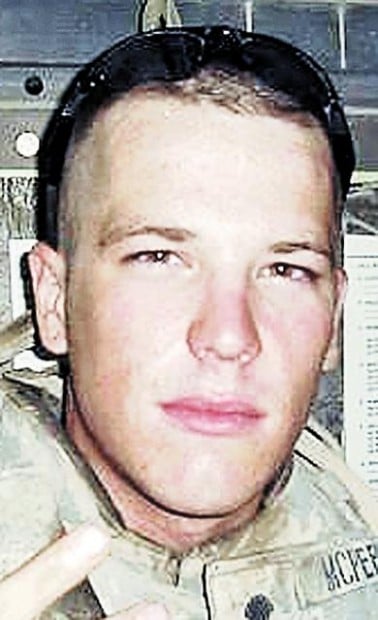
A Tucson soldier who died in February while guarding an outpost in Iraq was killed by tank fire from fellow soldiers, a military investigation has confirmed.
Spc. Alan E. McPeek, a 20-year-old graduate of Mountain View High School, on the Northwest Side, was serving his last day in Iraq when his outpost in Ramadi came under attack by insurgents.
The insurgents struck McPeek's outpost and another Army position from multiple sides. A tank gunner and commander at the second position targeted McPeek's post, thinking the soldiers there were insurgents, according to an investigation into the incident obtained by The Associated Press.
Pvt. Matthew Zeimer, an 18-year-old from Glendive, Mont., who had been in Iraq for about a week, also was killed by the friendly fire. Three other soldiers were wounded.
The families of the two soldiers initially were told the men were killed by enemy fire, though military officials told the families in March that they suspected friendly fire might have caused their deaths.
People are also reading…
Messages left with McPeek's Tucson family were not returned Wednesday.
Poor training and planning were to blame for the deaths, though they were were not a result of negligence, the investigators said.
Instead, "a series of decisions and actions by both the tank crews and their command, taken collectively, fell short of the high expectations we have of our soldiers and their leaders," the investigators said.
It was not immediately clear if the Army reprimanded the tank crews and their command.
The report said their decisions and actions "directly created the conditions which caused this accident, including deficiencies in training, manning, mission preparation, target validation procedures, and tactical level friendly force marking that, if addressed and corrected, can limit fratricide such as this in the future."
According to Army officials in April, unit commanders in Iraq did not at first suspect the men were killed by U.S. forces.
McPeek, a member of the 16th Engineer Battalion, 1st Brigade Combat Team, 1st Armored Division, based in Germany, was born in Hawaii while his mother, Rose Doyle, served in the Navy there.
Zeimer was a member of the 3rd Battalion, 69th Armor Regiment, 3rd Infantry Division, based at Fort Stewart, Ga.
McPeek moved to Tucson at age 2. Mountain View has seen five former students killed in conflicts, more than any other school in the region. Conflicts in Iraq and Afghanistan have claimed 31 other service members with ties to Tucson and Southern Arizona.
Known for his smile and sometimes flamboyant hairstyles, McPeek enlisted at 17 because "he decided he didn't like what was going on over there and he wanted to make a difference," Doyle's husband, Kevin Doyle, told the Arizona Daily Star in February.
McPeek even allowed friends and family members attending his going-away party to cut off locks of hair to prepare him for his military buzz cut, Kevin Doyle said.
Despite his non-conformist personality, McPeek was excelling in the Army and was close to being promoted to sergeant when he died, family members said.
"He had hundreds and hundreds of friends. He was just loved by everybody," Kevin Doyle said in February. "He was a joker. He always had a smile on his face."
At the time of McPeek's death, family members said the soldier was having difficulty gauging whether he was making a difference.
"He was in a very dangerous place," Kevin Doyle said. "He didn't see a lot of good happening there. He saw a lot of bad things going on."
McPeek told family that the outpost he served at near Ramadi was an al-Qaida hide-out and a hotbed for insurgent activity.
A Marine Corps commander who confirmed initial reports that McPeek and Zeimer's deaths may have been from friendly fire said in a memo that the two men died because of "the inevitable fog of war."
"A well-organized and numerous enemy engaged coalition forces from multiple directions in a crowded neighborhood on a dark, smoke and dust obscured battlefield," the commander wrote.
"The soldiers involved in this incident were combat experienced and familiar with the area and friendly positions. Nevertheless, they became disoriented relative to their own position and the targets they were engaging."
The Army came under heavy criticism for its handling of the death of former NFL player Pat Tillman, who was killed in an April 2004 friendly-fire incident in Afghanistan.
The Army initially said Tillman was killed by enemy gunfire when he led his team to help another group of ambushed soldiers. It was five weeks before his family was told the truth, a delay the Army has blamed on procedural mistakes.
As a result of those problems, the Army instituted a number of changes in its notification process and ordered that unit commanders now must investigate every hostile death, in part to ensure that families receive accurate information about how their loved ones died.
"The soldiers … in this incident were combat experienced and familiar with the area and friendly positions. Nevertheless, they became disoriented relative to … targets they were engaging."
Marine Corps commander, in memo confirming friendly fire killed Spc. Alan McPeek and a Montana soldier



 Tucson official: Air Force won't pay for D-M groundwater cleanup now


