

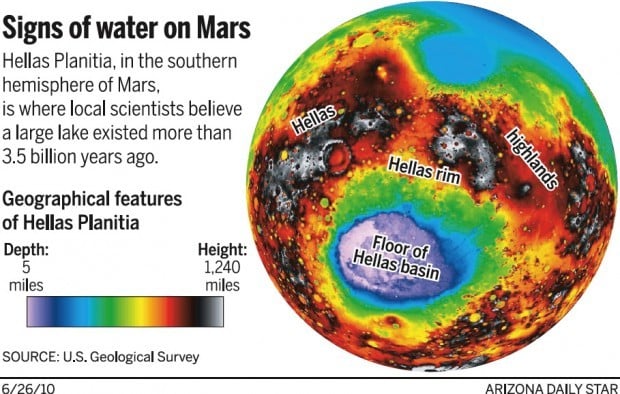
A mapping project by Tucson's Planetary Science Institute suggests the possibility that a large lake existed on Mars between 3.5 and 4.5 billion years ago.
The research will help scientists better understand Mars' past, which also may help them learn about the history of Earth. Additionally, the research might help answer whether Mars has ever supported life.
The map evaluations and findings come from Leslie Bleamaster, research scientist at the Planetary Science Institute; and his colleague, David Crown, principal investigator of a grant from NASA's Planetary Geology and Geophysics Program.
Bleamaster used recent data from several instruments to analyze various regions of Mars' southern hemisphere, focusing on an area called Hellas Planitia.
For example, the Thermal Imaging Emission System tool on the Mars Odyssey spacecraft provided image data at various wavelengths, identifying the form and structure of Mars' surface.
People are also reading…
Gathered data was merged, allowing the scientists to examine the diverse terrain.
"The attempt is to identify regions that represent a specific event or process and then relate them to other regions," Bleamaster said.
"Terrestrial geologists would call this fieldwork. I do, too. I just don't get my boots dirty," he said.
Bleamaster and Crown found sedimentary deposits supporting the possibility of a large lake in Hellas Planitia. Bleamaster said that when he took on this project, some new high-resolution data was available, allowing scientists to take a closer look than they had in the past.
"When we spotted the first finely layered deposits, we expected to find them all around Hellas," Bleamaster said. However, when they found deposits restricted to one area, they realized the eastern region of Hellas Planitia was different.
Those outcrops - layers of rock preserved on the shallow slopes of Hellas' eastern edge - are likely sediment deposits from the wearing down and movement of materials into the Hellas basin, Bleamaster said. He also said that while a lake isn't necessary to have the kind of deposits they found, it definitely matches their interpretation of the region's geologic history.
The Hellas basin is the biggest impact structure known on Mars. At more than 1,240 miles across and nearly 5 miles deep, it's more than 1 1/2 times wider than Texas and is deeper than the length of 650 school buses lined up bumper to bumper.
As another comparison, the Challenger Deep - the deepest surveyed part of the Pacific Ocean - is nearly 7 miles deep.
Peter Smith, a professor of planetary science at the University of Arizona, agreed: That's quite a bit of water. Smith led the Phoenix Mars Lander mission that launched in August 2007. The mission provided the first proof of water on Mars, in the form of ice.
"I have heard about smaller lakes in Hellas for many years, but to fill the crater to the top really spikes the imagination," he said.
Smith said that while he cannot assess the Planetary Science Institute's claims by himself, what it could mean for the planet is interesting to think about.
"A body of water of that size would last for a significant length of time and certainly have a strong effect on local climate and conditions," he said. "This would be an excellent location for life to start. Unfortunately, we have no way to tell whether it ever happened."
Smith hopes NASA's Mars Science Laboratory or "Curiosity" mission - another Mars rover slated to launch in November 2011 - might be able to tell scientists more about it. The mission plans to evaluate if Mars was ever habitable.
Bleamaster also said eastern Hellas is important for reconstructing past climate and surface conditions on the red planet.
"It shows a clear change from an early time dominated by fluvial processes - rivers and streams - to a more recent ice-dominated era," he said. "This area has sustained a significant presence of volatiles through time, which has influenced the geologic record."
At the same time Bleamaster and Crown were mapping possible lake deposits, researchers at the University of Colorado-Boulder hypothesized an ocean may have once covered a third of Mars' northern hemisphere.
Though scientists may not always see eye-to-eye when it comes to where water existed on Mars, Bleamaster said their work is mutually beneficial.
"CU's work and our mapping are just additional pieces of the puzzle," he said.
Though the "Is there water on Mars?" question has been revisited often, the evidence reliably returning to the likelihood of water is crucial, Bleamaster said. He said Mars' connection to Earth is just as useful.
"Mars can also give us a glimpse of Earth in the past," he said. "We can look to Mars to try to unravel what a planet looked like in the early solar system.
The fact that Mars may have been drenched in water during its early evolution makes it even more Earthlike.
"It is an understatement to address the biological implications," he said. "Water is life."
Victoria Blute is a University of Arizona journalism student who is an apprentice at the Star. Contact her at starapprentice@azstarnet.com


