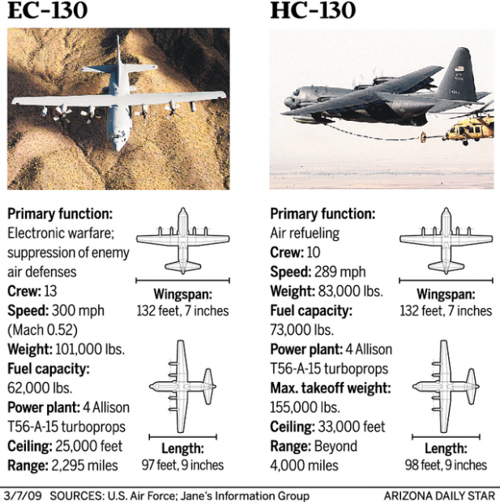
Hundreds of Air Force C-130 planes — including 22 assigned to Davis-Monthan Air Force Base in Tucson — are being checked for possible cracks in the nuts that help fasten the wings to the fuselage.
As of late Friday, five of the planes inspected at D-M were found to have the defect. Of those, three were grounded for repairs, and two were deemed safe to fly.
On Thursday, the Air Force ordered immediate inspections of its entire fleet of C-130s, nearly 600 in all, after cracks were found on some of the plane's upper wing-joint barrel nuts during routine maintenance at an air base in Georgia.
A stalwart performer for decades, the C-130 does myriad military jobs, from airlifting troops and equipment to evacuating disaster areas. .
D-M has three variants in its inventory: two C-130E transport planes; five HC-130 combat-search-and-rescue planes; and 15 EC-130s, an electronic-combat version used to jam enemy communications.
People are also reading…
Several of D-M's EC-130s currently are deployed overseas, but base officials wouldn't say how many for security reasons.
A spokeswoman, 1st Lt. Mary Pekas, said it's too soon to say what impact the situation will have on D-M operations.
As of Friday afternoon, all but one of the local C-130s had been inspected, she said. The base is still awaiting repair instructions from the Air Force for the planes found deficient, she said.
This is the second time in five months that D-M warplanes have been ordered to undergo inspection for airworthiness.
In October, the Air Force ordered the immediate grounding of 130 A-10 attack aircraft, including 82 in Tucson, after microscopic wing cracks were detected in some of the planes.
Fifteen of the more than 50 of the A-10s based at D-M found to have wing cracks are still grounded.