

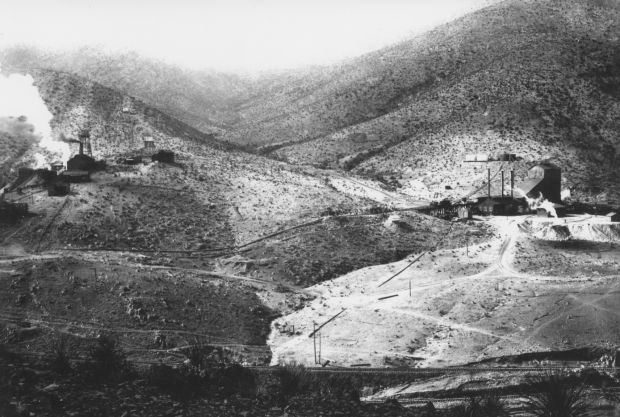
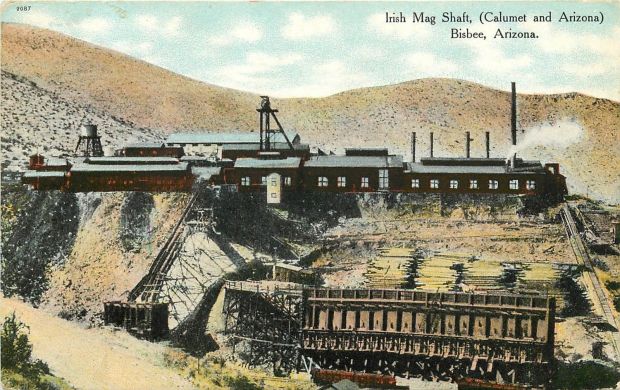
Located two miles southeast of Bisbee, the Irish Mag Mine — named after a Bisbee dance-hall girl — became known in 1899 as a large high-grade copper ore body.
The Copper Queen Consolidated Copper Co. had sought out the property a decade earlier, but conflicts with ownership and rival interests prevented the company from acquiring it.
The controversy involving ownership centered on James Daley, an Irishman who owned the Irish Mag claim. Daley loathed the management of the Copper Queen, who had isolated his claims by buying the surrounding mining property.
Neither Copper Queen Superintendent Ben Williams nor future president of Phelps Dodge James Douglas could convince Daley to sell the property. Daley responded to their overtures by threatening their lives if they ever set foot on his property.
In a reversal, Daley offered to sell the Irish Mag claim along with the Senator group of claims and a property on Sacramento Hill for $10,000. Williams rejected the offer as intimidation.
People are also reading…
Daley was later charged with killing town constable W.W. Lowther on April 10, 1890, while Lowther was serving paperwork on Daley for attacking a Mexican.
A decade of complicated litigation ensued among several potential claimants on the property who claimed connection with the Irishman.
The U.S. Supreme Court finally resolved the matter, granting Bisbee saloon owner Martin Costello title to Daley’s claims in 1899.
Ultimately the Irish Mag property along with 10 other claims was acquired for $500,000 from Costello by Eastern capitalists, including “Captain” James Hoatson and his brother Tom, who organized the Lake Superior and Western Development Co. along with T.F. Cole, who was interested in developing the claim.
Two years later the Calumet and Arizona Mining Co. was organized and assumed control of the capital stock of the Lake Superior and Western Development Co. It was to become the second largest corporate entity aside from Phelps Dodge’s Copper Queen Consolidated Copper Co., assuming a vested interest in Bisbee mining operations in the early 20th century.
In November 1900, work started on the Irish Mag shaft and within several years it reached 1,200 feet deep. By the 850-foot level, large ore bodies were discovered; previously only barren limestone had been encountered.
The ore was hoisted through the shaft and transported by steel cars to the Calumet and Arizona smelter near Douglas.
The rich strike at the Irish Mag Mine in 1900 instigated more prospecting several miles further south. Ore was discovered at the Cole Mine in 1903, at the Oliver Mine in 1904, at the Junction Mine in 1905 and the Hoatson Mine in 1908.
By 1911 the Irish Mag Mine was no longer producing. It was closed in 1917 and its structures removed. However, its notable impact was being the first mine developed by the Calumet and Arizona Mining Co., enabling it to become one of the most productive companies in Bisbee and the world.
The Irish Mag Mine is credited with having contributed a third of the company’s $47 million dividends over 20 years.
Toward the end of its operation, the Irish Mag Mine produced an average of 350 tons of ore daily and the market price for copper was 15 cents. More than 1.5 million tons of ore were produced during the mine’s 11-year history.
William Ascarza is an archivist, historian and author. His latest book, “The Chiricahua Mountains: History and Nature,” is available at Barnes and Noble online. Email him at mining@azstarnet.com
Sources: Lynn R. Bailey (1983), “Bisbee: Queen of the Copper Camps”; Richard V. Francaviglia (1982), “Copper Mining and Landscape Evolution: A Century of Change in the Warren Mining District, Arizona”; Stanton B. Keith (1973), “Index of Mining Properties in Cochise County, Arizona”; F.L. Ransome (1904), “The Geology and Ore Deposits of the Bisbee Quadrangle, Arizona”; Claude T. Rice (1910); “Camp of Bisbee, Arizona.”


 U of A acceptance rate rises to 90% as applications plunge


