

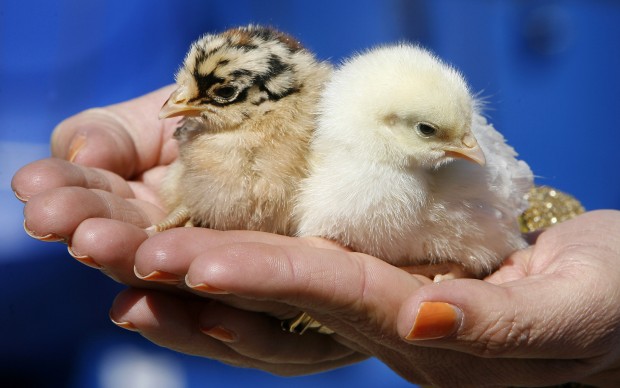
Those chicks, bunnies and other Easter pets that delight your child can suffer a sad fate if they're not cared for when the season is over.
Animals released into the wild can get sick, be hit by cars or be attacked by predators, say animal shelter and humane society officials.
This year, feed stores, shelters and humane societies are asking people to think carefully before bringing home an animal.
"People buy them for their kids, but if they did the responsible thing they'll bring them to a sanctuary," rather than dumping them when they're no longer wanted, said Darlene Braastad, founder of Forever Wild Animal Rehabilitation Center in Tucson.
Rabbits are very popular - but can be especially challenging as pets, said Lyndsay Bruno, spokeswoman for the Humane Society of Southern Arizona.
People are also reading…
Rabbits live up to 10 years, often have to be spayed or neutered, and can be very fragile, Bruno said.
"We just want to remind people that when you are adopting, the entire family needs to be involved because it is a long-term commitment," she said.
Braastad said popular Easter pets - chicks, bunnies, ducklings and geese - call for commitment on the part of owners.
Not only are such pets messy and difficult to take care of, but once they get used to a household it can be straining for them to be let go, according to Braastad.
"They bond with whoever is feeding them or taking care of them. It is almost immoral to give them up when they consider you family," she said.
Renée Bidegain, manager of Arizona Feeds Country Store, 2701 S. Sixth Ave., said she has seen an increase in the sales of chicks, ducklings and geese in the spring.
Braastad urges people to commit to an animal for its whole life and to not bring one home without doing the proper research beforehand.
"I wish that people would buy their child a stuffed rabbit or a toy duckling," Braastad said. "Kids get very bored with animals, and if they don't care for the animal properly it can die."
A BROADER PROBLEM
Easter-season pets aren't the only animals that sometimes get dumped when their owners lose interest in them.
State and county officials say people routinely release unwanted ducks, fish, turtles - and even alligators - into lakes and ponds.
Others abandon pets such as dogs, cats, birds, tortoises and exotic critters - leaving them to roam the wilds of Southern Arizona.
"The impact they have on the species that belong in these habitats can be dire," said Randy Babb, a biologist with the Arizona Game and Fish Department. "That impact can be anything from degrading the habitats to competing with the native animals for sites and food. In some cases, they will even eat the native animals."
Another possibility, Babb noted, is that the released pets can become prey for native species.
He said wildlife officers have seen "everything you can imagine" when it it comes to dumped pets.
"Most commonly, it's aquatic species," he said. "The Gila River outside of Phoenix is literally full of aquarium species. But birds are another thing we see." They are acquired as pets and later fly away to the desert or mountains.
"We've had calls for everything from loose primates to a kangaroo as tall as a wildlife officer … and an alligator was once released near Tombstone."
Urban area lakes are popular dumping grounds for fish and turtles, said Kerry Baldwin, a spokesman for Pima County Natural Resources, Parks and Recreation.
"Lakes, little ponds, you name it, if there's a water source people drop things off," Baldwin said. "They have fish they don't want to destroy so they dump them in Kennedy Lake."
The main pond at Agua Caliente Park east of Tucson is teeming with non-native species - from African fish to soft-shelled turtle, Baldwin said.
Elsewhere, some ponds are "totally infested with bullfrogs," he said.
"The best solution," Baldwin said, "is don't get the animals in the first place if you're not prepared to make a long-term commitment to keeping them."
It's a misdemeanor - punishable by a fine - to release animals in the wild, Babb said.
"If you need to get rid of an animal, take it to an animal-rescue organization," he said.
Doug Kreutz
"They bond with whoever is feeding them or taking care of them. It is almost immoral to give them up when they consider you family."
Darlene Braastad, founder of Forever Wild Animal Rehabilitation Center
Contact reporter Doug Kreutz at dkreutz@azstarnet.com or at 573-4192.


