
The grand opening of the Tohono O'odham Nation Cultural Center & Museum kicks off with two days of festivities starting Friday in the community of Topawa.
Priceless artifacts dating back 5,000 years up to modern-day pieces will be showcased in the nation's $15.2 million state-of-the-art complex.
Arrowheads, pottery and agricultural tools that were unearthed in archaeological digs and now rest in Arizona museums are returning to the O'odham, or the "Desert People".
"Not only will the legacy of our past be celebrated, but the future survival of our heritage will be practiced through the interactive programs and events planned by the staff," outgoing Tohono O'odham Nation Chairwoman Vivian Juan-Saunders said in a news release. "We embrace our past, honor our survival and prepare to meet tomorrow's challenges with the same spirit as our ancestors."
People are also reading…
Last week, the museum staff was working to prepare artifacts and complete exhibits for Friday's opening.
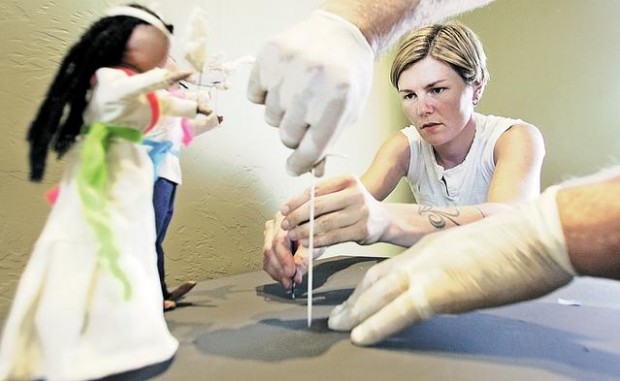
Among them were Allison Francisco, the museum's visiting curator, who was building an exhibit that included a roundhouse and a ramada. She made an adobe base and worked on the exhibit with mud, straw, mesquite and creosote.
She worked within the 38,000-square-foot complex nestled in desert with the sacred Baboquivari Peak as a backdrop. The O'odham creator, I'itoi, is said to live in a cave on the 7,730-foot mountain where O'odham make pilgrimages and pray to their creator.
The complex includes a community cultural and educational center with artist studios for a residency program, a special-collections cultural archive and two repositories for artifacts. Outside are an open amphitheater, a covered patio and a storytelling circle.
At the entrance of the museum, guests will receive both O'odham and English greetings that will air on a rotating video display.
The opening exhibit in the Changing Gallery features O'odham artists Monica Chana, Cody Chavez, Jamie Encinas, Shamie Encinas, Keith Norris, Louann Shannon and Delia Velasco. They prepared work on the theme "O'odham Brown — What It Means to Me." Their work includes paintings, photography and basketry.
Chana is the niece of the late Leonard Chana, a well-known painter from the Gu Achi District who died in 2004 at the age of 53. Leonard's widow, Barbara Chana, and friends hosted an exhibition of his work in 2005 in Topawa. It was later shown at the Fulton-Hayden Gallery in the Amerind Foundation in Dragoon.
Monica Chana dedicated her drawing "Our Protector" to her uncle.
"His artwork let me know who I was and what the Chana family did in the past," she wrote in her artist statement. "I feel his diary of artwork has meaning and I want to inspire someone and lead them toward their dreams as Leonard graced me with his love for art."
Barbara Chana, a member of the museum's artist advisory committee, said, "This cultural center and museum is a dream that many have carried with them and wanted to see happen, including Leonard.
"It is a manifestation of a desire to validate O'odham artists. This gives people an opportunity to see their gift of art. I am very excited to see what are in the exhibits and future works of artists."
Artifacts from the museum's personal collection and pieces on loan from O'odham families also will be on display in the museum, said Brenda Haes, curator of collections.
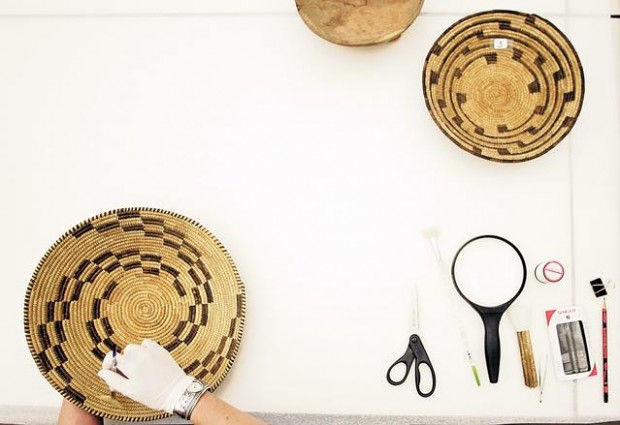
Pieces include baskets made from grass, metal and horsehair, and carved wooden bowls, trays and plates. The works are from the late 1700s to the present.
The O'odham Veterans Gallery is a hallway that is the backbone of the museum — running the length of the building with the exterior wall displaying a facade of stone tiles.
"We have borrowed a number of items from veterans and their families, including a rifle used in World War II, medals and photographs," said Haes. Medals soldiers received for service in Desert Storm and items from soldiers who served in Iraq also will be on display.
Memorabilia from World War I includes photos of Domingo Franco in uniform while stationed at Fort Huachuca. The photos were brought in by his son Patrick Franco.
"Most of the exhibits are about O'odham life and history within the last 200 years and focus on land, foods, language, government, family, seasons and youth," said Eric Kaldahl, an archaeologist who is curator of education and acting curator of exhibits.
Some prehistoric pieces on display were excavated in the San Xavier District during work on the Central Arizona Project canal in the 1980s, Kaldahl said.
A collection of baskets, pottery and figurines mostly from the late 1800s was borrowed from the Amerind Foundation.
Other pieces — some 60 items borrowed from the Arizona State Museum — include more recent pots, farming and ranching tools, a saddle close to 100 years old and a lariat.
"There are some collections at the Arizona State Museum from excavations that happened on the nation's land throughout the 20th century," said Kaldahl. Some occurred during the 1930s as part of Civilian Conservation Corps programs.
Some items date back close to 10,000 years and officials will work in partnership to turn over the artifacts to the O'odham museum in the future, Kaldahl said.
For artist Jeffers Chavez, also a member of the museum's artist advisory committee, the return of O'odham artifacts is a blessing.
"I am overjoyed that our work will come back home," she said. "Our ancestors will be at rest. This will be extremely overwhelming, especially for our elders."
Grand opening
• What: Celebration of the opening of the Tohono O'odham Nation Cultural Center & Museum. Activities include demonstrations by artists, a film festival, music and activities for families.
• When: Friday from 8:30 a.m. to 11 p.m. and Saturday from 9 a.m. to 5 p.m.
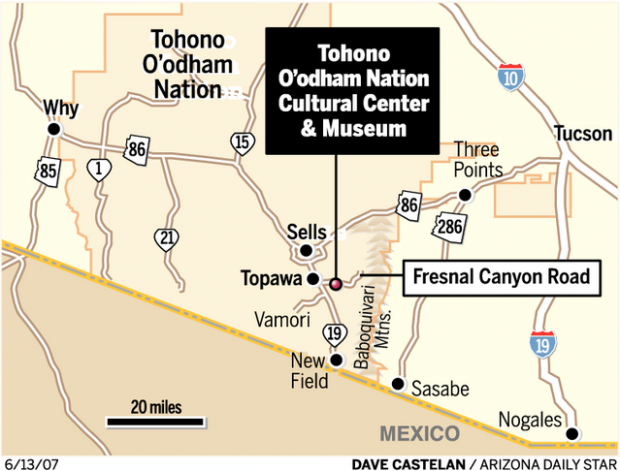
• Where: The cultural center and museum is in Topawa, a community 10 miles south of Sells on Fresnal Canyon Road. Sells, the capital of the nation, is 60 miles southwest of Tucson.
• Information: 1-520-383-0201
REGULAR HOURS
• The cultural center and museum is open Monday through Saturday from 10 a.m. to 4 p.m. Admission is free, but donations are accepted.

 U of A president declines to sign shared governance contract with faculty