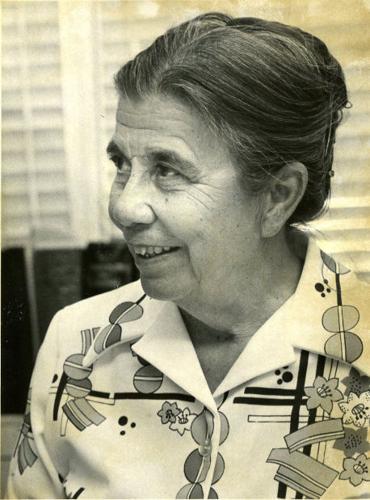
“I was born on a cold winter night by the light of an oil lamp. A curandera was in attendance, and my aunt … was accompanying my mother at my birth. She said I was born with a strange veil over my face. The curandera said this meant I would be able to tell the future.”
Maria Luisa Legarra Urquides was born in Tucson on Dec. 9, 1908. If she could tell the future, she would have foreseen her life unfolding significantly differently than that of her parents. Her father never attended school, and her mother did not go beyond the third grade. Yet their youngest child thrived in school, even though education of Mexican children in the Old Pueblo was far from perfect.
Schoolchildren were forbidden to speak anything but English. Those like Maria who only knew Spanish were punished for using their native tongue, and many youngsters spent two or three years in the first grade until they mastered the English language.
People are also reading…
At a young age, Maria gained a somewhat broad knowledge of her neighborhood when she went to work for local prostitutes. “When they legalized prostitution in Gay Alley,” she said, “it was right in back of our property. My dad quietly built a fence, but my curiosity was aroused and I loosened the boards and pushed in. Someone hollered, ‘Hi, Honey. Come on over.’ So I got acquainted with the girls. I was running errands for them, getting good tips. That’s the first time I ever had strawberries and cream with pink sugar.”
When Maria’s parents discovered her entrepreneurial enterprise, they moved.
In 1928, she received her teaching certificate from Arizona State Teachers College (ASU), graduating as valedictorian of her class. She went to work at Tucson’s Davis Elementary School, her students mainly of Mexican-American and Yaqui descent. She stayed there for 20 years.
Maria was forced to teach classes in English. “If I ever go to hell,” she once said, “it’ll be for scolding students for speaking Spanish.”
She painted the dull gray walls of her classroom with green paint she bought with her own money and enlisted the help of her students to get the job done.
The kids sold hot dogs and buns donated by Swift and Co. to buy shade trees for the barren playground. But when she returned in the fall, the trees were all dead.
In 1948 Maria began teaching at Sam Hughes Elementary. When she saw how attractive the grounds were and the book-filled library available to the students, she questioned why the Davis and Hughes pupils could not share their knowledge and backgrounds, learn from each other to enhance the spectrum of their education. She wanted to establish a bilingual-bicultural teaching program.
Along with other teachers, Maria surveyed school districts in surrounding Southwestern states to determine how they were introducing bilingual education to their students. The National Education Association published their findings, “The Invisible Minority.”
Her reputation as one of the most effective advocates for bilingual education led President Harry S. Truman to appoint her to the White House Conference on Children and Youth in 1950.
When she began teaching at Tucson’s Pueblo High School, Maria’s classes were composed mainly of Mexican children unable to read or write their native language and largely ignorant of their heritage. She initiated a concerted effort to teach Spanish to those students.
President Dwight D. Eisenhower reappointed her to the White House Conference on Children and Youth in 1960. She participated in the Symposium on Bilingual Education held in Tucson in 1966. It was so successful that members appeared before Congress to introduce the bilingual education concept.
During that time President John F. Kennedy appointed her to the State Advisory Committee to the Civil Rights Commission and President Lyndon B. Johnson called on her to sit on the National Advisory Committee to the Commissioner of Education on Mexican-American Education.
In 1968 Congress passed the Bilingual Education Act, providing school districts with federal funds to establish educational programs for students with limited English speaking abilities. The bill encouraged instruction in English while promoting multicultural awareness. That first year, 76 bilingual education programs were initiated for students who spoke 14 different languages.
Shortly after passage of the Bilingual Education Act, President Richard M. Nixon called on Maria to sit once again on the White House Conference on Children and Youth. She had earned the title “Mother of Bilingual Education.”
She also chaired the Arizona State Welfare Board and participated in a variety of local organizations, including the Pima County Association for Juveniles.
In 1965, the Tucson Daily Star named Maria Woman of the Year in Education, as did the League of Mexican American Women of Los Angeles. A scholarship was established in her name at the University of Arizona by the Mexican American Student Association. She received the Human Relations award from The National Education Association in 1968 and the Distinguished Service Award in 1970.
Maria retired from teaching in 1978, and was later awarded an honorary law degree from the UA for her work in education.
Yet despite her efforts to bring bilingual education into the classroom, the programs did not live up to Maria’s expectations.
“Bilingual education is not what I hoped it would be,” she said, “because we didn’t teach the monolingual child, the Anglo child, to speak Spanish.”
Maria was inducted into the Hispanic Hall of Fame and the Arizona Women’s Hall of Fame.
She died June 16, 1994, but her contributions to education continue to resonate throughout schools in Arizona as well as across the country.
Jan Cleere is an award-winning author, historian and lecturer. Her latest book, Levi’s & Lace: Arizona Women Who Made History (Rio Nuevo Publishers), is available in bookstores and online. Email her at Jan@JanCleere.com
Sources:
“46-Year Teacher Ahead of her Time.” Arizona Daily Star, Oct. 16, 1983.
“Bridging Three Centuries.” Tucson Unified School District. Accessed at http://www.tusd1.org/contents/distinfo/history/history9310.asp
Casey, Dick. “Angelenos Pay Tribute to Maria Urquides.” Arizona Daily Star, April 1, 1965.
Gonzalez, Elizabeth Quiros. “The Education and Public Career of Maria L. Urquides: A Case Study of a Mexican American Community Leader.” Dissertation submitted to faculty of Dept. of Educational Foundation and Administration in partial fulfillment of the requirements for the Degree of Doctor of Education in the graduate College, The University of Arizona, 1986.
Henry, Bonnie. “Maria Urquides Has Lived a Revolution in 84 Years.” Arizona Daily Star, Aug. 9, 1992.
“Maria Urquides Celebrates 25th Year as a Teacher.” Tucson Citizen, Oct. 28, 1952.
“Maria Urquides Named to Welfare Board.” Arizona Daily Star, Feb. 10, 1955.
Melcher, Mary. “ ‘This is not right’: Rural Arizona Women Challenge Segregation and Ethnic Division, 1925-1950.” Frontiers: A Journal of Women Studies, Vol. XX, No. 2. 1999.
“Miss Urquides Appointed to Welfare Post.” Tucson Daily Citizen, Feb. 10, 1955.
Quezada, Adolfo. “Teacher Wins Accolades.” Tucson Daily Citizen, Dec. 14, 1972.
Torres, Alva B. “’Mother of Bilingual Education Honored.’” Arizona Daily Star, April 15, 1986.