
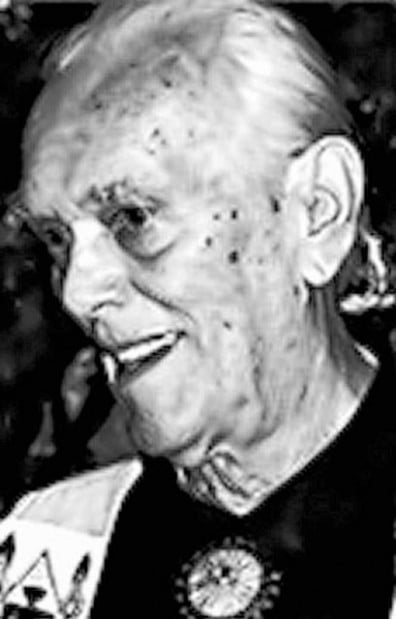
Charles "Chuck" Smith spent much of his life trying to find a balance between two worlds.
Born to a mother of German heritage and a father who was a full-blooded Lakota Sioux, the fair-skinned, blue-eyed Smith didn't look like other children living on the South Dakota reservation where he spent summers with his grandmother. Nor did he quite fit in at the Bronx, N.Y., neighborhood where he grew up.
It was in loom-style picture beading, learned from his Lakota grandmother, that Smith finally found harmony. It was a craft he honed in retirement and taught to others until his death Nov. 19 from a stroke. He was 74.
"It's a dying art," said Kathy Reyes, who owned a gallery in Tubac where Smith gave beading classes. "Native Americans aren't doing it anymore because it's just not cost-effective. There are so many hours put into these handmade beadworks. It would take them months to finish one piece. He could never get out of it what he put into it.
People are also reading…
"He was willing to teach non-Native Americans because he didn't want to see the art die," Reyes said.
Smith spent summers on the Pine Ridge Reservation. It was on these visits with his grandmother that he learned about beadwork, an art he passed on to his children and his grandchildren.
"When I was 6 years old, she made me a little loom out of two combs," Smith said, recalling, in a 2005 Arizona Daily Star article, his grandmother's beading lessons. That summer, he beaded his first diamond pattern. "I call my grandmother the Indian within my soul. She seems to always be with me."
Visits with his grandmother ended with his parents' divorce when Smith was 12.
At 17, Smith joined the Navy and continued beading in his spare time to maintain his skills and his connection with his grandmother. When he was discharged four years later, Smith returned to South Dakota to visit his grandmother only to find she had died while he was away.
Smith wed several times and spent much of his career working for an airline company to support his family, which included two sons and four stepchildren.
For years, he said, "I was living as a full-blooded white man."
Occasionally he would return to the reservation for powwows, where he sold his beadwork. But it wasn't until he and his wife of 17 years, Joan, moved to Tucson in 2002 that Smith began working on larger bead pictures.
"His work is a very old Native American process of loomed beaded art," said Kathi Rodgers, owner of Old Pueblo Frameworks & Gallery, the first gallery to represent Smith. "He would design a piece, draw it out and then would use thousands and thousands of tiny little beads on a loom and create these absolutely fabulous designs."
Smith's works — which require hundreds of hours and thousands of glass seed beads, named for their small size — sell for hundreds of dollars, but it was not money that motivated the artisan.
"The first time we tried to price out the pieces, Chuck just guessed, 'OK. What should I sell this for?' And from that we worked backwards," his wife said. After deducting the cost of materials, "we finally figured out he could get about $3 an hour for the work, but he just loved doing it."
The process Smith used is similar to weaving a rug on a loom. The finished product is like a piece of cloth, but made from tiny glass beads.
"What would get him excited was when he had an idea and he'd start putting it on graph paper and start thinking about the design coming together and what colors to use. Usually just that takes four or five days," his wife said.
Smith's patterns were in the tradition of Lakota beading styles — geometric, using triangles, bars and rectangles — but much larger than most of today's native beadwork, which is used for hatbands, bracelets and chokers.
"Handling those tiny beads with the needle and threading them back through the loom was not an easy task, I'm sure, with those big fingers," said one of Smith's stepsons, Michael Resnick of California.
Smith stood 6 feet 4 inches tall and had large hands and long, slender fingers.
It wasn't until Resnick took a summer beading class in seventh grade that he learned that his stepfather was an artist. When Smith saw the small, inadequate loom Resnick brought home from school, he helped his stepson build a better one and showed him the techniques he learned from his grandmother.
"He took time off from beading for a while," Resnick said. "He kind of scribbled some designs and things, but it wasn't really until he got to Tucson that he got back into beading, especially the large works. He would sit at that loom for hours making these beautiful designs and pictures."
On StarNet: Did you know Charles "Chuck" Smith? Add your remembrance to this article online at azstarnet.com/lifestories
Find a photo gallery of this Life Story at azstarnet.com/slideshows