

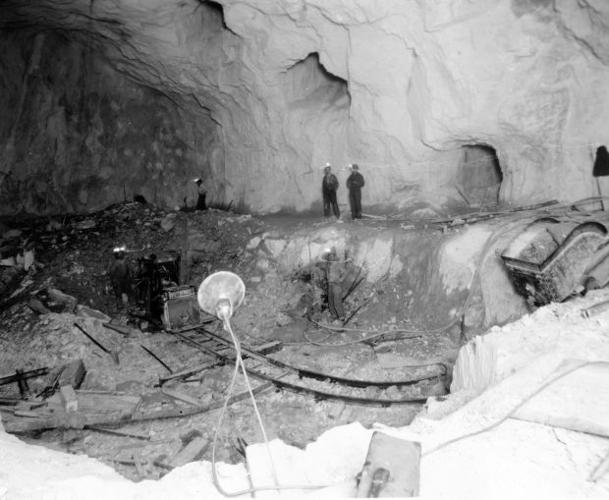
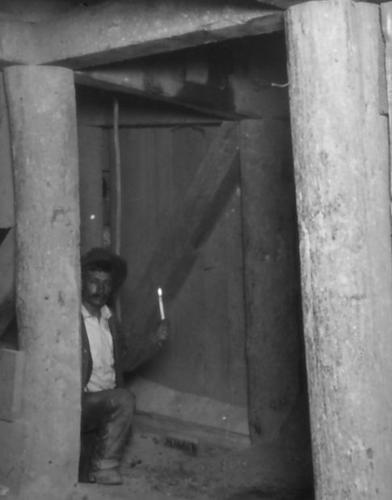
Lighting has played a critical role in the safety of underground coal and metal mining for several thousand years. Challenges in an underground mine environment include dust, confined spaces, surfaces with low reflectivity and reduced visual contrast.
Greek and Roman miners used oil lamps and candles in the first century A.D. Oil wick lamps were prevalent in the 16th century and remained in use until the early 20th century.
Another advance in technology occurred with the Davy lamp, a portable mine-safety lamp that debuted in 1816.
Developed by Sir Humphrey Davy, the lamp consisted of a wire gauze chimney that encased a flame. The metal of the gauze absorbed the heat, which reduced its ability to mix with flammable gas such as methane and ignite an explosion.
The lamp also was able to detect gases including carbon dioxide. It provided miners with early signs of oxygen-poor air by extinguishing the flame when the oxygen content of the surrounding atmosphere dropped below 17½ percent. These signs saved miners from asphyxiation.
People are also reading…
Miners originally used canaries to detect methane and carbon monoxide. The canary served as a bellwether for the miner: When it was singing, the air supply was safe; when it died, it was time to evacuate; hence the saying “canary in a coal mine.”
The mine-safety lamp did have major drawbacks, including poor illumination, and it proved defective when the wire gauze broke or rusted.
Edmund Davy, cousin to Humphrey Davy, discovered acetylene gas in 1836. But it was Canadian inventor Thomas L. Willson who discovered a method of producing calcium carbide and acetylene in 1892 during his quest for a more economic and efficient means of aluminum production.
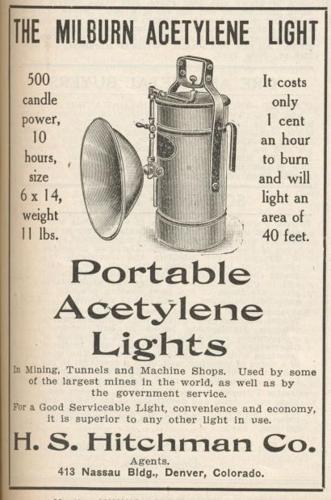
By 1900, Frederick Baldwin acquired patent 656,874 for an acetylene gas lamp for bicycles in the United States, the predecessor to the first carbide mining lamp. Afterward, production of carbide lamps was undertaken by a number of manufacturers, including Auto Lite, Justrite, Guy’s Dropper and Wolf.
Carbide lamps contain compartments for water and carbide. A valve is used to control water flow affecting the rate of gas production. The chemical reaction between the two produces acetylene gas channeled through a filter to a burner tip enclosed by a reflector responsible for directing light instigated by the flame.
The portable carbide lamp became an acetylene generator. The carbide lamp carried enough carbide to burn for four hours, along with an extra reservoir and supply of carbide sufficient for the miner to complete his shift. The miner’s canteen served as an additional water supply. Carbide lamps also were used in bicycles, motorcycles and automobile headlights.
By 1905, carbide lamps were used in coal and ore mines and were prevalent during World War I. By 1928, electric lights began to replace carbide lamps in mines. However, carbide lamps saw increased usage among cavers who preferred their light weight in contrast to the 3.6 to 5.3 pounds imposed by the electric mine lamp, which included a storage battery.
Today, advances in illumination technology have been made with the light-emitting diode (LED). Advantages in LED usage include durability and longevity providing more than 50,000 hours of light in contrast to the incandescent bulb that can provide up to 3,000 hours.
While increasing work efficiency, better lighting has allowed miners to see hazards and thus has led to a decrease in accidents at mines.
William Ascarza is an archivist, historian and author. His latest book, “The Chiricahua Mountains: History and Nature,” will be available Jan. 28 at Barnes and Noble online. Email him at mining@azstarnet.com
Sources: Clemmer, Gregg S., illustrated by Wendell E. Wilson (1987). “American Miners’ Carbide Lamps: A Collectors’ Guide to American Carbide Mine Lighting.” Tucson, Ariz. Westernlore Press; Halliday, William R. (1974). “American Caves and Caving.” New York: Harper & Row; Pohs, Henry A. (1995) “The Miners Flame Light Book.” Denver, Colo. Flame Publishing; Sammarco John J. and Timothy Lutz. “Visual Performance for Incandescent and Solid-State Cap Lamps in an Underground Mining Environment” from the IEEE Conference 2007; Young, George J. (1946) “Elements of Mining.” New York and London: McGraw-Hill Book Co. Inc.




 Tucson's having a big fast-food reshuffle


