

More so than those in other years, the most impactful stories of the past 12 months will reverberate far into the future.
They will stick with us – for the sheer horror.
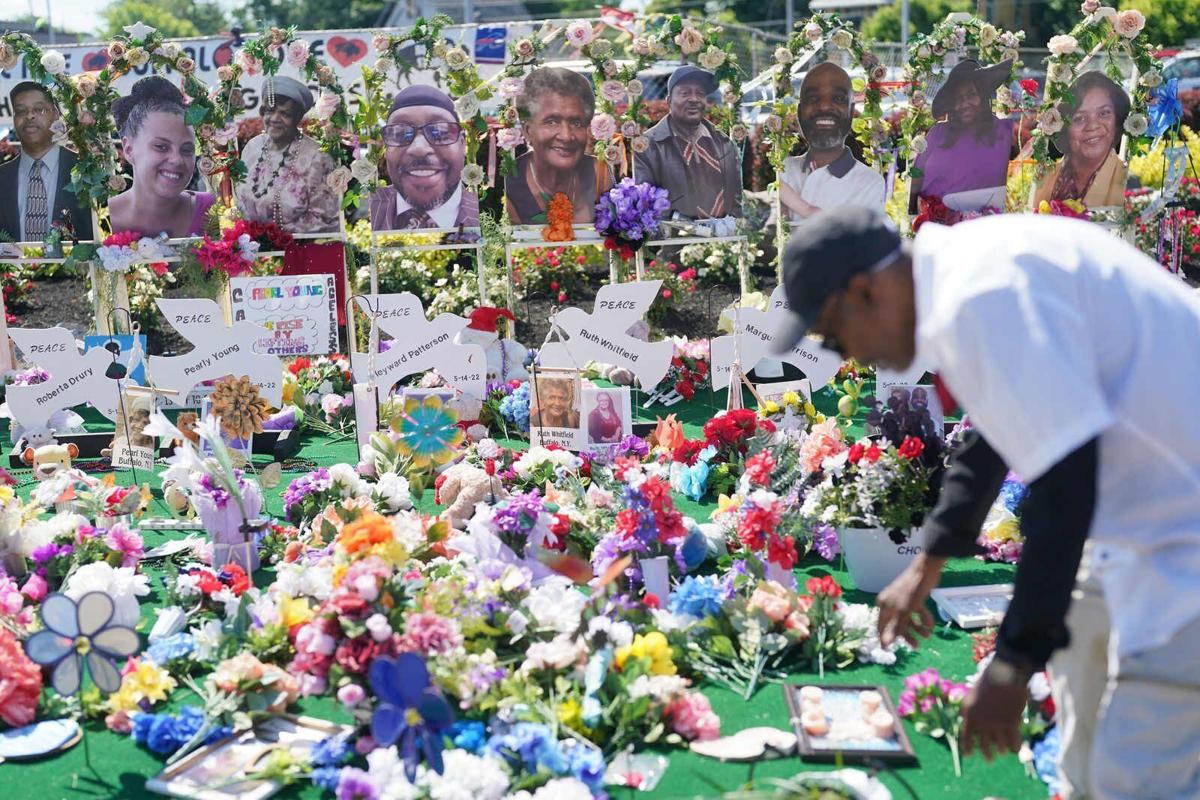
First came the racist mass shooting: An 18-year-old white supremacist opened fire May 14 at a Tops Markets grocery store on Jefferson Avenue, killing 10 Black shoppers and employees.
Then came the calamity: a fierce, unrelenting Christmastime blizzard that killed dozens as several feet of snow fell and winds reached 79 mph and left even first responders needing to be rescued and unable to answer calls for help.
People are also reading…
The trauma from those two events alone defined 2022 as one of the worst years to remember.
"2022 has been a horrible year for our community in so many different ways," Erie County Executive Mark Poloncarz said this week at a blizzard briefing. "I can't wait until 2023 starts, to tell the truth. I think we all feel the same way. Karma owes us next year, big time, for this community."
Beyond the immediate pain, the mass shooting and the blizzard could shape the Buffalo Niagara community for decades to come, depending on how successfully residents and community leaders overcome the East Side's legacy of segregation, disinvestment, food insecurity and poverty among other issues – and if City Hall comes up with a blizzard response plan.
Kathy Hochul's election as New York's first woman governor – and the first upstater in 100 years – keeps in Albany a leader familiar with the community and open to giving large amounts of state dollars to boost the East Side and address other issues.
She had a prominent role in developments that will shape our physical landscape for a generation or two.
A 30-year deal was reached to build a $1.4 billion stadium for the Buffalo Bills.
And a $1 billion plan was announced to reconnect predominantly Black neighborhoods and restore Humboldt Parkway by covering a portion of the Kensington Expressway.
These stories and more helped make for an unforgettable year – despite the reflex to try to forget many of them.
The massacre lasted 123 seconds, from 2:28:57 p.m. until 2:31:00 p.m. on a Saturday.
Ten people were gunned down at the Tops Markets in a horrifying mass shooting that officials were quick to label as "pure evil" and racially motivated.
Those killed were Pearl Young, Ruth Whitfield, Margus D. Morrison, Andre Mackniel, Aaron Salter Jr., Geraldine Talley, Katherine Massey, Roberta A. Drury, Heyward Patterson and Celestine Chaney. Three others were wounded.
Payton Gendron later pleaded guilty to 10 counts of first-degree murder, among other state charges, which guarantees life in prison without the chance of parole.
"What happened here is simple and straightforward: terrorism," President Biden said during a visit to Buffalo days after the shooting. "Violence inflicted in the service of hate and a vicious thirst for power that defines one group of people being inherently inferior to any other group."
Biden called white supremacy a poison that has "been allowed to fester and grow right before our eyes."
"No more, no more," Biden said. "In America, evil will not win, I promise you."
The National Weather Service forecast the storm as a "once-in-a-generation event."
They were right.
But the ferocity still came as a shock, with whiteout conditions for two days that paralyzed the first-responder response.
It was around 8:40 a.m. when Buffalo Niagara International Airport first began experiencing blizzard conditions. "Temps were nosediving into the 20s, with heavy snow and winds gusting over 65 mph," according to the weather service.
The Buffalo region's death toll from the Christmas weekend blizzard grew to at least 40 people, with 31 in Buffalo.
Seventeen of the people were found outside in Erie County, 11 were found in a home and four in a vehicle. Four of the deaths were cardiac events while a person was removing snow, and three died because of delayed emergency response during the blizzard.
More than 108,000 National Grid customers were without power, as the utility brought in high-powered torpedo heaters to melt snow and ice that accumulated on equipment and front-loaders to clear tall snowbanks piled up in front of substations. National Grid suffered 148 broken poles, 137 damaged transformers and 1,260 sub-transmission circuits that needed to be replaced.
"We’ve never had this. Even though we get snow in Buffalo, from November to March, we’ve never had it blow to the degree it did," said Kenneth Kujawa, regional director for Western New York for the area's biggest electrical power company.
At about 11:35 p.m., Gov. Kathy Hochul took the stage at her victory celebration in Manhattan.
“Tonight, you made your voices heard loud and clear, and you made me the first woman ever elected as governor of the State of New York,” she said.
Hochul, who assumed the office after Andrew Cuomo's resignation in August 2021, slogged it out in the closest gubernatorial contest in a generation, notching a victory of 5 percentage points over Republican Lee Zeldin.
While Zeldin ran strong in his native Long Island and scored decently upstate, he could not crack through the Democratic monoliths of Brooklyn and Manhattan.
A tentative deal for a new stadium in Orchard Park includes a lease provision that guarantees the team's long-term future in Western New York, Hochul said.
The Bills would get a new $1.4 billion home, with New York State and Erie County footing $850 million of the upfront cost to build it, but also with a pact that includes a 30-year lease that Hochul called "ironclad" and that County Executive Mark Poloncarz said will keep the team in Buffalo for as long as he lives.
“Buffalo Bills fans have enough stress,” Hochul said. “I did not want them to have to worry about the future of the team.”
Team owners Kim and Terry Pegula are contributing at least $350 million toward stadium construction, plus the $50 million they will have to reimburse the league.
"While there are more hurdles to clear before getting to the finish line, we feel our public-private partnership between New York State, Erie County, led by County Executive Mark Poloncarz, and the National Football League will get us there," they said.
Only in a blizzard year would a snowstorm that dumped nearly 7 feet of snow on Hamburg and Orchard Park over a three-day span be relegated to second-worst snowstorm of the year.
The storm, much like the deadly squall of 2014, left the Southtowns paralyzed, virtually overnight.
"We're dealing with a lot. Non-stop since those first snowflakes started to come down," Orchard Park Police Chief Patrick Fitzgerald said.
By just about all accounts, the massive government and private sector response succeeded in avoiding the serious disasters of the past monster snowstorms.
The towns dealt with hundreds of disabled vehicles on streets and roads, and emergency responders shuttled stranded motorists to warming shelters.
But few vehicles were stranded on the Thruway or other highways, as opposed to hundreds in the Wall of Snow in November 2014.
The School Board unanimously approved a termination agreement with Cash, who had come under fire for his handling of the Covid-19 pandemic and for how he handled tensions at McKinley High School that escalated into a violent assault last month.
The board picked Tonja Williams to run the region’s largest district.
Williams, a lifelong Buffalonian and graduate of Riverside High School, called it "a new day" for the district.
Williams said her two priorities are ensuring that all school campuses are safe and ensuring that all children are learning at high-quality levels.
"I am, through and through, a Buffalonian. I know the children. I know the parents. I know this community," she said.
By 10:45 a.m., the amphitheater of the Chautauqua Institution had mostly filled with patrons who came to hear author Salman Rushdie, who has been living under death threats from Iran for more three decades after the publication of his book "Satanic Verses."
Rushdie, 75, was on stage with his interviewer when a man bounded onto the stage and stabbed him. Among Rushdie's injuries were four stab wounds to the stomach and two to the chest, along with wounds to the right eye, hand and thigh. The interviewer, Ralph Henry Reese, suffered minor injuries in the attack.
Hadi Matar, 24, of Fairview, N.J., was later indicted on charges of second-degree attempted murder and second-degree assault.
At a community vigil that night, Michael E. Hill, president of the Institution, spoke about the horrific scene.
"What many of us witnessed today was a violent expression of hate that shook us to our core. We saw it with our own eyes and in our faces," Hill said. "But we also saw something else today that I don’t want us to forget. We saw some of the best of humanity in the response of all those who ran toward danger to halt it."
The New York State Court of Appeals voided congressional district maps drawn by New York's legislative Democrats, which Republicans labeled "gerrymandered and unconstitutional."
Four judges on the state's high court affirmed the GOP legal contention that the super-majority of Democrats in the State Legislature gerrymandered favorable districts after the Independent Redistricting Commission deadlocked. Three other judges fully or partially dissented.
Republicans said the Democratic plan was almost guaranteed to reduce New York's GOP delegation in Congress from eight to four.
State Supreme Court Justice Patrick F. McAllister in May ruled in the Republicans' favor, followed by reaffirming decisions in the Appellate Division and, ultimately, the Court of Appeals.
Voters in November elected 11 Republicans to the House of Representatives, helping to form a new Republican majority in the House.
"We just knew they were trying to eliminate the Republican Party as a political power in this state," said former Rep. John J. Faso, among the Republicans who filed the lawsuit challenging the Democratic plan to reapportion New York's congressional districts. "It's not in the public interest to have one party power, and that's what they were trying to do."
Hochul reinforced her commitment to converting a section of the Kensington Expressway that runs through the East Side into a below-ground tunnel.
In remarks at the Buffalo Museum of Science, the governor announced the required federal environmental review of the project "begins immediately."
"This community has literally been splintered apart," she said. "Righting the wrongs of the past is so smart for countless reasons, and they all tie into my philosophy of connecting communities once again and also stimulating the economic development and affordable housing opportunities."
Hochul later announced $1 billion in federal and state funds would be used for the project.
The Federal Highway Administration has agreed to fast-track the review, aiming to complete the study quicker than the three and even four years it typically takes to produce a plan for major transportation projects.
Around 9 p.m., Paul Marzello, president and CEO of the Buffalo and Erie County Naval & Military Park, discovered the ship was taking in water.
By the next afternoon, the World War II-era destroyer was leaning on its side and sinking in the shallow waters in the Buffalo Inner Harbor.
"This ship will rise again, and failure is not an option,” Marzello said of the floating tribute to a working-class family that lost all five of its sons aboard the torpedoed USS Juneau during World War II.
The USS The Sullivans was righted in the first week of May, after roughly 600,000 gallons of water were pumped from its hull.
On Dec. 20, Senate Majority Leader Charles E. Schumer confirmed that $7.5 million would be allocated to saving the USS The Sullivans from the $1.7-trillion government spending bill which President Biden signed Thursday.


