


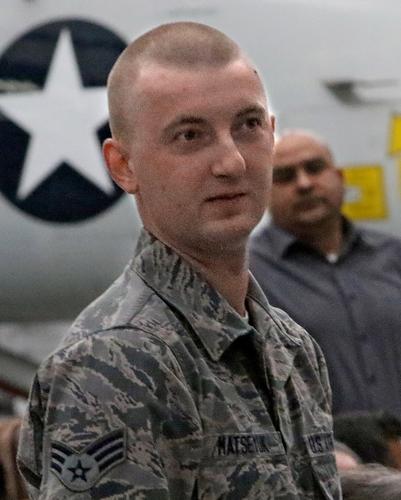
Sergei Matseyuk, a 25-year-old native of Belarus and senior airman in the U.S. Air Force, wore his fatigues as he stood front and center and took the oath of citizenship Friday morning.
Matseyuk was one of 126 people who took the oath during a ceremony at the Pima Air and Space Museum to commemorate Veterans Day. U.S. Citizenship and Immigration Services is swearing in about 10,000 new citizens at 130 ceremonies across the country in the coming week.
“This country has better opportunities than anywhere in the world,” Matseyuk said after the ceremony. “You still have a chance to be someone.”
He came to the United States from Eastern Europe in 2005 when his mother married a U.S. citizen. He signed up with the Air Force after he graduated high school in Albuquerque and now works in material management at Davis-Monthan Air Force Base.
People are also reading…
Matseyuk was joined Friday morning by new citizens from 28 countries, including Afghanistan, Burundi, Canada, El Salvador, Greece, Haiti, Indonesia, Jordan, Kenya, Nepal, Somalia, Togo, the United Kingdom and Vietnam.
For Eman Alhalabi, citizenship means she can visit her family in Palestine for the first time in four years. Before becoming a citizen, she worried about being stopped as she returned to the United States.
“Now, we can go,” she said with a beaming smile. “I’m very happy that we can go and come back.”
Her husband Tarek Hassan, a former resident of Lebanon who became a U.S. citizen in 1992, took the microphone to tell the crowd how becoming a U.S. citizen changed his life.
“It was impossible for me to go from one country to another without all the hardships,” he said.
In Lebanon, Palestinians are prohibited from working in 75 professions, despite the high rate of college graduates among Palestinians there, he said.
After becoming a U.S. citizen, “I was able to go anywhere I wanted without any problem, without any harassment, without any headache,” he said.
After Hassan spoke to the crowd, about two-dozen new citizens and their family members expressed their pride, happiness, and optimism for the future, often with tears in their eyes.
A man from India told the crowd he was happy “to come from the world’s largest democracy to the world’s best democracy.”
A schoolteacher from Canada said that despite not coming from a war-torn or dictatorial country, she still was thankful she could “read my Bible and go to church without fear of persecution.”
A man from Sudan applauded the kindness of people in Tucson, his home for the past four years.
Keynote speaker Johnny Williams, a former official with the Immigration and Naturalization Service, welcomed the new citizens.
“Many of you have endured severe persecution, others, unbearable hardships, and some are trying to find a better place to raise your families and make a better life,” he said.
“You chose America from over 196 countries in this world. That is an awesome choice to me,” he said.
In honor of Veterans Day, Williams said soldiers have guaranteed the freedoms many U.S. citizens value. He encouraged the new citizens to take advantage of those freedoms, such as the right to vote, and give back to their communities.
Contact Curt Prendergast at 573-4224 or cprendergast@tucson.com. On Twitter: @CurtTucsonStar

Curt Prendergast
Editor


