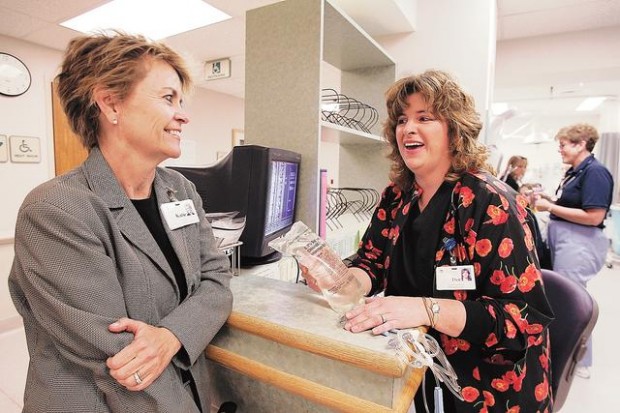
Registered nurse Katie Gleason was at the top, in charge of hundreds of Northwest Medical Center's emergency and urgent care workers. Then the roof caved in.
She was standing in the ambulance port outside an emergency room when its canopy collapsed on her.
Gleason, a longtime registered nurse, finally had her chance to be on the other side of the emergency-health-care provider-patient relationship, and she missed it.
"I actually don't remember anything of that day," said Gleason, emergency operations director at Northwest Medical Center, 6200 N. La Cholla Blvd.
But others have told her that thousands of pounds of rubble — which just a second before was the massive canopy over the ambulance port — crushed her around 2 p.m. on Aug. 31, 2005.
Gleason, who is in charge of several hundred employees at Northwest's emergency rooms and urgent care centers, was inspecting the ambulance port, which was being repaired after a vehicle had run into it. She was there to make sure there was enough clearance for ambulances to get through.
People are also reading…
Patients, and more often the families of patients, want odds of survival when someone has been injured or been diagnosed with a disease.
Gleason, 52, said someone with her combination of conditions and injuries — she stopped breathing for more than three minutes while buried under tons of debris and had collapsed lungs and many broken bones — survives only about 1 percent of the time. That works out to a chilling one-in-a-hundred chance of survival to the medical oddsmakers.
She credits her survival to having a Northwest Fire/Rescue District paramedic crew there when it happened, having skilled emergency room physicians, nurses and medical technicians at the ready, and a quick helicopter evacuation to the trauma center at University Medical Center.
Gleason said people made a complex series of critical decisions correctly and quickly.
The rescue crew had the specialized equipment needed to lift the debris off her and assessed the "life or limb" decision correctly, deciding to get her out as quickly as possible: Get the lungs and heart working and worry about the myriad broken bones — a pelvis shattered in eight pieces alone — and other injuries later.
She was at UMC in 38 minutes, within the "Golden Hour," Gleason said.
Gleason spent seven days on a ventilator in intensive care at UMC before being moved to a step-down unit for nine days.
Then she was on to Northwest Medical Center/Oro Valley for rehabilitation.
She was in a bed or a wheelchair until Dec. 16 and still goes to Oro Valley for rehab work on her right foot, which was crushed. She still uses a cane.
"I had to learn to walk again," Gleason said. She didn't start driving again until March.
"I had wonderful care," she said, but "no revelations."
Gleason, who had worked at Northwest for five years before the accident, says she already knew the Northwest Medical Center emergency room people were excellent, that it was important to have a top-notch trauma center nearby and that a helicopter could be crucial in some cases.
"As a nurse, you see so many sad things, horrible things over the years. I don't take good luck for granted," she said quietly while sitting in a nearly empty waiting room.
It's not easy for Gleason to talk about what happened to her, and it's not just that she doesn't remember a thing about Aug. 31. She is a very private person, she said.
"I would not be doing this," she said of the interview, "but I believe in nurses."
Gleason is the speaker at the 12th annual Fabulous 50, a May 13 dinner and dance at the DoubleTree Hotel at Reid Park, sponsored by the Tucson Nurses Week Foundation during National Nurses Week.
The event honors 50 Tucson nurses nominated by other nurses, doctors or patients for mentoring or being role models, their concern for humanity, or contributions to the community or significant contributions to nursing.
"It will be the first time that I've been at all public about my injuries. If I can highlight how important health-care workers are and highly skilled," then it would be worth the loss of her privacy. she said.
Mary Doyle, an RN who has known Gleason since the late '70s, said she isn't surprised by Gleason's reluctance to go public, or her decision to do it for her profession.
"It's really heartwarming," said Doyle, one of this year's 50 honorees.
Gleason came back to work at Northwest on Jan. 3.
"When you survive something like this, I think it's important to get back to normal," she said. And for her, normal means work.
"I really like — love — what I do," said Gleason.
"It's hard work," she said of emergency medicine.
"It's good work."