Money talks. But when it speaks in computer code about network maintenance, it’s not talking in a language many Pima County students apparently respond to.
Despite promising job growth in the field, enrollment in the Pima County Joint Technical Education District’s computer maintenance, information technology and software development classes have plummeted.
There are 300 students enrolled in those courses this year, down by more than half from 2012.
Teenagers that do find their way to a computer-related class seem to understand the post-graduation potential. Students in a new JTED information technology class said they were interested in the money.
“Employability,” in the words of Amanda Larmore, a junior at Canyon del Oro High School.
Jobs in computer support, information security, database administration and several other computer-science-type jobs are all on track to increase faster than average, according to the Bureau of Labor Statistics.
People are also reading…
“It’s a real quandary because we know that the jobs — IT related and computer programing related, software development related — those jobs are out there, but we can’t attract students to the pipeline,” said JTED Assistant Superintendent Aaron Ball.
JTED is an overlaying district open to all Pima County high school students. It offers more than 60 different vocational classes. Voters approved its creation in 2006.
In Tucson, jobs in science, technology, engineering and math, commonly known as STEM, account for 20.3 percent of overall employment in 2011. That’s higher than average, according to a 2013 Brookings Institution study.
“Right now, my belief is we have to continue to sell students on the economic value of them as far as the labor market need,” said Patti Greenleaf, the career and technical education director for the Amphitheater School District.
Classroom as a lab
The building where students meet for class is in the midst of a remodel, and the last tenant left a jumble of unlabeled, multicolored cords in the computer server room.
Students will be tasked with untangling, rewiring and perhaps even remodeling the room.
“It’s a work in progress,” teacher Abel Vazquez said of the building and the same is true for the new class.
The class is a hybrid with twice-monthly in-person meetings and online assignments. At the end of the course, students complete a paid summer internship and potentially earn a professional certification.
“What we understand is that if students can see that connection to the pathway, what it’s like to be out in the workforce, they might stick with it and connect up,” Ball said.
A $60,000 grant from Science Foundation Arizona funded the class. The curriculum is based on the Microsoft IT Academy, a set of lessons that correspond with tests students can take to earn professional technology certifications. State legislators approved a $1 million contract last year to purchase the program for public schools.
Students in the class come from several high schools, including Canyon del Oro, Ironwood Ridge and Flowing Wells, where they could take classes in graphic design, or Web and software development.
A majority of hands shot up when students were asked if they ever had to help fix someone’s computer.
Larmore, the CDO junior, plans to study molecular and cellular biology in college, but the job potential in IT is a big draw.
“I need a job that’s more than just minimum wage,” Larmore said. “I don’t want to be stuck working at McDonald’s while I’m going to college.”
Finding the students to enroll in the class was one hurdle, the other was finding the instructors.
“It’s hard to find folks with a coding background who are certified to teach,” said Flowing Wells School District Assistant Superintendent Kevin Stoltzfus. His district middle schools and elementary schools have after-school robotics programs, but have fewer options at the high school level.
JTED looked to its own ranks to staff the hybrid class. Vazquez is the district’s director of IT and his co-teacher, Debbie Anthony, is a network and systems administrator. Both completed a teaching certification, and the JTED program allows them to maintain their current jobs while teaching. It’s a model Ball hopes could be applied at other school districts who can’t find full-time teachers.
“A teacher really makes a program,” Ball said. “It sounds cliche, but it really is true.”
An example of this can be found at Sunnyside’s Desert View High School, where teacher Ivan Rodriguez, a former Raytheon employee, helped grow the technology classes, from 11 students to more than 200 in two years.
Rodriguez combats the sometimes-dry material by incorporating activities he knows pique young adults’ interests, such as video games.
In one term project, students designed their own fantasy video game, right down to the color of a villainous wizard’s outfit.
“They are excellent players,” Rodriguez said. “All they need to learn is thinking about how to solve a problem.”
Students are also working toward passing the Microsoft certification tests, something Rodriguez hopes will make it easier for students to connect with the industry after graduating.
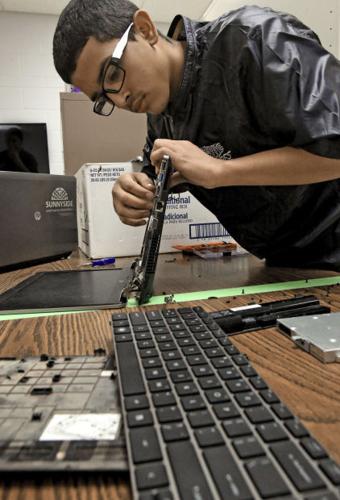
Desert View offers a unique opportunity for students to practice computer maintenance skills through the student-run tech support team dubbed the JAGWires — a play on the school’s mascot, the jaguar.
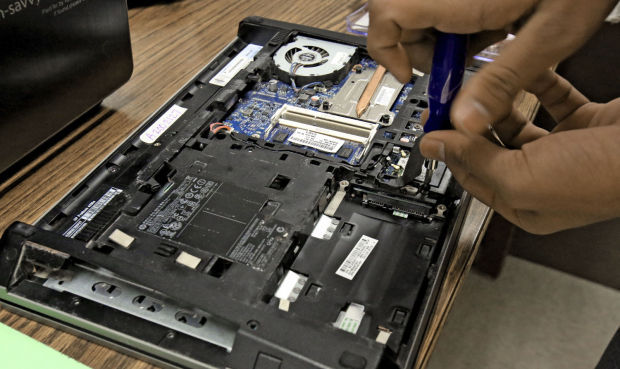
In a district that assigns every student a laptop, there’s no shortage of issues, from computers dropped off staircases to missing keys and broken screens.
“Primarily it’s just getting them exposed to what the computer is capable of,” said Lauren McIntyre, an instructional tech coach who pioneered the program.
There’s a regular group of 10 students, but with enrollment in the computer maintenance classes, there’s hope that will change.
Roman Aldana, a 15-year-old sophomore, started tinkering with computers in middle school and can change a laptop screen in 20 minutes. He comes in every morning — two hours before school starts on Wednesdays — to work on the computers.
“You just have to have the patience to go through the process of it,” Aldana said of the job’s minutiae, which usually includes wrangling dozens of tiny screws.
Aldana thought about pursuing a career in the Marines, but after working with JAGWires and taking computer science classes, wants to join the Air Force and pilot drones or work on cybersecurity.
Aldana already manages the security of the computer he built from scratch last summer. His cellphone pings him whenever malware or viruses threaten.
“When you build your own computer, it’s not simple,” Aldana said. “I’ve worked hard and I can show how I’ve learned it.”