They wore sable and Shalimar, and if the trail rides got too rough, why, there was always the limo to take them back to their rooms.
Sound like any dude ranch you know?
Hardly. Try lodge - as in El Dorado Lodge, which catered to Jewish guests wintering in Tucson during the '50s and '60s.
Located at the northeast corner of Wilmot Road and Speedway - then the middle of nowhere - the lodge opened in 1949 specifically to serve Jews who were banned from Tucson's other dude ranches.
Not that it tried much to emulate them. Instead, it was lavish buffets and dressing for dinner - sans blue jeans and boots.
"All the women were told not to bring their jewelry, but they did anyway," says Bobbi Janes, who started working the switchboard at El Dorado in the fall of '57 when she was 18.
People are also reading…
She also worked in the office with Evelyn Bittker, who with her husband, Arthur, bought the 320-acre Stone Ashley estate and converted it into a guest lodge in 1949.
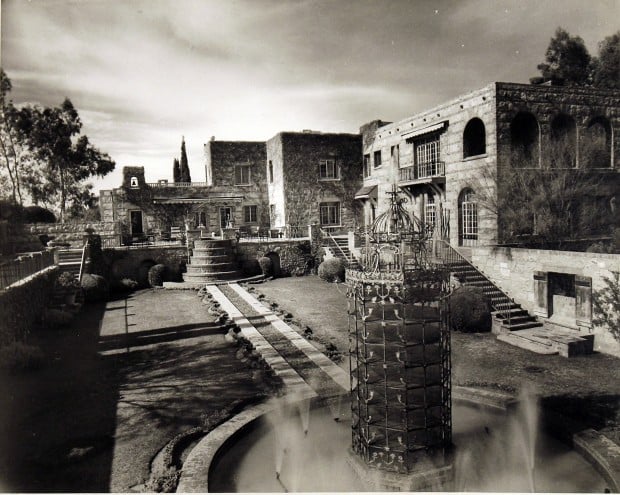
Built by Florence Pond in the 1930s, the 17-room mansion boasted a cypress-lined driveway that's still there, formal gardens and a swimming pool.
Originally from New York, the Bittkers, along with other investors, bought it all for $200,000 and spent another $400,000 adding accommodations for 80, a dining room that could serve 125 and quarters for 28 employees.
"I roomed with another woman, and we shared a bathroom," says Janes, who was paid about $100 a month plus room and board.
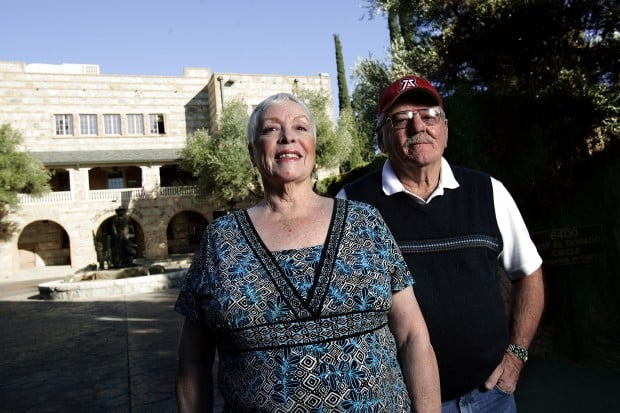
Also working at the lodge during the late '50s was David Cardenas, who now lives in California, and Jim Walters, who would marry Janes in 1960.
Long divorced, Walters and Janes still share fond memories of the lodge, as does Cardenas.
All remember a dining room that looked out at the Santa Catalina Mountains, and an elegant sunken Italian garden with its stunning water feature.
Cardenas, 68, worked in the dining room, where he remembers "great clouds of Shalimar" wafting from the ladies as they dined on everything from lobster to blintzes and latkes.
Walters, 74, was a bellhop and chauffeur, and also ran the motion-picture projector in the basement. "Not all the movies were ancient," he says. "I remember we showed 'Cat on a Hot Tin Roof.' "
It was his job to pick up the guests at the airport in one of three Jaguars - which "seldom ran well," he says.
"Most of the guests were from Chicago and L.A., and the women wore sable, not mink," says Walters, who made most of his money in tips.
"One night I picked up a man by himself at the airport, and he had 17 bags," says Walters. "I had to load all 17 of them up, then unload them in his room. My tip was 50 cents."
When Arthur found out about it, he threw the man out.
The season ran from October to May, and guests stayed a minimum of two weeks. Rates, says Janes, were a pricey for the times - $110 a day, double occupancy.
Then again, guests could afford it. "I was impressed by the great wealth there," says Janes. "Someone would whisper: 'There's Henry Crown. He owns the Empire State Building.' "
Once a week, the guests played cowboy, remembers Cardenas, with the dining room staff packing up barbecue fare and trucking it out to Sabino Canyon.
Meanwhile, guests - duded up in their best Western wear - saddled up on horses that the Bittkers kept at a small stable east of the lodge. More than one trail-weary rider would return to the lodge via limousine, says Cardenas.
The lodge also offered a swimming pool - sometimes cooled by ice cubes, remembers Cardenas - as well as a bar manned by Pete, the bartender.
"They did not have a liquor license," says Walters. "Clients brought their own, and Pete did the setups."
All three remember Hildegarde - though there's some disagreement about whether she was a parrot or a scarlet macaw - who held forth from a cage on the terrace, calling out, "Arthur, Arthur."
"She also sang, 'I could have danced all night,' then quit," says Walters. "We were all waiting for the rest, but it never came."
He also remembers the legendary card games at the lodge, in a room swirling with cigar smoke and high stakes.
One night, says Walters, a guest lost $1,200 to Arthur in a card game. "He got $1,200 worth of pennies and a wheelbarrow, and took them on the elevator to the third floor and dumped it in front of Arthur."
Walters spent just one season at the lodge; Janes and Cardenas were there three seasons.
"When the last guest left, the staff started packing things away," says Cardenas. "It was a kind of melancholy time. Hildegarde was gone, so there were no shrieks of 'Aw-thur! Aw-thur!' "
In 1968, the Bittkers sold the lodge and later moved to Las Vegas, where Arthur died in 1975, Evelyn in 1999.
Over the years, the property has been developed to include a golf course, homes and offices. Various restaurants, including the classy Charles, have occupied the dining room from time to time. Today the lodge is home to the Mountain Oyster Club.
As he walks the terrace where Hildegarde entertained one and all, Walters says, "It's not what it once was."
Then again, nothing is.
DID YOU KNOW
Former first lady Eleanor Roosevelt was a guest for a night at El Dorado Lodge, praising it in a November 1953 column for its "beautiful Italian gardens . . . dropped right in the midst of the desert."
Bonnie Henry's column appears Sundays and Mondays. Reach her at 573-4179 or at bhenry@azstarnet.com or write to P.O. Box 26807, Tucson, AZ 85726.