PHOENIX - Susan Regan said no one exactly asked her to take her son, Sam Schmid, off life support and donate his organs after an Oct. 19 traffic crash on Tucson's east side that left his University of Arizona roommate dead.
"What I remember, since I was in kind of a shock myself, is that the people who were surrounding us were just asking about Sam and what kind of person Sam was, and what Sam's goals were, and what he thought was important in life, what he considered his quality of life," she said at a news conference here. "That led (his brother) John and I to think about what Sam would want."
On Friday, though, Sam had a chance to speak for himself after what even his doctor said might be described as a miracle.
"Right now I'm feeling all right," he said, though the slow pace of his speech and the slight slurring clearly showed what he had been through. "Except for the rehabilitation I still have to do, (I'm) doing pretty good."
People are also reading…
Especially for someone who was nearly given up for dead.
Dr. Robert Spetzler, a neurosurgeon who also serves as director of St. Joseph's Barrow Neurological Institute, said the crash left 21-year-old Schmid with a severe head injury that put him into a deep coma. And Spetzler also said Schmid developed a "traumatic aneurysm" in his brain, essentially a balloon in the blood vessel that, had it burst, would have killed him.
Even after surgery, Schmid remained in a coma. That led to consideration about a week later whether life support should be discontinued.
But Spetzler said that, after doing an MRI scan, he counseled the family to hold off making a decision. As it turned out, that night Schmid was able to follow a command to hold up two fingers.
"Now, that may not seem like a lot to you," the doctor said. But he said it really is significant.
"Somebody that's comatose, to be able to hold up two fingers means they're receiving the signal, they're interpreting the signal, they're sending signals through the nerves to the muscle fibers to be able to do that," Spetzler explained.
"So it's an incredible loop that shows you the ability of that brain to function," he continued. "That was like the fireworks going off."
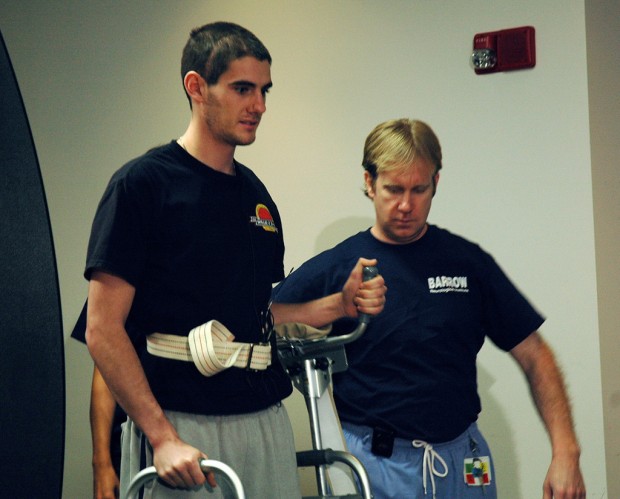
He called the ability of Schmid to walk into Friday's news conference, just two months after the crash, "a great Christmas story."
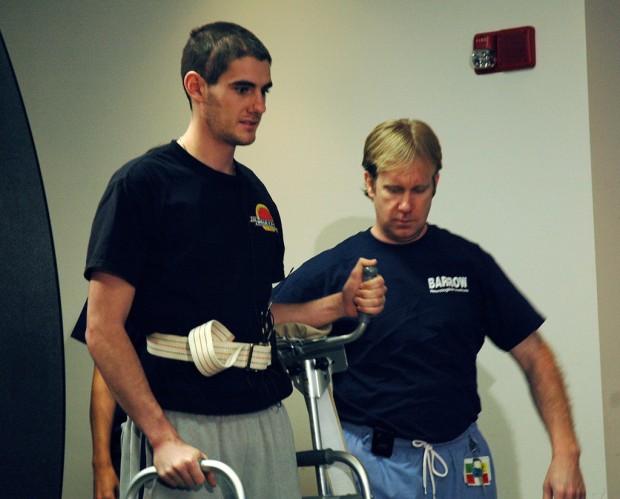
Since his first day out of bed, Schmid has been in intensive therapy. And Christina Kwasnica, Barrow's director of neurorehabilitation, said he is well enough to get a pass to go home for Christmas, though she said it will be a week until he actually is discharged.
But home won't be Tucson, at least not for awhile. Kwasnica said the family has moved to Phoenix and is staying with relatives because of all the rehabilitation Schmid still has to do.
Kwasnica said she cannot say how much her patient will be able to get back to where he was before the crash or whether there will be a "new normal" for him.
"It's so early in Sam's injury that we have no idea what that is and where the ceiling is," she said. "As long as we're continuing to improve, I anticipate improvement will continue."
Schmid does have some goals.
"I just want to be able to get back to Tucson, just what my life used to be," he said. Schmid said he wants to sleep in his own bed.
He also envisions going back to the UA where he was majoring in business.
But Kwasnica said things will be different.
"If you have a life-changing event, it's going to change his perspective on life and his family's, no matter what amount of neurologic injury there is afterwards," she said.
Kwasnica said it usually takes a year in therapy before figuring out how far someone can progress.
One thing Regan said she believes is helping her son's recovery is that his older brother, John, will be staying with them for the foreseeable future.
"I think it's real important that he be with somebody his age, with somebody who can relate to him at that level," she said. Having John around, Regan said, also restrains what might be an over-protective reaction to avoid the possibility of losing Sam again. "I probably would put him in a car seat to take him home," she said.
One thing Schmid does not yet know is the crash killed his 21-year-old roommate, Anthony Andrighetto. Hospital officials told reporters not to ask any questions that would give Schmid information about the fate of Andrighetto, who was driving the Jeep Wrangler when it collided with a minivan at East Golf Links and South Wilmot roads shortly before 5 p.m.
Spetzler took pains to say that just because someone with severe injuries like Schmid had might be thought of as an organ donor does not mean the hospital staff puts that person into that category.
"They have to meet all sorts of criteria," he said.
"One of those criteria for us is whether there is irreversible change on the magnetic resonance imaging setting," Spetzler said, which is why he sought "one more MRI and see whether in fact there is such damage to the brain that we do not think there is any hope for recovery."
What that MRI of Schmid's brain showed, the doctor said, was that the entire brain stem was not damaged, and that there were no other indicators of permanent and irreversible injury.
It was that scan, he said, that resulted in counseling the family to "hold off for the time being to see if there's any chance for recovery."

 Second wall planned across Arizona as Trump administration doubles down on border