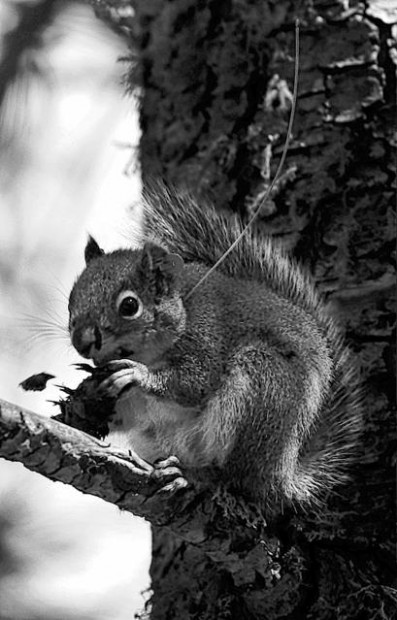
The little furball known as the Mount Graham red squirrel is holding its own.
The diminutive rodent — officially Tamiasciurus hudsonicus grahamensis — is found only atop Mount Graham south of Safford in southeastern Arizona, where its ancestors have lived since the last ice age ended 11,000 years ago.
Since 1987, it has been on the endangered species list, and for more than 20 years the squirrel and its habitat were mired in a now-subsided controversy over construction of the world's most powerful optical telescope — the $120 million Large Binocular Telescope.
The 8-ounce mammal has withstood threats to its limited habitat from major forest fires and ongoing drought that has resulted in poor cone crops and weakened trees susceptible to insect infestations. Spruce aphids and pine bark beetles have decimated stands of the spruce and fir trees that the 8-inch-long, bushy-tailed squirrel depends on for much of its food supply and cool covering.
People are also reading…
Even so, the most recent semiannual fall survey showed that the squirrel population has edged back up to an estimated 300 from 276 in fall 2006. The latest figure reflected a sizable gain over the spring 2007 survey total of 216 and the spring 2006 figure of 199.
In 2000, its numbers peaked above 550.
"From 1991 through 2007, none of our surveys statistically show a trend," said Tim Snow, a biologist with the Arizona Department of Game and Fish who coordinates the semiannual surveys.
"Our numbers are too close together to show either a trend of either a decrease or increase in population."
Surveyors base their population estimates on fresh use of middens — piles of pine cones that the secretive squirrels store for food.
It's easier to detect squirrels in the fall because "the cache cones are green, they stand out in the midden," Snow said, while wintry weather discolors some cone scale and makes recent use harder to distinguish.
Fall counts tend to be higher because of young squirrels' activity, while there may be more die-off, including some young, by the spring count, he added.
The squirrels are found primarily in the mountain's mixed conifer forests starting at about 7,750 feet in elevation, but the prime habitat is the spruce-fir forest higher still, up to its 10,720-foot peak.
The squirrel habitat totals less than 30,000 acres, but, "Given recent fires and insect outbreaks may well be half that," said John Koprowski, a professor in the University of Arizona's School of Natural Resources.
The major concern over the squirrel's future is habitat loss.
"Isolation on a single mountain in the desert means that habitat availability is not going to increase markedly in the future, although the quality of the habitat might be enhanced with forest management," Koprowski said.
"This is one of the major challenges that the squirrel faces, a simple lack of habitat."
But he said it's unlikely that the squirrels would move to lower, less desirable elevations.
"Fire and insects, drought which allows spruce aphids and pine beetles to come in, that shrinks habitat," Snow said. "That can result in the loss of squirrels. Those are certainly threats to the squirrel population."
Currently, though, there is snow on the mountain, he said. "The creeks were running, so that's always a good sign."
Ample fall and winter precipitation would increase the likelihood of a good pine cone crop in the coming year or two.
Snow said the long-term impact of climate change in the Southwest paints "a pretty grim picture."
But a Forest Service ecosystem management and restoration plan including removing dead and diseased trees to reduce the likelihood of catastrophic crown fires and to use pheromone treatments to try to prevent insect infestations close to middens could help, he said.
"We're doing things that we think . . . will keep squirrels there. So yes, I guess I am optimistic we can maintain the population there. If we can improve and increase habitat, then I think we can increase squirrels as well."


 Second wall planned across Arizona as Trump administration doubles down on border