The Seneca Nation of Indians has agreed to stop fighting the state over casino revenue payments, which is good news for the three communities that host their facilities.
But in Niagara Falls, home to the first Seneca casino in New York, the decisions will not mean a huge windfall of cash.

“Rather than pursue continued legal action,” Seneca Nation President Matthew Pagels said, “we believe we can now best address our concerns in a compact with greater clarity on our obligations and ... the obligations New York State has to the Nation in return.”
However, the Cataract City and the Senecas are working on a plan that would locate a new downtown sports arena and family entertainment center a block east of the casino, Niagara Falls Mayor Robert M. Restaino said Thursday.
In terms of immediate cash, Buffalo, which expects about $40 million, will do better than Niagara Falls as a result of the casino agreement.
Unlike Buffalo, much of Niagara Falls' share of the five years of backlogged payments already has been covered by the state in the form of annual "advances" to the cash-poor city, and those advances must be repaid, Restaino said.
People are also reading…

The latest ruling issued earlier this month by U.S. District Judge William M. Skretny said the Senecas must abide by an arbitration panel’s 2019 decision awarding the state a quarter of their slot-machine revenues from three Western New York casinos.
"The big lump of money already has been dribbled out to the city through those advances," he said.
The Falls used to count on $12.3 million a year from the Senecas. That would be $61.5 million over five years.
According to city budgets for 2018 through the present, Niagara Falls spent or planned to spend more than $48.5 million from its tribal revenue fund from 2018 through this year. The yearly figure has been reduced from $11.4 million in 2018 to $8.7 million in 2021 and 2022.
State advances totaled $28.4 million, Gov. Kathy Hochul's office said Tuesday night.
Also, Niagara Falls owes millions to local entities who, by state law, are guaranteed 26.5% of the city's casino money. They haven't been paid at all since the Senecas turned off the cash spigot in 2017, Restaino said.
Niagara Falls School Superintendent Mark R. Laurrie said Thursday that his district is owed $750,000 a year, or $3.75 million for five years.

When the Seneca Nation last made full payments of slot machine profits in 2016, the money went to Albany and then was passed on to the cities of Niagara Falls, Buffalo and Salamanca. The state kept 75 percent and transferred 25 percent to the cities. Each city received money derived only from the casino in their city. • Buffalo received $7,026,041 in 2016
Niagara Falls Memorial Medical Center is supposed to receive the same as the schools, and Destination Niagara USA, the official tourism promotion agency, is owed even more.
"I just know that in the past we have received anywhere between $1.2 million and $1.8 million per year. And we haven’t received anything from 2017 to now," said John H. Percy Jr., president and CEO of the tourism agency.
Niagara Falls International Airport also is owed money, through its owner, the Niagara Frontier Transportation Authority.
"The NFTA is owed anywhere from $2 million to as much as $4.5 million, depending on the amount of slot proceeds," spokeswoman Helen Tederous said.
The Niagara Falls Underground Railroad Heritage Center was supposed to receive $200,000 a year, while the Niagara Falls Housing Authority, Mount St. Mary's Neighborhood Health Center and the Western New York First Response and Preparedness Center are owed $50,000 a year.

As a stalemate between the Seneca Nation and New York State over slot machine revenue drags on, the three cities that host the Seneca casinos are feeling the effects. And there’s no quick fix in
Restaino said there's also a possibility that the Senecas' payments might be less than expected because the Covid-19 pandemic trimmed casino business.
The Senecas are supposed to pay Albany 25% of their slot machine revenues, with the state shuttling 25% of the amount it receives to Niagara Falls, Buffalo and Salamanca, the host cities for the Senecas' three casinos.
"People who aren't paying attention to the granular stuff are popping champagne corks," Restaino said. "It's great that it's settled, it's great that they're talking about the new compact, but the details of what we get has to be based on the whole equation."
Wednesday night, the Senecas announced that they had agreed to pay what they owe while beginning talks with the state on a new casino compact to replace the one that expires in December 2023.
The Senecas contended that the original 2002 agreement didn't obligate them to pay the state anything after 2016, but a panel of arbitrators – and later, federal judges – said they were wrong.
Meanwhile, Restaino disclosed talks that could lead to an arena seating 6,000 to 7,000 people, with indoor and outdoor year-round public recreational facilities ranging from ice skating to rock-climbing on the wall of the arena's parking garage.
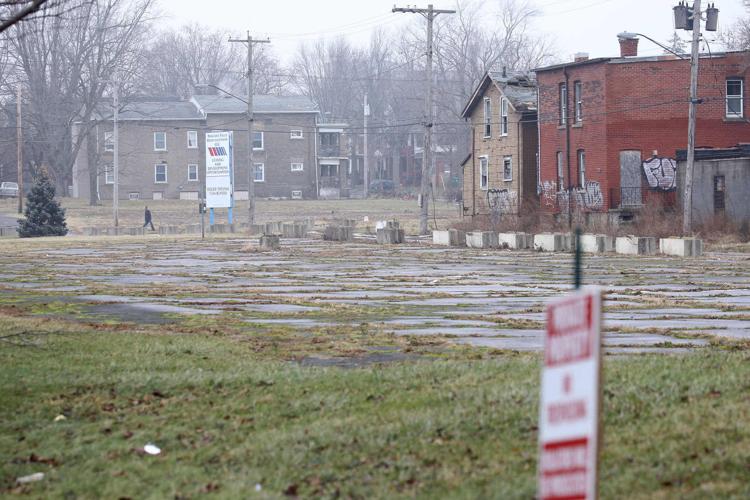
The preferred location for the venue is just east of the casino, at Falls Street and John Daly Boulevard, Restaino said.

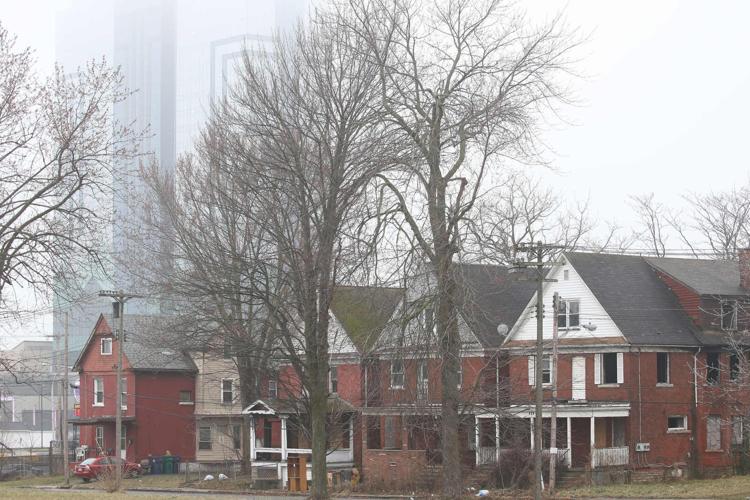
A vacant parcel of land owned by Niagara Falls Redevelopment on Niagara Street and John B. Daly Boulevard, Thursday, Jan. 13, 2022.
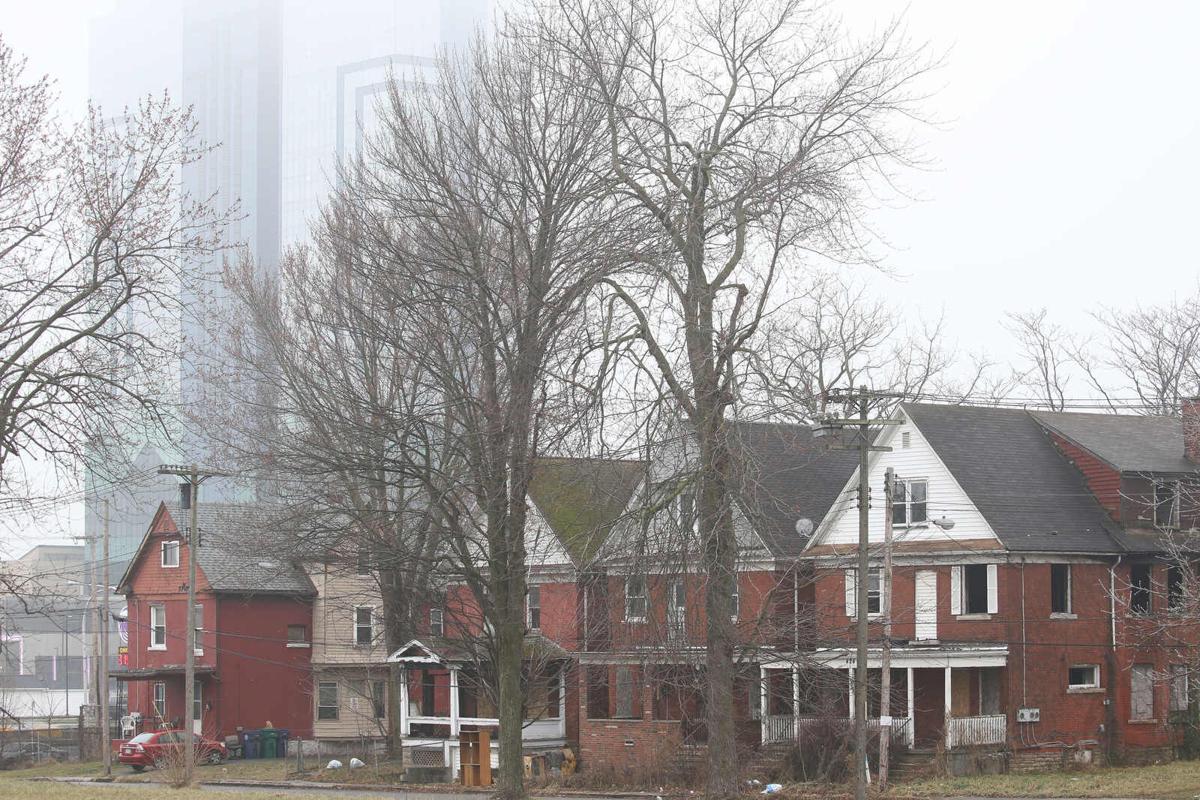
However, the mayor said, that property belongs to New York City developer Howard Milstein's Niagara Falls Redevelopment. NFR owns more than 120 acres surrounding the casino, almost all of it vacant.
Restaino said he and NFR have begun talks about acquiring a parcel. But if that deal is made, there remain many unanswered questions about the arena, including who will own it, who will manage it and what the Senecas' role will be.
"The Nation has expressed its support for the project, and as the project rolls forward, they've expressed their desire to be engaged in whatever they and the city think is most advantageous," Restaino said. "What I'm happy for is the fact that they support it. They see it's a good thing not just for the city, but also for them."

Gov. Andrew M. Cuomo’s announcement that the City of Niagara Falls would receive a $12.3 million advance on unpaid Seneca Niagara Casino revenue was good news for the Falls on Wednesday, but it didn’t do anything for the other former recipients of the casino cash. The City of Buffalo has lost out on an estimated $17 million since the
The other parties in the talks had little to say.
"We are always interested to hear about other potential projects that can potentially build on the positive momentum our operations continue to generate in the region," the Senecas said in a prepared statement.
"We have no comment on any discussions we may be having with the city," NFR spokesman James F. Haggerty said.
Meanwhile, Mayor Byron W. Brown said he expects Buffalo to receive about $40 million, after the deduction of a one-time $7.5 million advance from the state in the 2018-19 budget year. Unlike Niagara Falls, Buffalo is not required to fund any other agencies with casino cash.
The casino payments are “critically important” to Buffalo, he said.
“I don’t know what the pressure points were in those negotiations,” he said. “But, obviously, they came to an agreement, and the governor was able to successfully end the stalemate between the state and the Seneca Nation, and certainly as mayor of Buffalo I am very happy about that.”
Brown also pointed out the announcement comes at a time when the city is working on its 2022-23 fiscal budget recommendations, which the mayor will present to the Common Council by May 1.
“We will use it to invest in quality-of-life improvements for residents of our city, city-wide, and we will allocate some of the money to go into the city’s fund balance to further strengthen the financial security of the city,” Brown said.
Brown did not specify any projects or programs that were held in abeyance because of the lack of Seneca payments.
Brown had remained optimistic that the state-Seneca impasse would be settled, despite criticism from Council members and warnings from public finance experts against including the payments as revenue in city budgets every year, even though there was no telling when the money would arrive.
“I was confident that this money was going to come to the city all along. I said that from the very beginning,” he said. “I want to say a special thank you to Gov. Kathy Hochul and her staff that effectively negotiated with the Seneca nation to bring this issue to a close.”
The City of Salamanca, which lies primarily on Seneca land, also received advances from Albany – about $15.5 million, which will have to be repaid, Mayor Sandra Magiera said.
"We have just had money enough to cover our budget with nothing extra for vehicles, other needed equipment and staffing," Magiera said in an email. Her city used to receive about $6 million a year from the casino.
"It has been a rough few years, but we have handled it well, and we are just glad that it is behind us and our community as a whole can move forward," Magiera wrote.
It's still far too early to say what the terms of the new compact will look like in terms of local shares or whether receipts from games other than slot machines, such as table games or sports betting, will be included in the Senecas' payments.
“I hope the local revenue sharing goes up. We’ll see," Brown said. "Certainly don’t want to see any reduction in the local share that will come to Buffalo and the other host municipalities, and I would say with gambling being expanded in New York State, it is only right that more money come to local governments to be able to reinvest in communities."