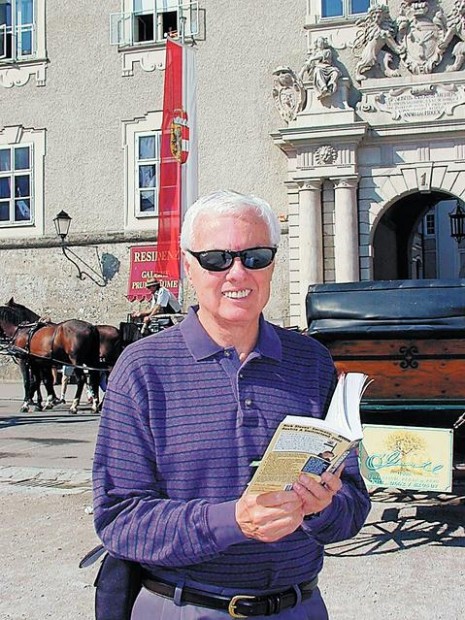
Eugene Morkin was 12 when his father died of congestive heart failure.
For years he'd watched as his father's condition became more and more debilitating.
It was this tragedy early in his life that prompted Morkin to become a cardiologist, put through medical school by his mother, an English teacher.
Dr. Morkin's combination of life experience and education manifested as several scientific breakthroughs in his role as an academic physician. In the mid-1980s, he co-founded what is now called the the University of Arizona Sarver Heart Center, to promote cardiovascular research and clinical care. He served as founding director until 1992.
Morkin, a pioneer in his field, spent his professional career trying to understand heart function as a way of furthering research into the prevention of heart disease and repairing a diseased heart genetically, precluding the need for transplants.
People are also reading…
Yet it was another disease — Alzheimer's — that claimed Morkin's life. After his diagnosis, the doctor and his wife, researcher Cynthia Adamson, a Ph.D. who worked with her husband, retired two years ago to Uruguay, where Morkin enjoyed the stunning beaches of Punta del Este until his death on July 19. He was 75.
Morkin, the son of a stone mason, graduated magna cum laude from Oklahoma City University with a bachelor's degree in chemistry. He received his medical degree from the University of Oklahoma in 1959 and served his residency at New York's Bellevue Hospital Cornell Division and Presbyterian Hospital. He was awarded a research fellowship to the New York Heart Association at Columbia University.
Morkin was chief of cardiology at Beth Israel Medical Center and a faculty member of Harvard University when he was recruited by the University of Arizona in 1974, with the promise of an endowed chair that would allow him to focus on his research. He also was a professor in the UA departments of pharmacology and physiology.
Some of his early research proved to be controversial, said colleague Joseph Bahl, a Ph.D. and research scientist at the Sarver Heart Center. His breakthrough discovery of an intracellular protein that regulated calcium levels in the heart led to an understanding of how calcium works in the organ to control the strength and rapidity of beats.
"Once you start to understand all the gears and levers and how they connect, then you can rationally start thinking about, 'OK, we need a drug that will do this,' " Bahl said. "Today there are many drugs that are used relating to the heart and calcium that have come along as our understanding of how things work has improved, and what Dr. Morkin did was an early step that opened doors.
"Back in the day, when Dr. Morkin discovered this, it was more than controversial. People stood up at meetings and said: 'No, this is just not true. It doesn't work this way.' He came under a lot of attack for presenting his results, and this happened at more than one meeting until people were able to go back to their own lab and try the same experiment and found he was right," Bahl said.
Dr. Steven Goldman, a longtime colleague of Morkin's, works at the local Veterans Affairs hospital and is a member of the Sarver Heart Center. He arrived in Tucson a year after Morkin.
"He was interested in the major control of the heart muscle, the mechanisms that control heart muscle function," Goldman said. "His work was basically a setup for what we would do in the future to create drugs that would control heart failure."
In a 1986 Arizona Daily Star article, Morkin, who had two daughters and two stepchildren, said he looked forward to the time when "we are able to restructure the heart genetically, so there is no need to do complicated surgery — perhaps no need to even put the person in the hospital."
Said his wife: "The impact of his scientific discoveries cannot be overstated. He was esteemed in science. He was very quietly determined about what he knew was the truth. He always said the data doesn't lie."
the series
This feature chronicles the lives of recently deceased Tucsonans. Some were well-known across the community. Others had an impact on a smaller sphere of friends, family members and acquaintances. Many of these people led interesting — and sometimes extraordinary — lives with little or no fanfare. Now you'll hear their stories.
On StarNet
Did you know Eugene Morkin? Add your remembrance to this article online at azstarnet.com/lifestories

 Second wall planned across Arizona as Trump administration doubles down on border