

He's a dark horse candidate who rises out of nowhere to win his party's nomination.
With almost no previous political experience, he riles the establishment and outpaces their anointed candidates.
A 45-year-old, handsome, driven rising star whose energy and enthusiasm excite his party and propel him to beat the odds.
A celebrity candidate, if you will.
Barack Obama? It could be.
But it's also the story of John McCain, the former naval officer who arrived in Arizona with few friends and even fewer connections 27 years ago.
In the course of just one year, the political newbie, dogged by accusations of carpetbagging, won a pivotal race, setting him on a path to where he is today — one step away from the White House, or one misstep away from being a footnote to history.
People are also reading…
"What he accomplished has no sequel in modern American political history," said Jay Smith, McCain's consultant in his first campaign, in a recent interview. "Here's a guy who moved to Arizona and 12 months after setting foot in the state for the first time, he's elected to the United States Congress. I've spent the last 30 years asking if anyone else has ever done that, and nobody's ever given me an example."
Since then, John McCain — whose life story and maverick reputation once made him a darling of the national media — has become one of the most powerful members of Congress, providing the foundation for his roller-coaster quest for the White House.
But his storied political career is one many voters in this fast-growing state do not recall.
The carpetbagger
McCain's bid for an Arizona congressional seat started 2,000 miles from here.
The Navy's liaison to the Senate in the late '70s and early '80s, McCain persuaded Smith though a mutual friend in the Senate to sit down for lunch in Washington to talk politics.
McCain unleashed his plans to run for Congress and asked Smith for help. Smith says he was taken aback when McCain said he planned to run in 1982 — just the next year — and had no idea even what district he would run in, other than somewhere in his new wife Cindy's home state of Arizona.
"I was very impressed with the person. We obviously hit it off," says Smith, still working in Washington. "But I was skeptical as anyone about the ambitious scenario that he laid out for me."
In his 2002 memoir "Worth the Fighting For," McCain wrote that, to his Washington mentors, his political ambitions "must have seemed to them a whimsical choice in second careers for someone who had no experience in running for office or, for that matter, any experience living in the state I had decided I was suited to represent in Congress."
"I had neither the time nor the patience to follow a 10-year plan for election to Congress," McCain wrote. "I was in my forties and in a hurry, ambitious for the kind of influence I had seen wielded by the country's most accomplished politicians and worried that my chances were diminishing by the day."
Adding to the anxiety, the Arizona Legislature created the state's new congressional district in Tucson (one that would be held by Republican Jim Kolbe for 22 years). McCain says he worried that if he ran there —100 miles from Cindy's childhood hometown of Phoenix — it would only further justify the carpetbagger charge.
But in December of 1981, it leaked that John Rhodes, the GOP leader of the U.S. House of Representatives, would soon announce plans to retire. Before the official announcement, the McCains made sure to buy a Tempe house in Rhodes' district.
Then, lacking any Arizona base and taking a public-relations job at his father-in-law's beer distributorship, McCain began collecting mostly out-of-state money. His connections included the Reagans, and Cindy's deep pockets would also come in handy.
The newcomer quickly impressed Democrats and Republicans alike. One of McCain's first calls was to a Phoenix political activist and attorney Jon Kyl. The two met for breakfast in north Phoenix, recalls Kyl, now Arizona's junior senator and McCain's seatmate.
"He was very serious about his plans," Kyl says. "He took everything in stride and made it pretty clear in thinking about political office that he was more interested in national office than, say, state office."
But many were resistant to jump on the McCain bandwagon, including a young lobbyist named Mike Hellon.
"My impression was, here's a guy just moving to Arizona, basically carpetbagging a seat," recalls Hellon, who attended an introduction of McCain hosted by state House Majority Leader Burton Barr around the same time. "I thought, frankly, John McCain would not win."
Today, Hellon is co-chair of McCain's presidential campaign in Arizona.
Debbie McCune Davis, a long-time Democratic state legislator from Phoenix, remembers Barr bringing McCain around the Legislature.
"I think it was pretty transparent that John McCain wasn't coming out here to find a job or join the Phoenix 40," McCune Davis says, referring to an influential group of business leaders. "He was looking to position himself politically."
The hero
McCain displayed an energy that shocked his rivals — many longtime established politicians — and even his supporters.
He could draw a crowd. He was new to the state, yes — but so were his potential constituents.
"Arizona was, and is, the second-fastest growing state in the country, and every other person has either just arrived or been there for less than five years, so the charge that someone is a carpetbagger doesn't have the resonance that it would in many other places," said Smith.
It's those fellow new arrivals the campaign targeted directly. Soon, McCain went from the bottom of the polls to the top.
"He was indefatigable," Hellon says.
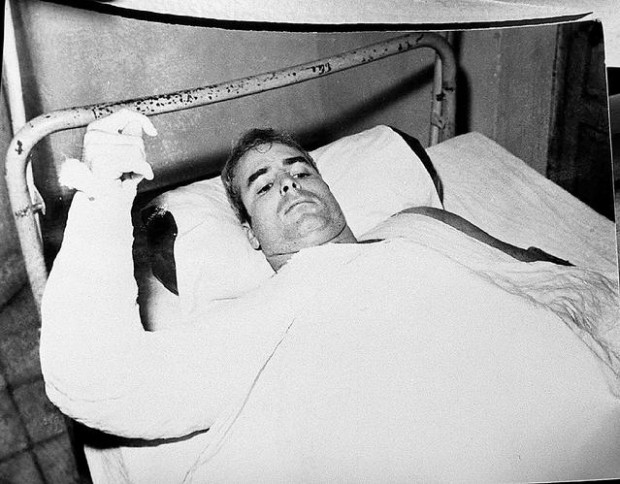
Then, as now, McCain used his prisoner-of-war experience to his advantage.
"I had, as they say in politics, a good first story to sell," he wrote in 2002.
And it worked. A review of newspaper stories from the time shows coverage of the campaign in the Phoenix Gazette and Arizona Republic focused heavily on McCain's experience in Vietnam.
When opponents harped on his lack of roots in the Grand Canyon State, McCain shot back. "Listen, pal. I spent 22 years in the Navy. My father was in the Navy. My grandfather was in the Navy," according to an account in Robert Timberg's 1999 book "John McCain: An American Odyssey."
"I wish I could have had the luxury, like you, of growing up and living and spending my entire life in a nice place like the 1st District of Arizona, but I was doing other things," Timberg reported.
"As a matter of fact, when I think about it now, the place I lived the longest in my life was Hanoi."
The guy no one gave a thought to a just few months earlier claimed more than 30 percent of the vote to win his crowded primary, and in a heavily Republican district, sailed through the general election.
The friend
From the very beginning, McCain became what his critics had predicted: A representative more interested in national politics than "chicken pot" issues back "home" in Arizona.
In a revealing speech last April in Prescott, McCain recalled "being viewed with resentment by some for my lack of an Arizona pedigree."
"And in truth, although I worked hard, I did not know as much about the state as one of its representatives to Congress should know," McCain said. "Moreover, in my two terms in the House, I had the reputation of an often confrontational partisan."
Before his race with Obama became so heated since then, McCain suggested the contest should be more an "argument among friends," an approach he took from the relationship he formed with two political mentors — Republican Sen. Barry Goldwater, whom he replaced, and Democratic Rep. Morris K. Udall of Tucson.
"Mo never saw me as a threat or even as an uninformed, inexperienced and somewhat presumptuous politician," McCain said. "To him, I was a well-intentioned servant of my country, and a fellow Arizonan, who might someday be able to help him accomplish important things for our state."
McCain also reached out to then-Republican congressional hopeful Jim Kolbe, who had narrowly lost a bid for a seat in 1982 and was again challenging one-term Democrat Jim McNulty.
McCain — unknown south of the Gila River at the time — made the trek to Tucson every weekend in September and October of '84 to work the streets for Kolbe.
"We'd go door to door. He'd work one side of the street, I'd work the other side of the street," Kolbe said. "One could say in retrospect that he was already looking ahead at a statewide race, but he did far more than he needed to do to accomplish that."
After Kolbe knocked McNulty out of office that November, McCain helped the freshman get settled on Capitol Hill. "His office was my office," Kolbe said. "He just said, 'Come in and take whatever you need.' "
A decade later, when news was about to break that Kolbe was gay, he pulled McCain aside after an Arizona delegation breakfast on Capitol Hill to tell him the news himself.
"He was very supportive," Kolbe recalls, "and he basically said 'It doesn't make any difference in terms of our relationship or how I think of you as a legislator or as a friend.'"
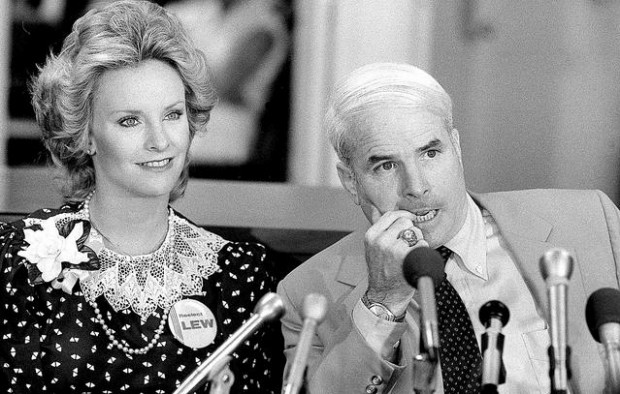
Paul VanDevelder / Arizona Daily Star 1983 Rep. John McCain fields press questions while Cindy, wearing button for Tucson Mayor Lew Murphy, looks on, on July 8, 1983.
two-part series
• Today: How John McCain won a seat in Congress just one year after moving to Arizona.


