
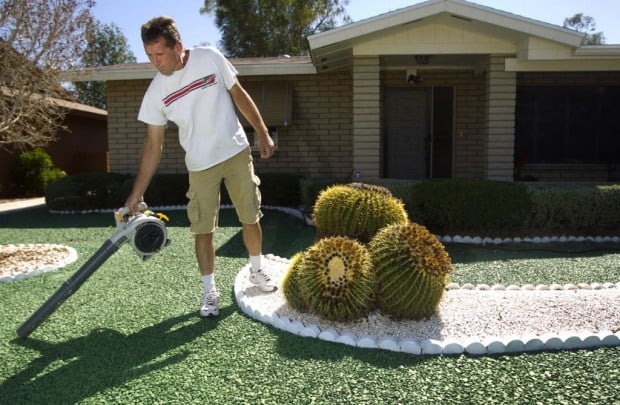
PHOENIX — Long before xeriscaping, the low-maintenance landscaping of choice for many Arizonans involved a different kind of green movement.
Thousands of homeowners from Sun City to Mesa spread generous blankets of pea gravel on their yards, glued it down and painted it green to look like a lawn — at least from an airplane.
But green-rock landscaping is going the way of disco, polyester and avocado-green kitchen appliances.
“It’s becoming a lost art,” Phoenix-area landscaper Kevin Parker told The Arizona Republic. “I’m kind of unique. Now, nobody can find anybody who does this anymore. That’s kind of good for me.”
Even so, Parker said he receives only a few calls a year.
While xeriscaping — which emphasizes low water-use native plants and shade — can actually cool the landscape down, green gravel yards tend to soak in the heat and can contribute to the so-called “urban heat-island effect.” That could explain some of the decline in popularity.
People are also reading…
But there are still those who prefer the no-muss, no-fuss of glued-down gravel.
That’s not surprising to Terry Mikel, a retired University of Arizona horticulturist, who remembers well his first encounter with painting a rock yard.
“I was 5 or 6 years old and was with my dad at a hardware store,” he said. “The salesman said that if he used this gravel and painted it green it would look just like grass from an airplane. As a kid, it made a lot of sense, but later I wondered why anyone would want their yard to impress somebody in an airplane.
“In Sun City, it was kind of an art form,” Mikel added. “They used painted rocks with different colors. There was room for creativity.”
Sun City was one of the first communities in the Phoenix metropolitan area to have painted yards. But the trend is vanishing there, too.
“We’re seeing less and less of it,” said Paul Herrmann, executive director of the Sun City Visitors Center. “It was one of those goofy things that was fashionable back then. ... Most people coming in are doing remodeling and going in with natural landscaping. The green, glued-down, painted rock doesn’t fit.”
Although gravel lawns are commonly associated with homes in the desert, Purdue University professor emeritus and landscape architect Greg Pierceall believes the trend started in the Midwest, where residents have been known to paint their dormant grass green in winter.
As early as the late 1960s, Pierceall said common washed river gravel could be coated with a pigment and sold in a rainbow of colors as garden accents and surfaces. He said the green-gravel trend took on new shapes and colors as Americans sought visual impact and contrast in their yards and gardens, but in retrospect it had all the sensibilities of the “aluminum Christmas tree.”
He recalled a client at the time who wanted him to design a gravel landscape with a berm that resembled a big Rice Krispie bar — all of it held together with an epoxy material.
There are still those who like to look out the window of their home to a yard with curb appeal and little demand for maintenance.
“You can sweep the dirt off of it,” said Charlotte Rosenberry, who has lived in a Phoenix-area retirement community for about 19 years. “The yard was already done like this before I moved in. I had it repainted one time.”

 Tucson official: Air Force won't pay for D-M groundwater cleanup now