

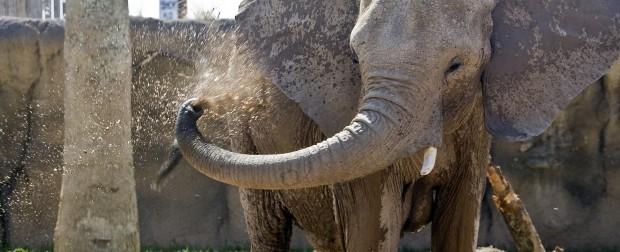
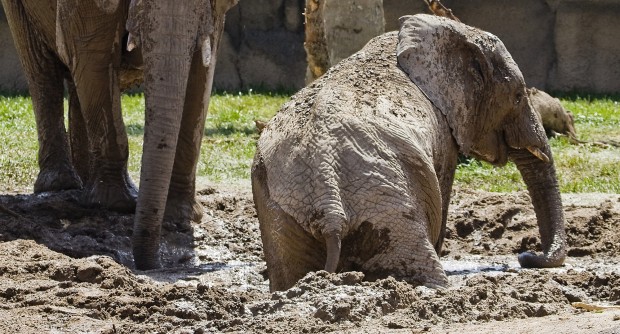
For elephant enthusiasts who can't get enough of the five African elephants, the latest additions to the Reid Park Zoo, live cameras streaming video to the zoo's website are in the works.
The live webcams will capture the pack of pachyderms noshing on grass and bark, splashing around in their mud wallow and roaming around the 3 acres of open space in the zoo's new Expedition Tanzania exhibit, which opens to the public Wednesday.
The zoo has secured a grant to install six high-definition cameras that can zoom, pan and tilt in the elephant exhibit, but is waiting to find additional funding before moving forward with the project, said Vivian VanPeenen, a spokeswoman for the zoo.
She declined to comment on how much the project will cost but hopes the cameras will be up and running by the start of the next school year.
People are also reading…
Video won't be streaming 24 hours a day and will be up only during times when the elephants are most active, she said. But zookeepers would be able to use the cameras to check in on elephants from home at any time if they need to.
In the meantime, elephant watching will have to be done in person at the new exhibit opening to the public this week after a decade of preparation.
The lone bull, Mabu, and adult female Lungile were the first to arrive at the Reid Park Zoo in early February. Samba and her two calves, 1-year-old Sundzu and 5-year-old Punga, followed in early March.
"Pretty much within a couple of days within their arrival they settled in like they own the place," VanPeenen said. "The group itself is just extremely calm and relaxed and still completely interested in the space."
During his first week exploring the exhibit, Mabu knocked down a tree with his head and gobbled up most of it in one day, leaving only the stump behind, VanPeenen said.
Throughout the 7-acre exhibit visitors will learn about the Tarangire Elephant Research Project the zoo helps support in Tanzania. Kids and adults can hop on a scale and compare their weight to an elephant's weight. They can even listen to what an elephant fart sounds like through an interactive display of an elephant's rear and get the scoop on elephant poop, which researchers study for information about elephants including age and fertility, but is also used by other creatures for habitats and food, and helps disperse seeds throughout Africa.
Zoo patrons got a sneak peek of the elephants starting Sunday, when about 4,500 people visited the exhibit.
"They're amazed at being able to see young elephants and watching the youngsters," VanPeenen said.
The zoo could see its own elephant birth sometime in the next couple of years, she said.
Keepers are hoping that Mabu will mate again with Samba, but they're leaving that up to Mother Nature.
"Our goal is to provide them with space and good food and the optimal surrounding to let them do their thing," VanPeenen said.
On StarNet: See more photos of the elephants at azstarnet.com/photo
DID YOU KNOW?
Who's who in the Expedition Tanzania exhibit:
• Mabu - Father of Punga and Sundzu Name meaning: Full name Mabhulane means "he who walks in hostile places." How to identify him: The biggest of the bunch at 10,500 pounds, he also has a stainless cap on his left tusk.
• Samba - Mother of Punga and Sundzu Name meaning: Full name Litsemba means "hope" in Siswati. How to identify her: Has a small hole on lower right ear and a saggy belly.
• Punga - 5-year-old male Name meaning: Full name Impunga means "experienced adviser." How to identify him: The second-smallest in the herd, Punga has short, small tusks.
• Sundzu - 1-year-old male Name meaning: Full name Tsandzikle means "beloved." How to identify him: The pint-sized pachyderm doesn't have visible tusks.
• Lungile - Adult female Name meaning: "Good natured one." How to recognize her: The smallest female has a rounded backbone and several notches in her right ear.
Source: Reid Park Zoo and San Diego Zoo Safari Park
Contact reporter Veronica Cruz at vcruz@azstarnet.com or 573-4224.


